
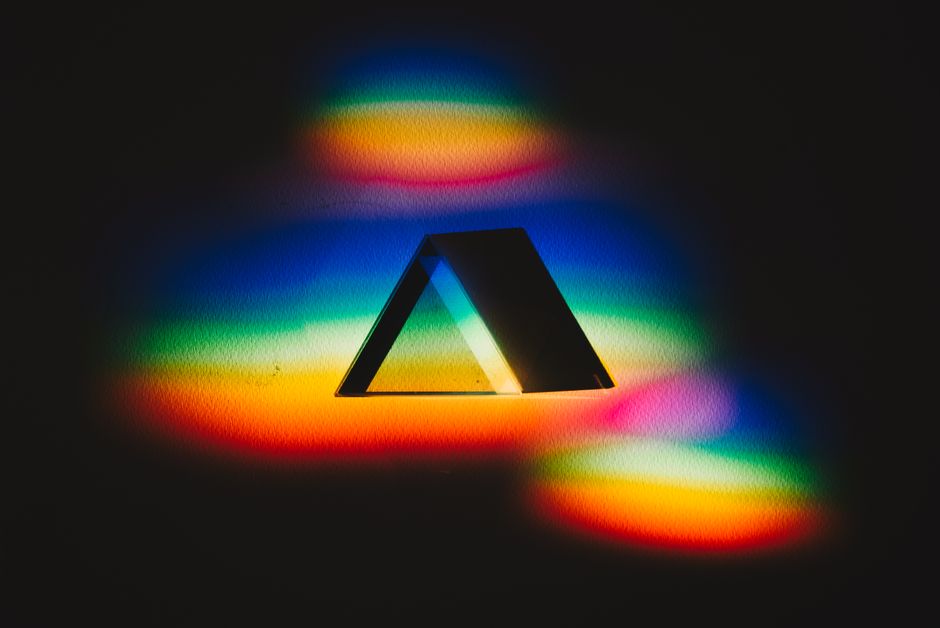
A prism splits white light into a rainbow, and your eyes depend on that same basic physics to see color. Light enters the eye, gets focused onto the retina, and the retina’s cone cells respond differently to short, medium, and long wavelengths. That wavelength separation is what lets you tell red from blue. Prism “light therapy” products sold online borrow this language, but the way a glass prism actually separates light is not the same as how a therapeutic lamp delivers it. Understanding both helps you separate real vision science from marketing.
What Does a Prism Actually Do to Light?
A prism is a shaped piece of transparent material, usually glass or plastic, that bends light as it passes through. The amount of bending depends on wavelength. Shorter wavelengths, like blue and violet, bend more than longer wavelengths, like red. This is called dispersion.
When white light enters one side of a triangular prism and exits the other, the colors spread apart into a band. Isaac Newton demonstrated this in the 1660s, showing that the colors were already present in white light rather than created by the glass itself. A second prism could recombine them back into white light.
That is the entire optical story. A prism does not add energy, create new wavelengths, or produce any special healing property. It sorts light that is already there. The rainbow you see is a separation effect, nothing more.
How Do Prisms Get Used in Eye Care?
Prisms have a legitimate and long-standing role in vision correction, but it has nothing to do with rainbows. In eyeglasses and vision testing, a prism shifts the apparent position of what you see.
When the two eyes do not point at the same target, the brain receives two mismatched images. This is called strabismus when the misalignment is visible, and it can cause double vision, eye strain, or headaches. A prism in a lens bends light so the image lands on the correct part of each retina, allowing the brain to fuse the two pictures into one.
Eye doctors also use prisms during exams to measure how well the eyes align and to test the range of binocular vision. Prism lenses are sometimes prescribed for conditions involving double vision or convergence problems. The strength is measured in units called prism diopters, and the prescription is specific to the individual.
This is established clinical practice. It is also entirely separate from any “prism light” device sold for general wellness.
How To Use A Prism Light Photos And Vision: What the Products Claim
Search for “prism light” and you will find lamps, panels, and glasses marketed for eye health, mood, focus, and more. Most of these devices do not contain a prism in the optical sense. They typically emit colored light, sometimes in patterns or pulses, from LEDs.
The claims usually fall into a few categories:
- That specific colors support specific eye functions
- That pulsing or flickering light “trains” the visual system
- That the devices improve focus, sleep, or mood
- That they mimic benefits of natural sunlight
Some of these ideas connect loosely to real research. Others do not. The problem is that the marketing rarely distinguishes between them, and the devices are often sold without regulatory review as medical treatments.



Is There Evidence That Colored Light Helps Vision?
For the eye itself, the evidence is weak. There is no established mechanism by which staring at colored light improves the optical or retinal function of a healthy eye. The retina does not need to be “balanced” or “recalibrated” by color exposure.
There is one area where light exposure genuinely matters for vision: protecting the retina from damage. High-energy visible light, particularly blue light, has been studied for its potential role in retinal stress. But the concern is about limiting excessive exposure, not adding colored light. No clinical evidence confirms that colored light therapy strengthens or repairs the retina.
Some research has looked at specific wavelengths for specific conditions. Certain forms of light exposure are used in clinical settings for newborn jaundice, for example, but that is a treatment for a blood condition, not a vision treatment, and it is delivered under medical supervision.
Where light therapy does have solid support is in circadian rhythm and mood, not eyesight. Bright light exposure, particularly in the morning, is an established approach for seasonal affective disorder and some sleep timing problems. That research involves broad-spectrum bright light, not prisms or color-specific devices.
Can Light Exposure Affect Sleep and Eye Comfort?
Yes, and this is where the real science sits. Light is the main signal your body uses to set its internal clock. Bright light in the morning helps align that clock. Bright light late at night, especially blue-rich light from screens, can delay sleep timing for some people.
Eye comfort is a related but separate issue. Prolonged screen use is linked to digital eye strain, which causes tired, dry, or irritated eyes. The usual contributors are reduced blinking, poor posture, and glare, not the color of the light itself. Taking breaks and adjusting screen position tend to help more than switching light colors.
If a device helps you keep a consistent bright-light routine in the morning, that routine may support sleep and mood. That is a circadian effect, not a vision improvement, and the same benefit is available from a walk outside on a bright day.
What Are the Risks of Prism Light Devices?
The main risk is not physical harm. Most consumer light devices operate at intensities unlikely to damage the eye in normal use. The bigger risk is indirect.
First, relying on a device for a real eye problem can delay proper care. Blurry vision, sudden floaters, flashes of light, eye pain, or a sudden change in vision all warrant prompt evaluation by an eye doctor. These can signal conditions that need treatment, and no light device substitutes for that.
Second, some devices use flickering or pulsing light. Flicker at certain frequencies can trigger discomfort or seizures in people with photosensitive epilepsy. Anyone with a seizure disorder should be cautious with flashing light of any kind.
Third, cost. These products can be expensive, and the money may be better spent on an eye exam or proven treatments.
How Should You Think About Light and Eye Health?
The well-established steps for eye health do not involve prisms or colored lamps. They involve protecting the eyes and getting regular care.
- Wear sunglasses that block UV light when outdoors in bright sun
- Get regular dilated eye exams, especially after age 40 or with a family history of eye disease
- Manage conditions like diabetes and high blood pressure, which affect the retina
- Take screen breaks to reduce eye strain
- Avoid smoking, which is linked to cataract and macular degeneration
If you are curious about a light device for sleep or mood, the evidence is stronger there than for vision. If you are considering one for an eye condition, talk to an eye doctor first. No clinical evidence currently confirms that prism light devices improve vision.
Why the Confusion Between Prisms and Light Therapy?
The word “prism” carries scientific weight. It sounds precise and technical. Marketing leans on that association even when the product contains no prism at all.
Real prism use in eye care is about aligning images for the brain. Real light therapy research is about circadian timing and mood. These are two different fields that got blended into a single product category. Keeping them separate is the key to evaluating any claim you read.
Frequently Asked Questions
Does a prism light improve eyesight?
No clinical evidence currently confirms that prism light devices improve eyesight. Prisms in eyeglasses correct eye alignment, but that is a different use than light therapy.
Can colored light therapy fix vision problems?
There is no established mechanism by which colored light repairs or strengthens the eye. Conditions like blurry vision or double vision need evaluation by an eye doctor.
Is light therapy good for anything proven?
Bright light exposure has solid research support for seasonal affective disorder and some sleep timing problems. That research involves broad-spectrum bright light, not prisms or color-specific devices.
Are prism light devices safe?
Most consumer light devices are unlikely to harm the eye at normal intensities, but flickering light can trigger seizures in people with photosensitive epilepsy. The larger risk is delaying proper care for a real eye problem.
