
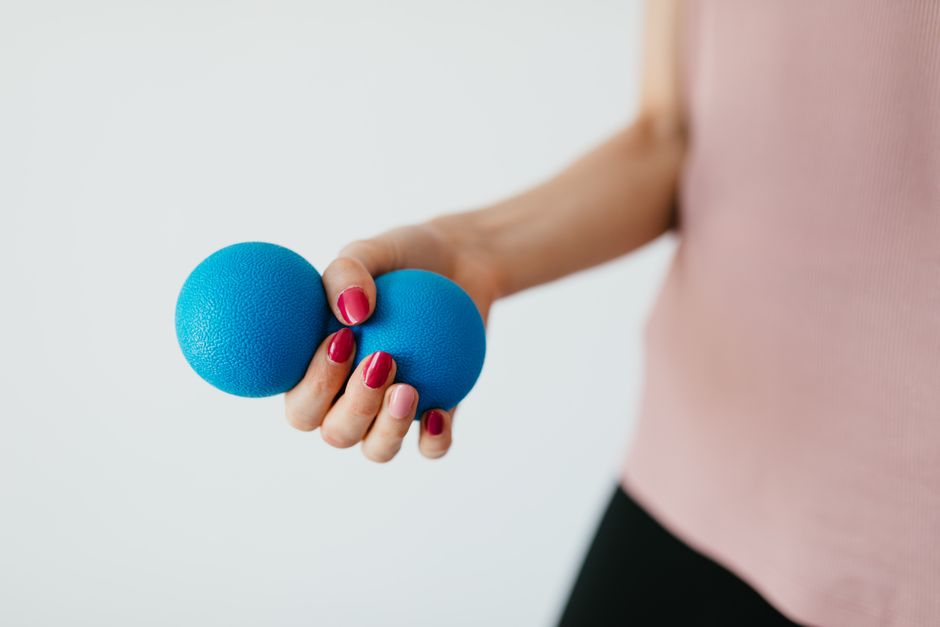
A peanut ball is a firm, peanut-shaped birthing ball used during labor to help open the pelvis and encourage the baby into an optimal position. It is placed between your thighs while you lie on your side, which keeps your hips flexed and widens the pelvic outlet. To use it effectively, you alternate sides every 30 to 60 minutes, ensuring the ball supports your upper leg without putting pressure on your knee or hip joint.
What Is a Peanut Ball and How Does It Work?
A peanut ball looks like two exercise balls connected in the middle, resembling the shape of a peanut. It is typically used in hospitals and birth centers, but some people use one at home during early labor. The ball is firm enough to support weight but has enough give to be comfortable between your legs.
The main benefit comes from hip flexion. When you lie on your side with the ball between your thighs, your top leg is raised and supported. This position opens the front of your pelvis and increases the space at the pelvic outlet. Research suggests that using a peanut ball during labor can shorten the first stage of labor and reduce the need for a cesarean delivery, particularly for people who have an epidural and cannot move freely.
How To Use A Peanut Ball For Labor And Delivery Position by Position
The side-lying position is the most common and most studied way to use a peanut ball. You lie on your side with the ball between your knees and thighs. Your top leg rests over the ball, keeping your hips bent at roughly a 90-degree angle. This position works well whether you have an epidural or not.
To get into this position, start by sitting on the bed or mat. Place the ball between your legs, then lower yourself onto your side. Adjust the ball so it sits between your thighs, not directly on your knees. Your knees should be bent and your top knee should rest comfortably on the upper curve of the ball. A nurse, partner, or support person can help you adjust the ball if you cannot move easily due to an epidural.
Stay on one side for 30 to 60 minutes, then turn to the other side. Switching sides regularly helps the baby rotate and descend. If you feel pressure, numbness, or pain in your hip or leg, change positions or ask for help repositioning the ball.
Some people also use a peanut ball in a semi-sitting or upright position. You sit on the bed with the ball between your knees and lean forward over a table or the back of the bed. This position can help if you are tired of lying down. The evidence for this position is less established than for side-lying, but it is generally considered safe if you feel stable and comfortable.
Who Should Use a Peanut Ball During Labor?
Peanut balls are most helpful for people who have an epidural. An epidural can numb your legs and make it difficult to move, change positions, or squat. When you stay flat on your back for a long time, the baby may have a harder time rotating into the best position for birth. The peanut ball gives your body a way to keep your pelvis open even when you cannot move freely.
They are also useful if your labor has slowed down. Some nurses and midwives suggest a peanut ball when cervical dilation has stalled. The position change can encourage the baby to shift and apply more pressure to the cervix.
Peanut balls are not appropriate for everyone. If you have a condition that limits hip movement, such as severe hip arthritis or a recent hip surgery, talk to your care provider first. If you have high blood pressure or certain pregnancy complications, your provider may have specific position restrictions. Always check with your labor nurse, midwife, or doctor before using one during labor.





What the Research Says About Peanut Ball Benefits
Several studies have looked at peanut ball use during labor, mostly in hospital settings with epidurals. Some research published in obstetrics journals found that using a peanut ball was associated with a shorter first stage of labor compared to standard care without the ball. Other studies found lower rates of cesarean delivery among people who used a peanut ball, though results vary between studies.
The evidence is not unanimous. Some studies found no significant difference in delivery outcomes. This means the peanut ball is a reasonable tool to try, but it is not a guaranteed way to avoid a cesarean or speed up labor.
What the research does support more consistently is the general principle behind it: upright and side-lying positions during labor are associated with better outcomes than lying flat on your back. The peanut ball is one practical way to achieve this, especially when an epidural limits your movement.
No major safety concerns have been reported in studies of peanut ball use during labor. The main risks are discomfort, pressure on nerves, or skin irritation from prolonged pressure. These are managed by repositioning regularly and checking in with your care team.
Tips for Getting the Most Out of a Peanut Ball
Start using the ball early if you want to use it. Once you are in active labor with strong contractions, learning a new position is harder. If your hospital offers peanut balls, ask about using one as soon as you are settled into your labor room.
Keep these practical points in mind:
- Place the ball between your thighs, not directly on your knees, to avoid joint strain.
- Use a pillow behind your back for support if needed.
- Change sides every 30 to 60 minutes.
- Ask for help repositioning if you have an epidural and cannot move your legs easily.
- Tell your nurse immediately if you feel numbness, tingling, or sharp pain.
Your labor nurse is your best resource. Nurses are often the ones who suggest peanut balls and have experience positioning them correctly. Do not hesitate to ask for guidance.
Where To Get a Peanut Ball and What To Look For
Many hospitals and birth centers provide peanut balls as part of their standard equipment. Ask your care provider or hospital ahead of time whether they have them available. If you plan to give birth at home or want to use one during early labor at home, you can purchase a peanut ball from medical supply stores or online retailers.
Look for a ball made of burst-resistant material. Standard peanut balls come in a few sizes, typically small, medium, and large. The right size depends on your height and leg length. A ball that is too large will push your hips too far apart and cause discomfort. A ball that is too small will not keep your hips open enough. If you are unsure which size to buy, ask your midwife or a labor nurse for guidance.
Inflate the ball until it is firm but has slight give when pressed. Overinflated balls are uncomfortable and can put too much pressure on your legs. Underinflated balls do not provide enough support.
When a Peanut Ball Is Not the Right Choice
There are situations where a peanut ball is not helpful or appropriate. If your baby is in a breech position, your provider may not want you using a peanut ball without specific guidance. If you have a condition that requires continuous fetal monitoring in a specific position, or if you have had a cesarean in the past and are attempting a VBAC, your care team may have position restrictions.
If you simply find the ball uncomfortable, there is no evidence that forcing yourself to use it provides any benefit. Other positions, such as side-lying without the ball, kneeling, or using a standard birthing ball, can also help open the pelvis. The peanut ball is one option among many, not a required tool.
Listen to your body during labor. Discomfort is expected, but sharp pain, numbness, or a feeling that something is wrong are reasons to stop and reassess with your care team.
Frequently Asked Questions
When should I start using a peanut ball during labor?
You can start using a peanut ball as soon as you are in labor and settled into your room, typically once you are in active labor. Using it before labor begins at home is not necessary and has no proven benefit.
How long should I stay on each side with a peanut ball?
Stay on each side for 30 to 60 minutes before switching. This gives your pelvis time to open and encourages the baby to rotate without putting prolonged pressure on one hip.
Can I use a peanut ball if I do not have an epidural?
Yes, you can use a peanut ball without an epidural. However, if you can move freely, other positions like squatting, kneeling, or using a standard birthing ball may offer more benefits since they use gravity more effectively.
Does a peanut ball guarantee a faster labor or avoid a C-section?
No, a peanut ball does not guarantee any specific outcome. Some studies found shorter labors and fewer cesareans among users, but other studies found no difference, so results vary from person to person.
