
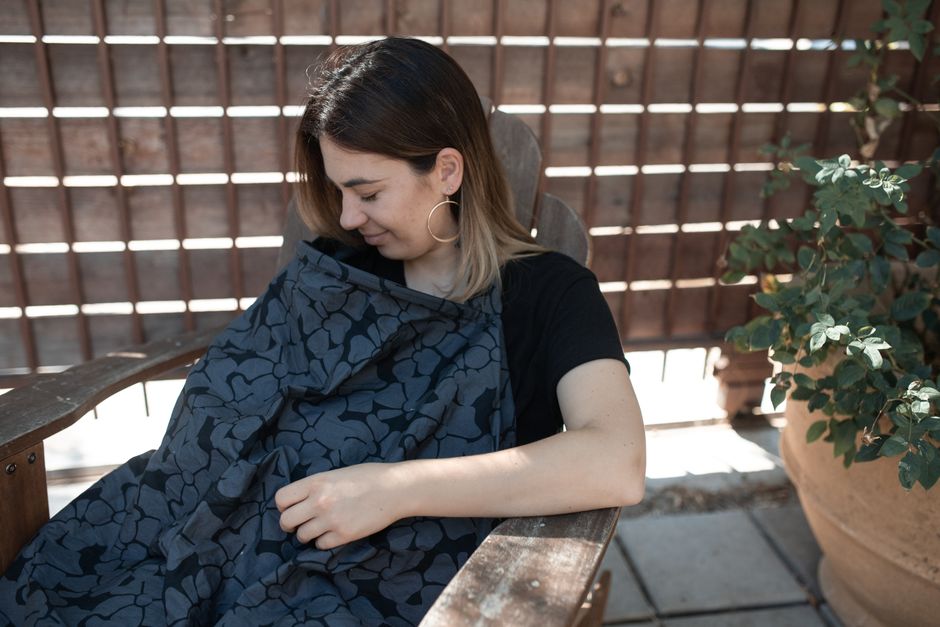
A nursing cover is a piece of fabric you drape over your shoulder and chest while breastfeeding in public or around others. Using one safely comes down to three things: a fit that leaves room for airflow, a position that lets you see your baby’s face, and a fabric that does not trap heat. Get those right and a cover can make nursing in public more comfortable without adding risk.
The safety part matters more than most people realize. A cover that blocks your view of your baby or traps warm air around their face is a problem, not a convenience. This guide covers how to put one on, what to look for, and the warning signs that you should take it off.
How Do You Put On A Nursing Cover Without Fuss?
Most covers are designed to go on one-handed, which matters when you are holding a baby. The common designs are a loop or strap that goes over your head and rests on one shoulder, an apron-style neck strap, or a poncho that slips over your head entirely.
For the shoulder-strap and apron styles, the sequence that works for most parents is:
- Loosen the strap or neckband before you put it on.
- Slip it over your head and settle the strap on the shoulder opposite your nursing side, or centered if the design calls for it.
- Latch your baby first, then adjust the fabric so it drapes over your chest and the baby’s body.
- Tuck the lower edge under your arm or behind your back if the cover has extra length.
Latching before you drape is the step people skip. It is much easier to get a good latch when you can see what you are doing. Once the baby is feeding, the cover just needs to sit over the top.
Poncho-style covers go on before you start. Some parents find them simpler because there is no strap to adjust. Others find them hotter, since more fabric sits against the body. Neither style is better in general. It comes down to what you find easier to manage.
What Should You Look For In A Safe Nursing Cover?
The single most important feature is a rigid, open neckline. Many covers are built with a stiffened curved band at the top, sometimes called a structured neckline, that holds the fabric away from your face and your baby’s face. That gap is what allows airflow and lets you look down and see your baby while nursing.
A cover with a soft, collapsing neckline that presses against your baby’s face is not a good choice. The fabric can rest against the nose and mouth, and you cannot see what is happening underneath.
Fabric choice matters too. Breathable, lightweight woven cotton or a cotton-blend is a reasonable choice. Heavy synthetic fabrics or thick fleece-style materials hold heat. In warm weather or a heated room, that trapped warmth can make both you and your baby uncomfortable.
Other practical features worth checking:
- Adjustable strap so the cover fits your body and does not gape open.
- Machine washable fabric, since spit-up and milk happen constantly.
- Enough width to cover your chest and the baby’s body without pulling tight.
- No loose ties, long cords, or dangling straps that could wrap around a baby’s neck.
That last point is a genuine safety issue. The Consumer Product Safety Commission has repeatedly warned about cords and strings near infants because of strangulation risk. A cover with a long drawstring or loose tie is a hazard you can simply avoid.
How Do You Keep A Baby Safe Under A Nursing Cover?
You keep a baby safe under a cover by making sure air can move and by checking on them regularly. The structured neckline does most of that work. Your job is to confirm the gap stays open and that your baby’s face is not pressed against fabric.
Watch for these signs that the cover needs adjusting or removing:
- Your baby’s face is against the fabric rather than in open space.
- You cannot see your baby’s nose and mouth when you look down.
- Your baby’s skin feels hot or looks flushed.
- Your baby seems to be working harder to breathe, or you notice flaring nostrils, grunting, or chest retractions.
- Your baby is sweating, limp, or unusually drowsy.
Any of those signs means remove the cover and let your baby cool down and breathe freely. If breathing looks labored or your baby is hard to wake, that is a medical emergency. Call for help right away.
One clarification worth making: there is no specific body of research establishing a safe maximum time under a nursing cover. The general guidance from health organizations is to keep a baby’s face clear and to avoid overheating, and a cover should never interfere with either. Treat any cover that blocks your view or traps heat as unusable, no matter how briefly you planned to wear it.





How Do You Nurse Discreetly In Public With A Cover?
Practice at home first. Fumbling with fabric in a restaurant is stressful; doing it a few times in your living room makes it routine. Once you have the strap adjusted and know how the fabric drapes, public nursing gets much calmer.
A few things that help:
- Wear nursing-friendly clothing, like a top you can lift or a clip-down bra, so you are not wrestling with layers.
- Latch your baby before draping the cover, as covered above.
- Sit somewhere with a backrest so you can relax your shoulders and the fabric hangs loosely.
- Bring a light blanket or muslin as a backup in case the cover feels too warm.
It is worth knowing that in most U.S. states, breastfeeding in public is protected by law. A cover is a comfort choice, not a legal requirement. Some parents use one because it helps them feel more at ease. Others nurse without one. Both are normal.
If a cover makes you anxious because you cannot see your baby well, that is a signal to reconsider the design. The cover should reduce stress, not add it.
When Should You Skip The Cover Entirely?
Skip the cover when it gets in the way of feeding safely. That includes times when your baby is congested, running a fever, or having any breathing difficulty. In those situations, keeping the face fully visible matters more than modesty.
Also skip it in hot environments. A cover adds a layer of fabric and trapped warmth. In a hot car, outdoors in summer heat, or in a stuffy room, nursing without a cover is the safer choice for a young infant. Babies cannot regulate their body temperature well in the first months of life, and overheating is a recognized risk factor for sleep-related infant death.
Newborns and babies under a few months deserve extra caution with any fabric near the face. Their airways are small, and they cannot move fabric away from their nose and mouth on their own. If you use a cover with a very young infant, check on them more often.
Some parents also find that certain babies simply dislike the cover. A baby who pulls at the fabric or cries under it is telling you something. Nursing without it, or using a different design, is a reasonable response.
What Are Common Mistakes With Nursing Covers?
The most common mistake is choosing a cover that collapses against the baby’s face. It looks fine in a product photo and fails in real use. If you cannot see your baby’s nose and mouth when you look down, the cover is not working.
Other frequent mistakes:
- Leaving it on too long in warm settings. Check your baby’s skin and breathing regularly.
- Using a cover with long dangling ties. Strangulation risk around an infant’s neck.
- Draping it before latching. Makes a good latch harder to achieve.
- Assuming a cover is required. It is a personal comfort choice, not a rule.
- Ignoring your baby’s cues. Fussiness or heat under the cover means adjust or remove it.
The bottom line is simple. A good nursing cover has a structured neckline, breathable fabric, no loose cords, and lets you see your baby. If it does all of that, it can make nursing in public easier. If it does not, it is not worth using.
Frequently Asked Questions
Are nursing covers safe for newborns?
They can be, but newborns need extra care because they cannot move fabric away from their face. Use a cover with a rigid neckline that keeps fabric off the face, and check your baby’s breathing and skin often.
How do you know if your baby is too hot under a nursing cover?
Signs include flushed skin, sweating, and feeling warm to the touch. If you notice any of these, remove the cover and let your baby cool down in open air.
Do you have to use a nursing cover in public?
No. Breastfeeding in public is legally protected in most U.S. states, so a cover is a personal choice about comfort and privacy, not a requirement.
Can a nursing cover cause breathing problems?
It can if the fabric rests against your baby’s nose and mouth or traps too much heat. A cover with a structured open neckline and breathable fabric lowers that risk, and you should always be able to see your baby’s face.
