
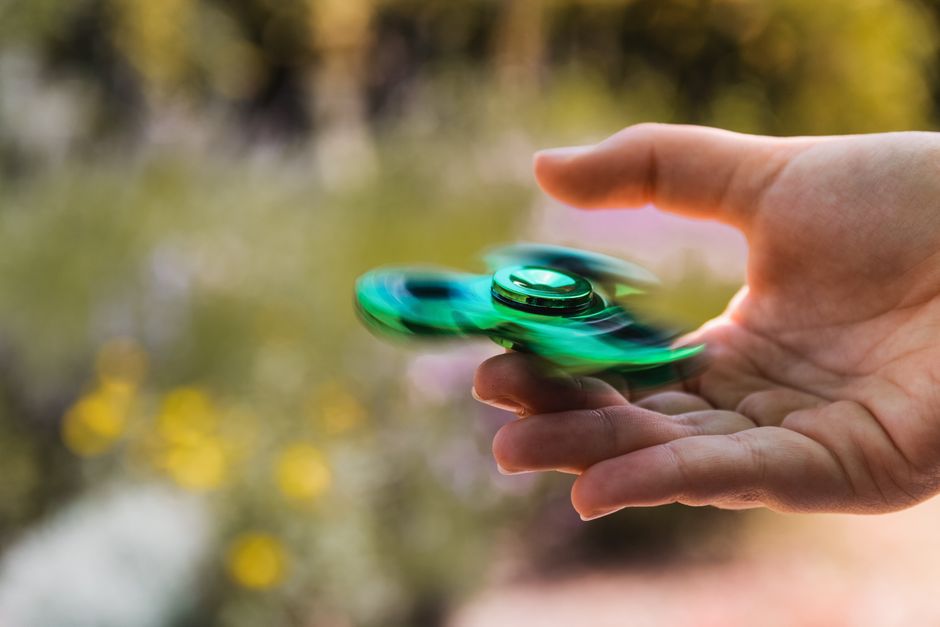
A fidget spinner is a small, weighted device that spins on a central bearing. You hold it between your thumb and fingers and give it a flick. For anxiety relief, the idea is simple: giving your hands something repetitive to do can redirect nervous energy and give your mind a low-stakes place to settle. It is not a treatment for anxiety disorders, and no large clinical trials have tested it as one. But as a self-soothing tool, it fits into a well-understood category of strategies that use physical sensation to interrupt a spiral of anxious thoughts.
How To Use A Fidget Spinner For Anxiety Relief
The basic technique takes about ten seconds to learn. Hold the spinner between your thumb and middle finger, resting it on your index finger. Give one of the outer weights a firm flick with your other hand. Let it spin. Then focus on it.
The focus part matters more than the spinning. A spinner left running while you scroll your phone is just a toy. Used with attention, it becomes a grounding exercise. Here is a practical way to do it:
- Hold the spinner in one hand and flick it into motion.
- Watch the blur of the weights. Notice the sound it makes.
- Feel the slight vibration through your fingers.
- When your mind drifts to the anxious thought, notice that, then bring your attention back to the spin.
- Repeat for one to two minutes, or until your breathing slows.
This is a form of attention anchoring. You are not trying to force the anxious thought away. You are giving your attention a physical object to rest on instead. That distinction is why the tool can help some people and do nothing for others.
Why Does Spinning Something Help Calm Anxiety?
Anxiety activates the body’s stress response. Heart rate rises, breathing gets shallow, muscles tense. The thinking part of the brain gets pulled toward threat detection, which is why anxious thoughts tend to loop.
A repetitive physical action gives that arousal somewhere to go. Movement and focused attention on a simple task can pull attention away from the internal loop. This is the same principle behind squeezing a stress ball, knitting, or rolling a smooth stone in your pocket.
One clarification worth making: the spinner does not “release nervous energy” in any measurable physiological way. There is no evidence that anxious energy builds up in the hands and needs an outlet. What it does is occupy attention and provide a predictable, controllable sensation. Predictability and control are two things anxiety takes away. Getting a small amount of both back can feel calming.
Is There Real Evidence That Fidget Spinners Reduce Anxiety?
The evidence is limited and mixed. Fidget spinners became popular in 2017, and the research since then has not been kind to the stronger claims made about them.
Some small studies have looked at fidgeting and attention. The findings are inconsistent. Some research suggests that fidgeting may help some people concentrate, while other studies find it distracts. A device that helps one person may do nothing, or even add stimulation, for another.
What is better established is the general principle behind fidgeting. Repetitive movement and sensory grounding are used in some therapeutic approaches for anxiety and trauma. But that does not mean a spinner produces the same effect as a structured clinical technique. A spinner is a tool. It is not a therapy.
No large human trials have confirmed that fidget spinners reduce anxiety symptoms in a clinically meaningful way. If you find one helpful, that is real and worth paying attention to. It just is not proof that the device works for everyone.





When A Fidget Spinner Might Not Help
For some people, a spinner makes anxiety worse. The motion, the sound, or the feeling of the bearing can be overstimulating. If you are already flooded with sensory input, adding more can push you further out of balance rather than back toward it.
There is also a risk that the spinner becomes another thing to do compulsively. If you find yourself spinning it constantly, unable to put it down, or using it to avoid situations rather than to steady yourself in them, that is worth noticing. Avoidance tends to feed anxiety over time, even when the avoidance feels good in the moment.
And for some people, the spinner simply does not work. That is not a personal failure. Different grounding tools work for different nervous systems.
Other Grounding Tools To Try Instead
If a spinner does not do it for you, the same principle applies to many other objects and actions. The goal is a simple, repeatable physical sensation you can return your attention to.
- A smooth stone or a ring you can turn on your finger
- A stress ball you squeeze and release in rhythm
- Slow breathing with a hand on your chest to feel the rise and fall
- Naming five things you can see, four you can hear, three you can touch
- Pressing your feet firmly into the floor and noticing the pressure
Many of these cost nothing and work anywhere. A spinner is one option among several, not a special case.
When To Get Professional Support
A fidget spinner is a coping tool, not a treatment. If anxiety is interfering with your sleep, your work, your relationships, or your ability to leave the house, that is a signal to talk to a doctor or a mental health professional.
Anxiety disorders are common and treatable. Evidence-based approaches include certain forms of talk therapy, such as cognitive behavioral therapy, and in some cases medication. A spinner can sit alongside those approaches. It cannot replace them.
If you are having thoughts of harming yourself, contact a crisis line or emergency services right away. Do not wait.
Frequently Asked Questions
Does a fidget spinner actually help with anxiety?
It helps some people by giving their hands and attention a simple, repetitive focus. No large clinical trials have confirmed it reduces anxiety symptoms, so it is best treated as a personal coping tool rather than a proven treatment.
How long should I use a fidget spinner for anxiety?
There is no established guideline on duration. Most people use it for a minute or two at a time, or until their breathing and heart rate settle.
Can a fidget spinner make anxiety worse?
Yes, for some people. The motion or sound can be overstimulating, and using it to avoid situations rather than to steady yourself can reinforce anxiety over time.
Is a fidget spinner a replacement for therapy or medication?
No. It is a coping tool that can sit alongside professional treatment, not a substitute for it.
