
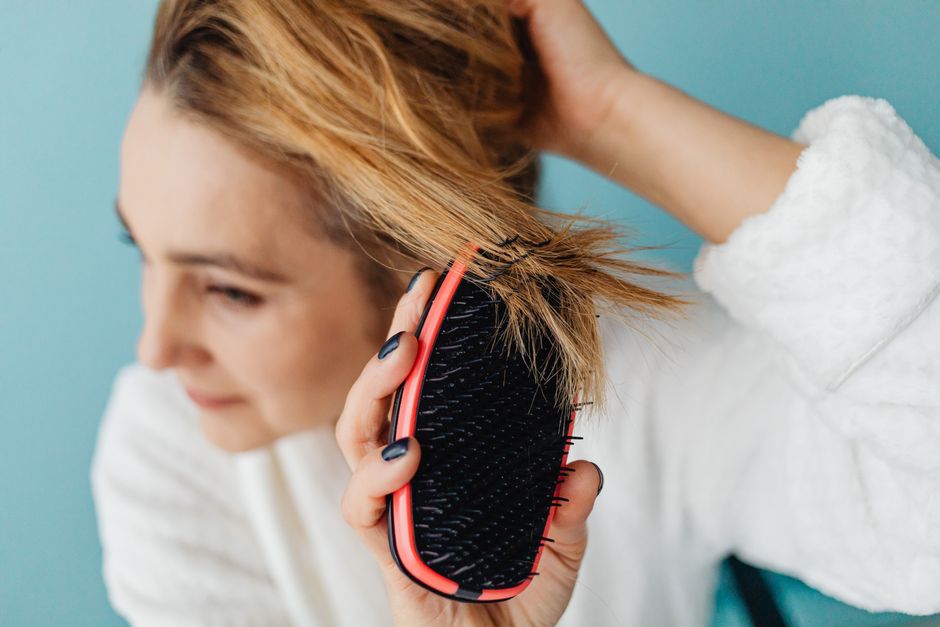
Matted hair forms when individual strands wrap around each other into tight knots that tighten with friction, moisture loss, and time. The way to untangle it is to work from the ends upward, use a lubricating conditioner or detangling product, and separate the mass with your fingers or a wide-tooth comb before you ever pull a brush through it. Ripping through a mat from the top down is the single most common mistake, and it causes breakage that can take months to grow out.
How To Untangle Matted Hair Without Causing Damage
Start with dry detangling only if the mat is loose. For anything firm, wet the hair and coat it with a slippery conditioner. Water alone increases friction between strands; conditioner reduces it.
Work in this order:
- Separate the mat into smaller sections with your fingers. Do not skip this.
- Apply conditioner or a detangling spray from the ends up to the mat.
- Hold the hair above the knot with one hand so the pull does not reach the scalp.
- Use a wide-tooth comb, starting at the bottom edge of the tangle.
- Comb a little, then stop. Reapply product. Repeat.
Patience is not a virtue here, it is a method. A large mat can take 30 to 60 minutes or more to work through. Rushing it is what causes the damage people are trying to avoid.
Fingers first, then a comb. A brush with dense bristles forces strands together rather than separating them, which makes mats worse.
Why Does Hair Mat in the First Place?
Hair mats because of the structure of the hair shaft itself. Each strand has an outer layer of overlapping scales called the cuticle. When those scales lift, from friction, heat, chemical treatment, or dryness, neighboring strands catch on each other and lock.
Once strands are locked, the knot tightens with every movement. This is why mats grow fast once they start. A small tangle left alone for a day can become a solid mass.
Common causes include:
- Dry or damaged hair, which has a rougher cuticle
- Friction from pillows, hats, and collars
- Not detangling before washing
- Washing hair in a pile on top of the head, which tangles it against itself
- Fine hair, which tangles more easily than coarse hair
- Curly and coily hair, where shed hairs stay trapped instead of falling away
One detail worth knowing: people with curly or coily hair shed roughly the same number of hairs per day as anyone else, but those shed strands stay woven into the curl pattern instead of dropping out. Over weeks, they form the core of many serious mats. That is why detangling and removing shed hair regularly matters more for textured hair, not less.
What Tools Actually Help
A wide-tooth comb does most of the work. It has enough space between teeth to pass through a tangle without forcing strands to bunch. A fine-tooth comb does the opposite.
Detangling products work by coating the hair shaft and reducing friction between strands. Silicone-based conditioners and leave-in detanglers are effective for this. Some people prefer oil-based products, and these can help, though heavy oils can make fine hair look greasy.
What does not help:
- Brushing a dry mat from the top down
- Pulling hard to “just get through it”
- Cutting before you have tried proper detangling
- Using water alone on a tight mat
A rat-tail comb or the tail of a comb can help lift the outer layer of a mat so product reaches inside it. Some people use a small amount of conditioner worked in with fingers to soften the mass before combing.





What If the Mat Will Not Come Out?
Some mats are too tight, too large, or too old to comb out without significant pain or hair loss. This is more common with severe matting that has been present for weeks or months.
Options in that situation:
- Soak the mat in conditioner and cover it with a plastic cap for 20 to 30 minutes to soften it
- Work through it in small sections over more than one session
- See a professional stylist who has experience with mat removal
- Cut the mat out as a last resort, working with a stylist if possible
Cutting is not a failure. If a mat is tight against the scalp or causing pain, removing it is the safer choice. Hair grows back.
If matting happens repeatedly or comes on suddenly without an obvious cause, it is worth mentioning to a doctor. Severe, unexplained matting can sometimes be associated with underlying health conditions or with hair that has become extremely dry or brittle for a medical reason. That is uncommon, but it is a real possibility and not something to dismiss.
How to Prevent Mats From Forming Again
Prevention comes down to three habits: detangle regularly, reduce friction, and keep hair conditioned.
Detangle before every wash, not after. Hair is weakest when wet, so removing tangles while dry causes less breakage. Use your fingers or a wide-tooth comb from the ends up.
For sleep, loose braids or a satin pillowcase reduce friction. Cotton pillowcases grip hair and pull strands together overnight. This is a small change that makes a measurable difference for people prone to tangles.
Condition every time you wash. Dry hair mats faster than conditioned hair because the cuticle stays rougher. Deep conditioning treatments can help hair that is chronically dry or damaged.
For textured hair, detangling with conditioner in the shower and removing shed hair regularly is standard practice. Shed hair left in place becomes the scaffolding for future mats.
Does Matted Hair Mean Something Is Wrong?
Usually not. Most matting is caused by ordinary factors: dryness, friction, missed detangling, or hair texture. It is a mechanical problem, not a medical one.
There are situations where matting is a sign of something more. Hair that suddenly becomes extremely tangled, breaks easily, or mats despite good care can sometimes reflect a nutritional deficiency, a thyroid issue, or another health condition. This is not common, and most people who get mats do not have an underlying illness.
The practical takeaway: if matting is new, severe, or unexplained, see a doctor. If it is the usual kind, caused by life getting in the way of your hair routine, it is a detangling problem and it can be solved.
Frequently Asked Questions
How do you untangle matted hair fast?
You cannot rush it without causing damage. Work from the ends up with conditioner and a wide-tooth comb, section by section, and expect it to take time.
Should I detangle matted hair wet or dry?
Wet hair with conditioner is easier to detangle because the product reduces friction between strands. Dry detangling works only for loose tangles.
Can I just cut out a mat?
Yes, cutting is a valid option when a mat is too tight or painful to remove safely. A stylist can help minimize how much hair you lose.
Why does my hair mat so easily?
Dry or damaged hair, fine texture, and curly or coily patterns all tangle more readily. Shed hairs trapped in textured hair are a common cause of larger mats.
