
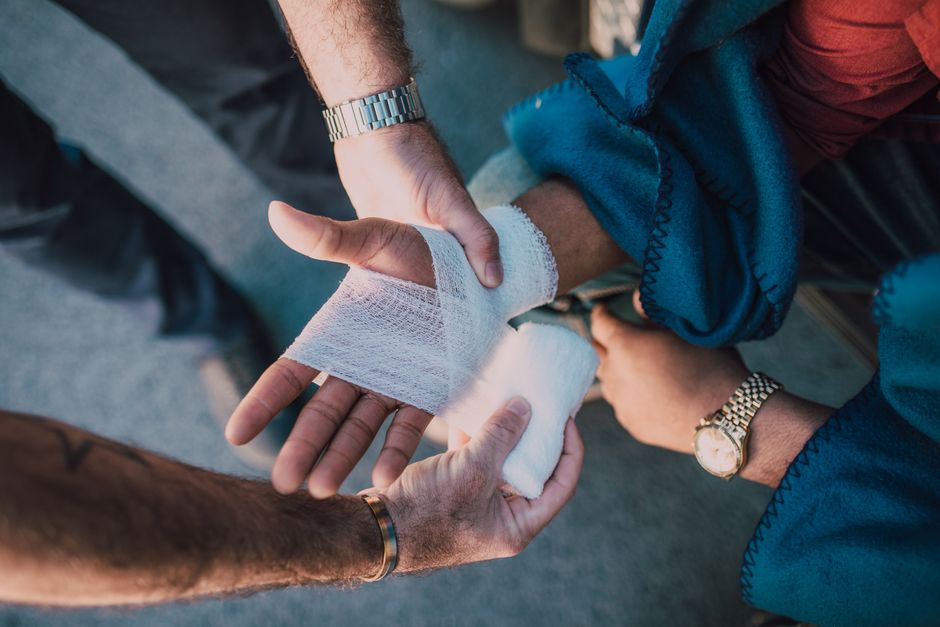
Soaking the bandage with warm water is the safest way to loosen it. Water softens dried blood and adhesive so the bandage lifts away instead of pulling. Never rip a bandage off dry. That tears the new tissue forming at the wound surface and can reopen a cut that was starting to heal.
The method you choose depends on where the bandage is, how long it has been on, and why it stuck. Most stuck bandages come off in a few minutes with the right approach.
Why Does A Bandage Stick To A Wound?
Two different things hold a bandage in place, and they need different solutions.
The first is the adhesive on the edges of the bandage. That is the sticky strip touching healthy skin. It bonds tighter the longer it stays on and the warmer the skin gets.
The second is what forms over the wound itself. When a cut or scrape bleeds, platelets and clotting proteins build a fibrin mesh to stop the bleeding. As that clot dries, it fuses with the absorbent pad of the bandage. That is not glue. It is a physical bond between dried biological material and fabric fibers.
This is why a bandage that has been on for two days can feel welded to a scrape, while a bandage over intact skin peels off easily. The pad is stuck to the scab, not to the skin.
Understanding that distinction matters. Solvents that break down adhesive, like rubbing alcohol, do nothing for a pad fused to a scab. And they sting badly on open skin. Water is the tool that works on both problems.
How To Unstick A Bandage From A Wound Without Pain
Warm water is the single most effective approach, and it works on almost every stuck bandage.
Here is the sequence:
- Wash your hands with soap and water first. This is not optional. You are about to open a wound.
- Soak a clean cloth, cotton ball, or gauze pad in warm water. Not hot. Warm tap water is fine.
- Hold the wet cloth against the bandage for one to two minutes. Let the water soak through the pad and reach the scab underneath.
- Start lifting from a corner, not the middle. Pull the bandage back over itself, low and parallel to the skin, not up and away from it.
- If you feel resistance or the person flinches, stop. Re-wet and wait another minute. Forcing it is how wounds get reopened.
- Keep the wet cloth pressed just ahead of where you are peeling. Water should be doing the separating, not force.
The low-angle pull matters more than most people realize. Pulling straight up concentrates all the force on a tiny area of healing tissue. Pulling sideways spreads that force along the skin surface.
If the bandage still resists after several minutes of soaking, do not keep pulling. Leave the wet cloth in place for another few minutes and try again. Dried blood can take time to rehydrate.
What If The Bandage Is On A Finger Or Toe?
Small bandages on fingers and toes are the easiest to remove because you can submerge them.
Fill a bowl with warm water and soak the finger or toe for five to ten minutes. The bandage often floats loose on its own. If it does not, peel gently from one edge while the digit is still underwater.
A few practical notes for these spots:
- Wrap bandages that go all the way around a finger can tighten as they get wet. Watch for any color change, numbness, or tingling in the fingertip and loosen the bandage if you see it.
- Do not use scissors to cut a bandage off a finger or toe unless you can clearly see where the skin ends and the bandage begins. It is easy to cut skin along with the bandage.
- If the bandage is over a nail bed injury, soak longer. Nail bed wounds tend to bleed more and form a firmer crust.



Does It Help To Use Oil, Lotion, Or Alcohol?
Oils and lotions can loosen adhesive on the edges of a bandage, but they do not dissolve a scab bonded to the pad. They also leave a residue that can interfere with the next bandage sticking.
Rubbing alcohol and adhesive remover wipes do break down medical adhesive. They are useful for tape and sticky residue on intact skin. They are a poor choice for a bandage stuck to an open wound because alcohol on broken skin causes sharp pain and can irritate healing tissue.
There is one situation where an oil-based approach makes sense. If the pad has already separated from the wound and only the adhesive edges are holding on, a small amount of baby oil or mineral oil on a cotton ball can lift the sticky border without tugging the wound at all.
Some clinicians suggest applying a thin layer of petroleum jelly to the pad of a new bandage before placing it over a scrape, specifically to prevent it from bonding to the scab next time. This is common practice in wound care, though it can reduce how well the pad absorbs fluid. Ask your pharmacist or clinician if this suits your situation.
How Do You Prevent A Bandage From Sticking Next Time?
Prevention is more reliable than removal.
Change the bandage before it becomes fused. A bandage over a healing scrape is usually changed once a day, or sooner if it gets wet or dirty. The longer a bandage stays on, the more firmly it bonds.
Use a non-adherent dressing for wounds that are oozing or crusting. These are sold as non-stick pads or gauze with a perforated film layer. They let fluid pass through but do not fuse to the wound surface. This is the standard approach in wound care for exactly this reason.
Keep the wound moist rather than letting it dry out. A dry scab is what glues the pad down. A thin layer of petroleum jelly or a moist wound dressing keeps the surface from hardening into the bandage. Note that this runs against the old advice to “let it dry out and form a scab.” Current wound care guidance favors a moist healing environment for most minor wounds, though the evidence is strongest for specific wound types and settings.
Trim the bandage so the adhesive only touches healthy skin, not the wound itself. If the pad is bigger than the wound, cut it down.
When Should You Not Remove A Bandage Yourself?
Some bandages should be left for a clinician to remove.
Do not remove a bandage yourself if:
- It was placed after surgery and you were told to leave it in place until a follow-up visit
- The wound is bleeding through the bandage
- You see signs of infection — spreading redness, warmth, swelling, pus, or a fever
- The wound is deep, gaping, or was caused by a bite, puncture, or dirty object
- The bandage is over a burn, a skin graft, or a pressure ulcer
In these cases, call your clinician. Removing a surgical dressing too early can disrupt the closure. Removing a dressing over an infected wound without proper care can spread infection.
For a minor scrape or cut at home, soaking and slow peeling is the right approach. For anything that looks worse than a minor wound, it is not a do-it-yourself situation.
What If The Bandage Is Stuck And The Wound Starts Bleeding Again?
Stop peeling immediately. Apply steady pressure with a clean cloth or gauze for several minutes and let the bleeding stop.
Once bleeding has stopped, soak the bandage again and try once more. If it keeps re-bleeding, or if the wound reopens each time you try, leave the bandage in place and get medical advice. Repeatedly reopening a wound delays healing and raises the risk of infection.
Some bleeding during removal is common and usually minor. Steady bleeding that does not stop with pressure is not.
Frequently Asked Questions
Does warm water really loosen a stuck bandage?
Yes. Warm water softens dried blood and weakens the bond between the pad and the scab, which is what usually holds a bandage in place. Soak for one to two minutes before peeling.
Can I use olive oil or baby oil to remove a bandage?
Oils can loosen the adhesive edges on intact skin but do not dissolve a scab fused to the pad. They work best when only the sticky border is holding the bandage on.
Should I pull the bandage fast or slow?
Slowly, and at a low angle parallel to the skin. Pulling straight up or fast concentrates force on healing tissue and can reopen the wound.
How long should I leave a bandage on a minor cut?
Change it at least once a day, or sooner if it gets wet or dirty. Changing it before it fuses to the scab is the simplest way to avoid a painful removal.
