
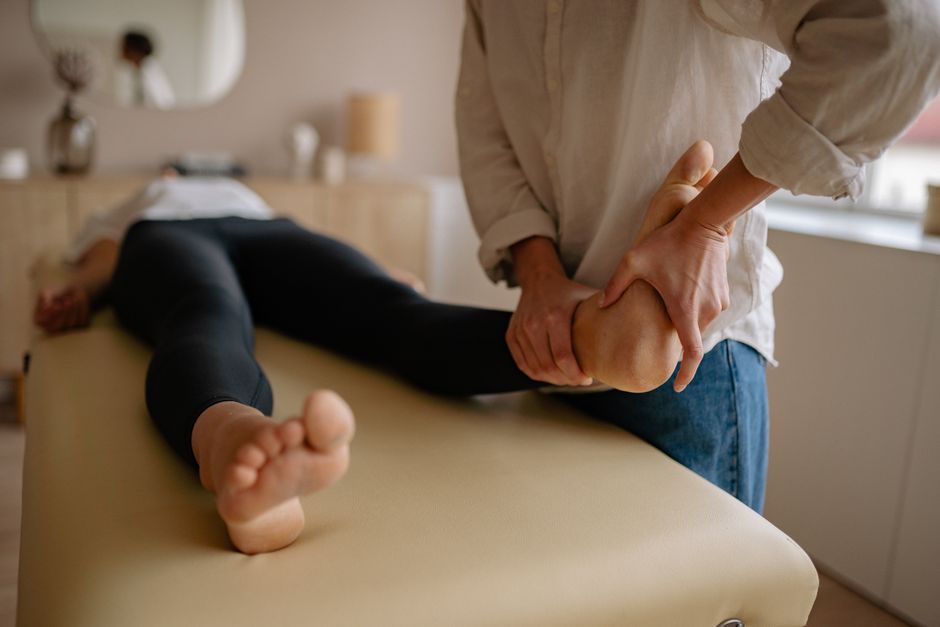
Patellofemoral pain syndrome is one of the most common knee problems, especially for runners and active adults. The good news is that most people get better without surgery. The most effective treatment is a structured exercise program that strengthens the muscles around your hip and knee, combined with a temporary reduction in pain-provoking activities. Simple pain relief and activity modification help early on, but building strength is what treats the root cause and keeps the pain from coming back.
What Is Patellofemoral Pain Syndrome?
Patellofemoral pain syndrome is pain at the front of the knee, around or behind the kneecap. The patella (kneecap) sits in a groove on the femur (thigh bone). When you bend and straighten your knee, the kneecap glides up and down in that groove.
In patellofemoral pain, that gliding motion becomes less smooth. The kneecap may track slightly off-center, putting extra pressure on the cartilage and soft tissues underneath. This causes the aching pain you feel when climbing stairs, squatting, or sitting with your knee bent for a long time.
The condition is often called “runner’s knee,” but it is not limited to runners. Anyone who does repeated knee bending—cyclists, hikers, soldiers, or people who sit at desks all day—can develop it.
What Actually Causes the Pain?
The pain is not from cartilage damage in most cases. Imaging often looks normal even when pain is severe. The problem is usually an imbalance in the forces pulling on the kneecap.
Weak hip muscles are a major contributor. The gluteal muscles control how your thigh rotates when you walk, run, or climb stairs. When these muscles are weak, the thigh rotates inward, pulling the kneecap out of its normal alignment. This puts uneven stress on the joint.
Quadriceps weakness also plays a role. The quadriceps muscle attaches to the kneecap and helps guide its movement. When the inner part of the quadriceps is weak, the kneecap can drift outward.
Tightness matters too. Tight hamstrings, calf muscles, and the iliotibial (IT) band all pull on the knee and can worsen tracking problems. Foot mechanics can contribute, but they are not the primary issue for most people.
What Works First: Pain Relief and Activity Modification
In the first few days, the goal is to reduce pain. Stop doing activities that cause sharp pain. Running, jumping, deep squats, and stair climbing are common triggers. You do not need to stop moving completely, but you should stay below the pain threshold.
Ice can help temporarily. Apply an ice pack to the front of the knee for 15 to 20 minutes after activity. This reduces inflammation and numbs the area, but it does not fix the underlying problem.
Over-the-counter pain relievers like ibuprofen or naproxen can be used short-term. They can help you stay comfortable while you start your exercise program. Long-term daily use is not recommended without talking to a doctor.
Knee braces and taping can provide temporary relief. Some people find patellar taping or a simple knee sleeve reduces pain during activity. The evidence for these tools is mixed, but they may help you stay active while you build strength. They are a bridge, not a cure.


The Core Treatment: Strengthening Exercises
Exercise is the only treatment consistently shown to reduce pain and improve function in patellofemoral pain syndrome. Research consistently shows that a structured exercise program beats stretching alone, and it beats doing nothing.
The most effective programs target both the quadriceps and the hip muscles. Hip strengthening is critical because weak hips change the mechanics of your entire leg.
A typical program includes:
- Quadriceps strengthening: Straight leg raises, terminal knee extensions, and wall sits done in a pain-free range.
- Hip strengthening: Side-lying leg lifts, clamshells, and glute bridges.
- Progressive loading: As you get stronger, you add resistance with ankle weights or resistance bands.
Start with exercises that do not cause pain. If an exercise hurts, modify it by reducing the range of motion or the resistance. Pain during exercise should stay below a mild level.
Consistency matters more than intensity. Doing a short set of exercises daily is better than a long session once a week. Most programs require two to three months of consistent work before significant improvement is noticed.
How To Treat Patellofemoral Pain Syndrome What Works: The Full Plan
A complete treatment plan combines several elements. Here is what works based on the strongest available evidence.
Step 1: Reduce pain triggers. Cut back on activities that cause pain, but do not stop moving entirely. Walk, swim, or use an elliptical if these are pain-free.
Step 2: Start a daily strengthening routine. Focus on hip and quadriceps exercises. Perform two to three sets of 10 to 15 repetitions of each exercise. Rest one day per week.
Step 3: Stretch what is tight. Stretch the hamstrings, calves, and IT band after exercise. Stretching alone will not cure the condition, but it complements strengthening.
Step 4: Return to activity gradually. When you can do your exercises without pain, start adding your sport back slowly. Increase distance or intensity by no more than 10 percent per week.
Step 5: Keep strengthening. Weakness takes time to develop, and it takes time to reverse. Continue your maintenance program even after the pain resolves.
Physical therapy is the most reliable way to get this plan right. A physical therapist can assess your specific weaknesses, correct your exercise form, and progress your program appropriately. Many people can do this on their own, but professional guidance improves outcomes, especially if you have had pain for more than three months.
What Does Not Work: Common Myths
Several popular treatments have little or no evidence behind them. Knowing what does not work can save you time and money.
Rest alone does not treat the condition. The pain may settle down with rest, but it returns as soon as you resume activity because the underlying weakness remains.
Shockwave therapy has mixed evidence. Some studies show modest benefit, but the results are inconsistent. It is not a first-line treatment.
Foot orthotics (custom shoe inserts) help some people but not most. If you have flat feet or overpronation, orthotics may reduce pain. For everyone else, they do not change the outcome. A simple trial with over-the-counter inserts is reasonable, but do not expect a cure.
Surgery is rarely needed. Arthroscopic surgery for patellofemoral pain has not been shown to be more effective than exercise in clinical trials. Surgery is reserved for cases where a specific structural problem is identified on imaging.
How Long Does Recovery Take?
Most people notice improvement within four to six weeks of starting a consistent exercise program. Full recovery typically takes two to three months. For people who have had pain for many months or years, recovery can take longer.
Do not expect a linear recovery. Some days will feel better than others. Flare-ups happen, especially when you increase activity too quickly. This is normal and does not mean you are getting worse.
The goal is not to eliminate all knee sensations. Some mild discomfort during exercise is acceptable. The goal is to reduce pain to a level where you can do your daily activities and return to sport.
When To See a Doctor
See a doctor if the pain is severe, if the knee swells, if you cannot bear weight, or if the knee locks or gives way. These symptoms may indicate a different problem such as a meniscus tear, ligament injury, or arthritis.
Also see a doctor if your pain does not improve after six to eight weeks of consistent exercise. You may need a more thorough evaluation or a referral to physical therapy.
Patellofemoral pain syndrome is not dangerous. It does not damage the joint permanently in most cases. It is a mechanical problem, and mechanical problems respond to mechanical solutions—namely, strengthening the muscles that control the kneecap.
Frequently Asked Questions
Can I run with patellofemoral pain syndrome?
You can run if the pain stays mild and does not worsen during or after the run. If running causes sharp or increasing pain, stop and switch to a lower-impact activity while you strengthen.
How long should I do exercises for runner’s knee?
Most people need two to three months of consistent daily or near-daily exercise to see full resolution of symptoms. Continue a maintenance program after that to prevent recurrence.
Is it okay to squat with patellofemoral pain?
Deep squats often aggravate the pain and should be avoided early in recovery. Shallow squats or wall sits in a pain-free range are acceptable and can help strengthen the quadriceps.
Do I need surgery for patellofemoral pain syndrome?
Surgery is rarely needed and has not been shown to be more effective than exercise in clinical trials. It is only considered when imaging identifies a specific structural problem and conservative treatment has failed.
