
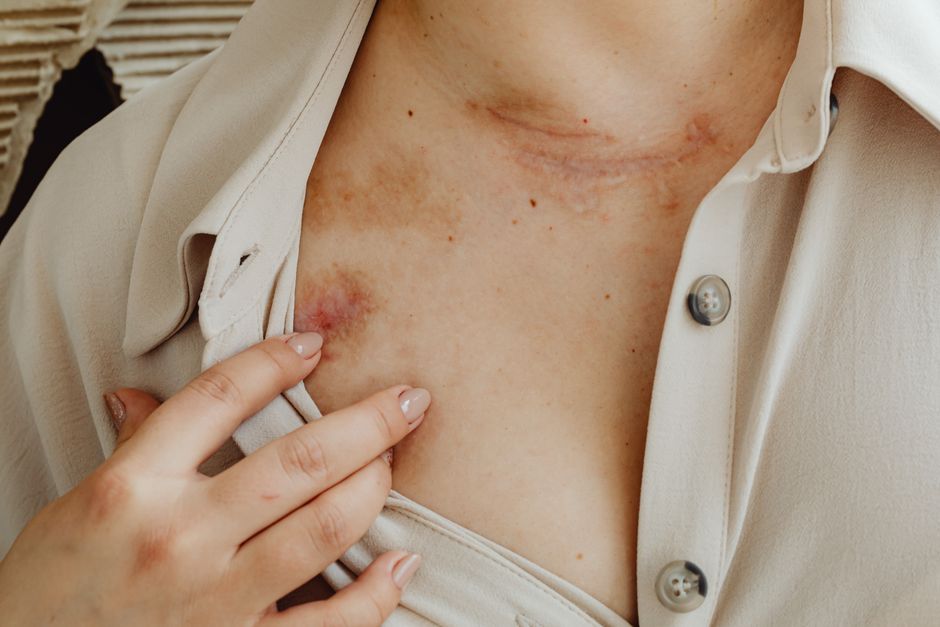
Burn marks fade on their own, but slowly. Most superficial burns heal with minimal scarring within a few weeks, while deeper burns can leave permanent changes in skin texture, color, and thickness. The most effective approach combines consistent scar care in the first year after injury, sun protection that lasts for years, and realistic expectations about what topical products can and cannot do.
How To Treat Burn Marks And Fade Scars
Scar treatment works best when it starts early and stays consistent. The first step is understanding what kind of mark you are dealing with, because burn injuries produce several different types of scars, and they do not all respond to the same approach.
A burn that damages only the epidermis, the outer layer of skin, usually heals without a permanent scar. Once the injury reaches the dermis, the layer beneath, the body repairs the damage with collagen. That repair tissue looks and behaves differently from normal skin. It may be raised, firm, discolored, or tighter than the surrounding area.
Three main scar types come from burns:
- Hypertrophic scars stay within the boundary of the original wound. They are raised and often red or pink.
- Keloid scars grow beyond the original wound edges. They are more common in people with darker skin tones and can continue growing for months.
- Contracture scars happen when skin tightens over a large area, often after a deep burn. They can restrict movement if they form over a joint.
Discoloration is a separate issue from raised tissue. Many burns leave flat marks that are darker (hyperpigmentation) or lighter (hypopigmentation) than surrounding skin. These color changes can persist long after the wound has closed, and they respond differently to treatment than raised scars do.
What Actually Works To Fade Burn Scars?
Silicone is the most studied non-invasive treatment for burn scars, and it has the strongest evidence behind it. Silicone gel sheets and silicone gels are widely used in burn care. Research consistently shows they can improve scar color, thickness, and flexibility when used consistently over months.
The mechanism is not fully understood. One leading explanation is that silicone creates an occlusive barrier that increases hydration in the scar tissue, which may reduce collagen overproduction. Another is that it applies gentle pressure. Whatever the exact reason, the clinical results are well documented.
Silicone works best on new scars, typically within the first year of healing. It needs to be worn for many hours per day, often 12 to 24 hours, for at least two to three months before changes become visible. Results vary. Some people see significant improvement. Others see modest change.
Pressure therapy is another established approach, especially for hypertrophic and contracture scars. Custom pressure garments are standard in burn rehabilitation. They apply continuous pressure to the healing tissue, which is thought to reduce blood flow to the scar and limit collagen buildup. Like silicone, pressure therapy requires months of consistent use.
Corticosteroid injections are used for raised and thickened scars that do not respond to topical treatment. A dermatologist injects the medication directly into the scar tissue. This can flatten and soften hypertrophic scars and keloids. It usually requires multiple sessions spaced several weeks apart. Side effects can include skin thinning, discoloration, and small blood vessels becoming visible near the injection site.
Laser therapy has become more common in burn scar management. Different types of lasers target different problems. Pulsed dye lasers target redness by affecting blood vessels in the scar. Fractional lasers target texture and thickness by creating tiny columns of controlled injury that trigger the skin’s repair process. Laser treatment typically requires multiple sessions and is performed by a dermatologist or plastic surgeon. Results are variable, and not all scars respond equally.
Do Over-The-Counter Creams And Oils Really Fade Scars?
Most over-the-counter scar creams have weak or no evidence supporting their use for burn scars specifically. This is one of the most misunderstood areas in scar care.
Vitamin E is the classic example. It is widely marketed for scar reduction, but clinical studies have not shown it to be effective. Some research actually found that topical vitamin E caused contact dermatitis in a notable percentage of users. It is not recommended as a scar treatment by most dermatologists.
Onion extract gel, often sold under brand names, has some limited evidence for reducing scar redness and thickness. The studies are small, and results are modest. It is not harmful, but it is not a substitute for silicone.
Products containing ingredients like aloe vera, cocoa butter, or vitamin C are commonly marketed for scar fading. No large human trials have confirmed that these ingredients fade burn scars. They may moisturize the skin, which can help with comfort and flexibility, but moisturizing is not the same as scar reduction.
There is one important exception. If a scar is still healing and the skin around it is dry and tight, keeping the area moisturized can help prevent cracking and improve comfort. That is a legitimate use of these products. It just should not be confused with scar fading.
No topical product currently available has been shown to remove a burn scar entirely. The best topical treatments can improve the appearance of scars, but they do not restore normal skin.
Why Sun Protection Matters More Than You Think
Sun exposure is the single biggest factor that makes burn scars more visible over time. This is not a minor point. It is one of the most well-established facts in scar care.
Scar tissue has less melanin than normal skin, which means it has less natural protection against ultraviolet radiation. When UV rays hit a healing scar, they can trigger excess pigment production in some areas and destroy pigment in others. The result is a scar that becomes darker, more uneven, or more noticeable than it would have been with sun protection.
This effect can happen for years after the burn. A scar that looks nearly faded at six months can darken significantly after a summer of sun exposure.
The recommendation is straightforward: keep burn scars covered or protected with sunscreen every time they will be exposed to the sun. This applies for at least a year after the wound has healed, and longer for scars that remain pink or sensitive. A broad-spectrum sunscreen with an SPF of 30 or higher is the standard recommendation from dermatologists.
Clothing provides reliable protection. For scars on the face or hands, where covering is not always practical, sunscreen needs to be reapplied every two hours during sun exposure.
When Should You See A Doctor About A Burn Scar?
Some burn scars need medical evaluation. Knowing when to seek help can prevent complications and improve outcomes.
See a doctor or dermatologist if:
- A scar is growing beyond the original wound area, which may indicate a keloid
- A scar restricts movement or feels very tight over a joint
- A scar becomes painful, itchy, or starts to bleed
- A scar changes color or appearance months after it seemed stable
- A burn scar covers a large area or is on the face
- A scar does not improve after several months of consistent at-home care
Deep burns and burns that required skin grafts often need specialized scar management. Burn centers and dermatology clinics offer treatments that are not available over the counter, including laser therapy, steroid injections, and custom pressure garments.
Timing matters. Scars that are treated early, while they are still forming and remodeling, tend to respond better than older scars. The remodeling phase of wound healing can last up to a year or more. During that window, the scar tissue is still changing, and interventions have the best chance of influencing the final result.
What About Home Remedies And Natural Treatments?
Home remedies for burn scars are popular online, but most have no clinical evidence supporting their use. It is worth being direct about this.
Honey, coconut oil, shea butter, and essential oils are frequently recommended in informal sources. None of these have been shown in controlled studies to fade burn scars. Some can cause irritation or allergic reactions, especially on sensitive scar tissue.
Lemon juice is sometimes suggested as a natural lightener. It is a bad idea. Lemon juice is acidic and can irritate skin, cause chemical burns, and make hyperpigmentation worse by triggering inflammation. Dermatologists consistently advise against putting lemon juice on scars.
Aloe vera has some evidence for soothing fresh burns and promoting wound healing. Whether it helps with scar fading specifically is not established. Using it on a healed scar is unlikely to cause harm for most people, but it should not replace proven treatments.
The honest position is that no home remedy has been shown to fade burn scars in clinical trials. If a product or remedy claims to fade scars without evidence, that claim should be treated with skepticism.
How Long Does It Take For Burn Scars To Fade?
Burn scars fade slowly, and the timeline depends on the depth of the original injury. There is no way to speed up the body’s natural remodeling process beyond what established treatments can offer.
Superficial burns that do not reach the dermis typically heal within two to three weeks with minimal or no scarring. Any redness or discoloration usually fades over several months.
Deeper burns that reach the dermis or beyond take much longer. The wound itself may take weeks to close. After that, scar remodeling continues for 12 to 18 months or longer. During this time, the scar may gradually become less red, softer, and flatter. Some improvement continues for years, but the rate slows significantly after the first year.
Hypertrophic scars often peak in thickness and redness around three to six months after injury, then gradually improve. Keloids behave differently. They can continue to grow for months or even years before stabilizing, and they are more likely to recur after treatment.
Pigment changes are often the last thing to improve. A scar may be flat and soft but still visibly lighter or darker than surrounding skin for years. In some cases, pigment changes never fully resolve.
This is the part that most people find frustrating. Scar care requires patience measured in months, not weeks. Products that promise fast results are not being honest about how scar biology works.
Frequently Asked Questions
Can burn scars go away completely?
Superficial burns that do not damage the dermis can heal without leaving a permanent scar. Deeper burns leave scar tissue that may fade significantly over time but rarely disappears entirely.
What is the best cream for burn scars?
Silicone gel or silicone gel sheets have the strongest evidence for improving burn scar appearance. Most over-the-counter creams marketed for scars, including vitamin E products, have not been shown to be effective in clinical studies.
How long should I use silicone on a burn scar?
Silicone is typically worn for at least two to three months before improvement is visible, and many clinicians recommend continuing for six months or longer. It should be worn for 12 to 24 hours per day for best results.
Does sunscreen really help fade burn scars?
Yes. Sun protection is one of the most important steps in scar care because UV exposure can darken scars and make them more visible. Dermatologists recommend broad-spectrum sunscreen with SPF 30 or higher on scars for at least a year after healing.
