
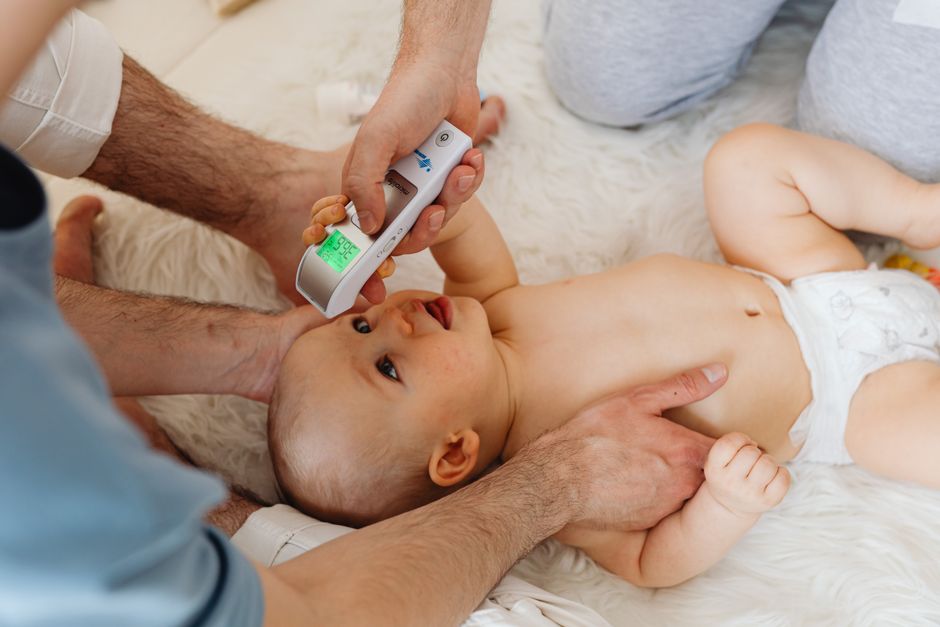
Fever after vaccination is a normal sign that your baby’s immune system is responding to the vaccine. It is not an illness. For most babies, the fever is mild, lasts 24 to 48 hours, and can be managed safely at home with simple measures. You treat it by keeping your baby comfortable, offering extra fluids, dressing them lightly, and using infant acetaminophen or ibuprofen only when needed and at the correct dose for their age and weight. You should never give aspirin to a baby. Call your pediatrician if the fever is high, lasts longer than two days, or your baby seems unusually fussy, lethargic, or is not drinking.
What Is a Normal Fever After Vaccination?
A fever after vaccination is a normal immune response. The vaccine is teaching your baby’s body to recognize a specific germ. A mild fever means that process is working.
Most vaccine-related fevers are low-grade. That usually means a temperature between 100.4°F (38°C) and 102.2°F (39°C). These fevers typically begin within 12 hours of the shot and resolve within 48 hours. Some vaccines, like the MMR (measles, mumps, rubella) shot, can cause a delayed fever that appears 7 to 12 days later. That is also normal.
Not every baby gets a fever after vaccination. Many have none at all. The absence of a fever does not mean the vaccine did not work.
How To Treat Baby Fever After Vaccination Safely
The goal is comfort, not eliminating the fever entirely. Fever is part of the immune response. Lowering it does not make the vaccine work better or worse.
Start with physical measures. Dress your baby in light clothing. Keep the room at a comfortable temperature. Offer breast milk, formula, or water (if over 6 months) more often than usual. Dehydration is the main risk with any fever, so frequent feeds matter most.
Do not sponge your baby with cold water or rubbing alcohol. Cold water can cause shivering, which raises body temperature. Alcohol can be absorbed through the skin and is dangerous. A lukewarm bath is acceptable if your baby enjoys it, but it is not necessary for treating the fever.
Medication is optional. If your baby is eating and sleeping reasonably well, you may not need it. If your baby is uncomfortable, fussy, or not feeding well, medication can help.
Use these medications only:
- Acetaminophen (Tylenol) — safe for babies 2 months and older. Dose by weight, not age.
- Ibuprofen (Motrin, Advil) — safe for babies 6 months and older. Dose by weight.
Check the label for the correct dose for your baby’s weight. If you are unsure, call your pediatrician. Do not give both medications at the same time unless your doctor specifically instructs you to. Do not give aspirin to any child under 18 years old. It is linked to Reye’s syndrome, a rare but serious condition that affects the liver and brain.
When Is Fever After Vaccination a Concern?
Most fevers after vaccination are harmless. But some situations need medical attention.
Call your pediatrician if your baby is under 3 months old and has a rectal temperature of 100.4°F (38°C) or higher. For older babies, call if the fever reaches 104°F (40°C) or higher, or if it lasts more than 48 hours.
Seek care immediately if your baby shows any of these signs:
- Difficulty breathing or wheezing
- Swelling of the face or throat
- A rash that looks like bruises (not the mild rash that can follow MMR)
- Seizure or convulsion
- Extreme lethargy — not waking to feed or interact
- Signs of dehydration — no wet diapers for 6 hours, no tears when crying, dry mouth
These symptoms are not typical vaccine reactions. They require prompt medical evaluation.





What About Febrile Seizures?
A febrile seizure is a convulsion triggered by a rapid rise in body temperature. It can look frightening but is usually brief and does not cause lasting harm.
Febrile seizures are rare. They occur in about 2 to 5 percent of children overall, usually between 6 months and 5 years of age. After vaccination, the risk is slightly elevated for a few days, especially after the MMR vaccine. The overall risk remains very low.
If your baby has a seizure, lay them on their side on a soft surface. Do not put anything in their mouth. Do not restrain them. Time the seizure. Call 911 if it lasts longer than 5 minutes or if your baby does not recover quickly afterward.
Most children who have a febrile seizure after vaccination develop normally and have no long-term issues. Having one febrile seizure slightly increases the risk of another, but it does not mean your baby has epilepsy or a seizure disorder.
Why Does My Baby Have a Fever If the Vaccine Is Safe?
Vaccines are safe, but they are designed to trigger an immune response. That response is what causes the fever. It means the body is building protection against the disease.
The fever is caused by immune signaling molecules called cytokines. These molecules travel to the brain and reset the body’s thermostat slightly higher. This higher temperature helps immune cells work more efficiently. It is a sign the vaccine is doing its job.
This is different from a fever caused by an infection. With an infection, the fever is part of a battle against a live, multiplying germ. With a vaccine, there is no live germ causing illness (except in rare cases with live-attenuated vaccines, which cause a very mild, contained infection). The fever is shorter and milder.
Some parents worry that treating the fever will reduce vaccine effectiveness. This is not supported by evidence. Treating discomfort does not interfere with the immune response.
What to Expect After Different Vaccines
Not all vaccines cause fever at the same rate. Knowing what to expect can reduce worry.
| Vaccine | Likelihood of Fever | Timing |
|---|---|---|
| DTaP (diphtheria, tetanus, pertussis) | Common, often mild | Within 24 hours |
| MMR (measles, mumps, rubella) | Less common, can be higher | 7–12 days after shot |
| PCV (pneumococcal) | Common | Within 24–48 hours |
| Rotavirus (oral) | Uncommon | Within 48 hours |
| Influenza (flu shot) | Uncommon | Within 24 hours |
| COVID-19 | Common in older children, less in infants | Within 24–48 hours |
This table is a general guide. Every baby is different. Some have no fever at all. Others have a brief, mild one. Neither response is unusual.
How Long Does Vaccine Fever Last?
Vaccine fevers are short-lived. Most resolve within 24 to 48 hours after they start.
If the fever comes from the MMR vaccine, it can appear later and last 1 to 3 days. This delayed response is normal and does not require different treatment. The same comfort measures and medication rules apply.
A fever that lasts more than 3 days is not a typical vaccine reaction. It may be from something else entirely, like a viral infection your baby picked up around the same time. Call your pediatrician to discuss next steps.
Frequently Asked Questions
Can I give Tylenol before the vaccine to prevent fever?
No, giving acetaminophen before vaccination is not recommended. Some research suggests it may slightly reduce the immune response, and it does not meaningfully prevent fever.
What temperature is too high after a vaccine?
A temperature of 104°F (40°C) or higher is too high and warrants a call to your pediatrician. For babies under 3 months, any fever of 100.4°F (38°C) or higher needs medical attention.
Is it safe to bathe my baby with a fever after vaccination?
Yes, a lukewarm bath is safe if your baby seems to enjoy it. Avoid cold water, which can cause shivering, and never use rubbing alcohol in the bath water.
Should I wake my baby to give fever medicine?
No, do not wake a sleeping baby to give medication. Rest is important for recovery, and the fever can be treated when your baby wakes on their own.
