
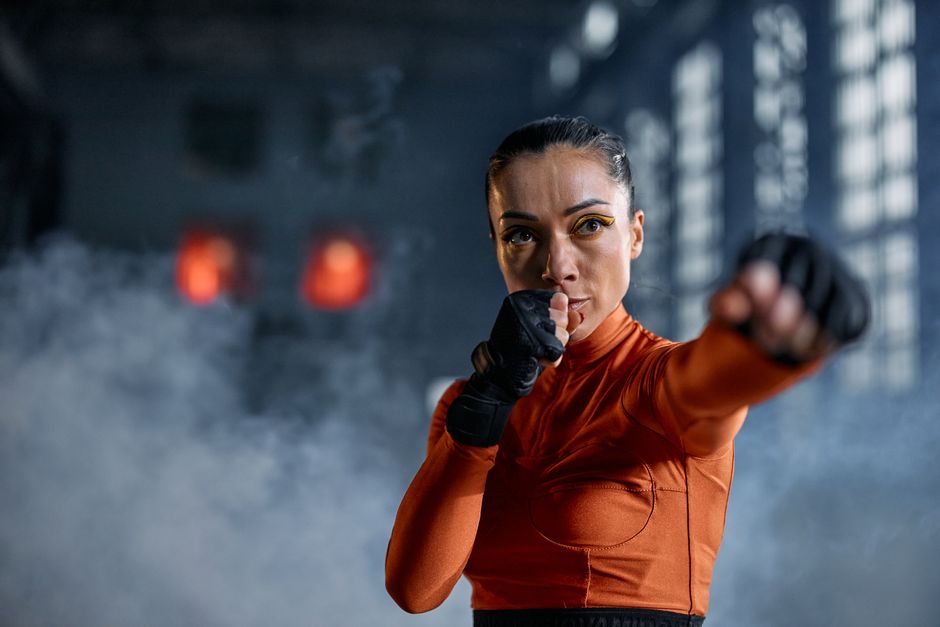
Power in a punch does not start in your arm. It starts where your foot meets the floor. Force travels from the ground, up through your legs and hips, through your torso, and out through your arm. A punch thrown with only the arm is weak and easy to see coming. A punch built from the ground transfers the force of your whole body into a small target. The short version: get your stance right, drive from the legs, rotate the hips, keep your body aligned, and train the movement until it is automatic.
How To Throw Stronger Punches From The Ground Up?
The answer is a sequence. Your feet grip the ground, your legs push, your hips rotate, your core transfers that rotation to your shoulder, and your arm delivers it. Skip any link and power leaks out.
Think of it like a whip. The handle moves first. The tip moves last and fastest. In a punch, your back foot is the handle and your fist is the tip. If your fist moves first, you are swinging a rope with no handle.
This is not a new idea. Coaches have taught it for decades. What matters is that the sequence is real and you can feel it. A punch that lands with your whole body behind it feels different to throw and different to receive.
Why Does Punching Power Start In The Legs?
Your legs are the largest muscles you can recruit in a punch. The force you generate against the ground has to go somewhere. If your stance is stable, it travels up into your hips and torso. If your stance is loose, it stops at your feet.
The push comes mostly from the back leg in a standard stance. As you throw a rear hand, that back foot pivots and drives. The front leg braces so the push has something to push against. Both legs matter. One delivers, one anchors.
This is why fighters with strong legs tend to hit hard. It is also why a punch thrown while off balance feels weak even when the arm is strong. The arm is just the last part of the chain.
How Do You Set Up A Stance That Transfers Force?
Your stance is the foundation. Get it wrong and every punch after it suffers.
- Feet about shoulder-width apart, or slightly wider, for balance.
- One foot forward, one back. Your back heel stays slightly raised so it can pivot.
- Knees soft, not locked. Locked knees block the push from your legs.
- Weight balanced between both feet, not sitting back on your heels.
- Chin tucked, hands up, shoulders relaxed.
The raised back heel is easy to miss. It lets your back foot rotate as you throw. A flat back foot acts like a brake. Some beginners are taught to keep both feet planted, which is fine for a jab but limits power on the rear hand.
Your stance should feel stable but mobile. If you can be pushed off balance easily, your base is too narrow or your weight is in the wrong place.
What Role Do The Hips Play In A Strong Punch?
The hips are where the power changes direction. Your legs push forward and up. Your hips turn that push into rotation. That rotation is what drives your shoulder and fist forward.
When you throw a rear hand, your back hip rotates toward your target. Your back foot pivots at the same time. The whole lower body turns as one unit. If your hips stay square while your arm punches, you are throwing with your arm alone.
A simple way to feel this: stand still and throw a slow rear hand using only your arm. Now do it again and let your back foot pivot and your hip turn. The second one should feel like it has more behind it with less effort from the arm.
Hip rotation is not the same as twisting your whole body wildly. It is a controlled turn that stays balanced. Over-rotating leaves you open and off balance.
How Does The Core Connect Your Hips To Your Punch?
Your core is the bridge. It carries the rotation from your hips to your shoulders. A weak or slow core lets power leak before it reaches your arm.
This is not about doing sit-ups until your stomach burns. It is about your torso being able to transfer force without collapsing. When you punch, your torso should rotate slightly with the hip turn, not stay stiff and not fold over.
Some studies suggest that training the core for stability and rotation helps transfer force through the body. The exact amount of benefit from any single exercise is hard to pin down. What is clear is that a torso that cannot hold its position under force will waste the power your legs produce.
Exercises that involve rotation and resistance, like medicine ball throws and cable rotations, train this transfer more directly than static planks alone. Planks build a base. Rotation drills teach the transfer.
Why Does Technique Matter More Than Arm Strength?
A strong arm with poor technique hits softer than an average arm with good technique. The reason is simple. Arm strength adds a small amount of force. Body mechanics multiply the force you already have.
You can test this yourself. Throw a punch with your arm only and note how it feels. Then throw one with a proper pivot and hip turn. The difference is usually obvious even at half speed.
This does not mean strength training is pointless. Stronger muscles can help, especially in the legs and core. But strength without the sequence is like a powerful engine with no driveshaft. The force has nowhere to go.
One thing worth knowing: many people chase power by trying to hit harder with the arm. That usually makes them tense up, which slows the punch and reduces force. Relaxed, fast movement with good mechanics tends to land harder than a tense, muscled swing.
What Drills Build Power From The Ground Up?
You build the sequence by practicing it slowly, then adding speed. Here are drills that train the chain from the floor to the fist.
- Slow-motion punches. Throw rear hands at quarter speed, focusing on the foot pivot and hip turn. Feel the order: foot, hip, torso, arm.
- Pivot drills. Stand in stance and practice turning your back foot and hip without throwing a punch. Build the movement pattern first.
- Medicine ball throws. Rotational throws against a wall or with a partner train the hip-to-torso transfer under load.
- Step-in punches. Take a small step forward as you throw to feel how forward drive adds to the punch.
- Shadowboxing with focus. Throw punches in the air and check that your back foot is pivoting each time.
Do these with control. Speed comes later. A drill done sloppy just trains a sloppy habit.
What Common Mistakes Kill Punching Power?
Most power problems come from a few repeated errors. Fix these and your punches will feel different.
- Flat back foot. If your back heel does not lift and pivot, your hip cannot turn freely.
- Arm-first punching. The fist leads instead of following the hips.
- Tense shoulders. Tension slows the punch and cuts off the transfer from the torso.
- Over-rotating. Turning too far leaves you off balance and exposed.
- Locked knees. Stiff legs cannot push or absorb force.
- Standing too tall. A slightly settled, athletic posture transfers force better than standing straight up.
Pick one mistake at a time. Trying to fix everything at once usually fixes nothing.
How Long Does It Take To Build A Stronger Punch?
There is no fixed timeline, and anyone who gives you an exact number is guessing. What is fair to say is that the movement pattern can improve quickly with focused practice, while real strength and power gains take longer.
Most people notice better mechanics within a few sessions of slow, deliberate practice. Noticeable power gains usually take weeks to months of consistent training. The rate depends on your starting point, how often you train, and whether you are also building leg and core strength.
Be patient with the process. Power is a skill as much as a physical quality. The people who hit hardest usually spent a long time refining the sequence, not just lifting weights.
Frequently Asked Questions
Where does punching power actually come from?
It comes from the ground up. Your legs push against the floor, your hips rotate, your core transfers that rotation, and your arm delivers it. The arm is the last link, not the source.
Can you punch harder without lifting weights?
Yes. Better mechanics can add noticeable power without any added strength. Strength training can help, but technique is the bigger factor for most people.
Should your back heel lift when you punch?
Yes, for most rear-hand punches. A raised, pivoting back heel lets your hip rotate freely, which is where much of your power comes from.
Why do my punches feel weak even though I am strong?
Usually because the power is not traveling through your body in the right order. If your arm leads and your hips stay still, your strength has nowhere to go.
