
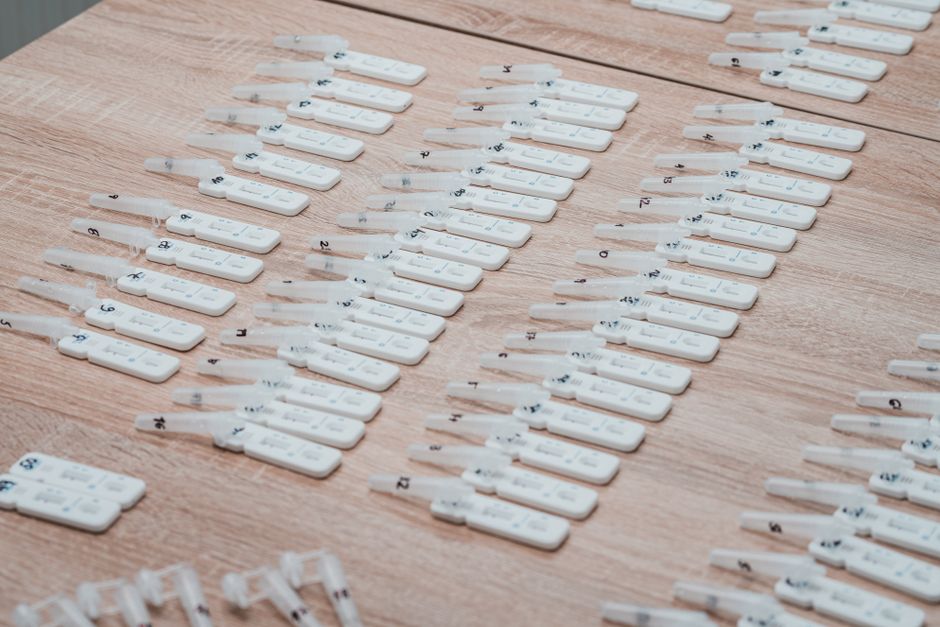
If you suspect dust mites are behind your sneezing, coughing, or nighttime congestion, there are two very different things you might want to test: whether mites are actually living in your home, and whether your body is actually allergic to them. Home dust mite test kits check for mite proteins in dust samples. Allergy testing checks your immune system’s response to those proteins. These are not the same test, and one does not replace the other.
The most reliable way to confirm a dust mite allergy is a skin prick test or a specific IgE blood test ordered by a clinician. Home dust mite kits can tell you whether mite allergens are present in your environment, but they cannot diagnose an allergy. Understanding what each test measures helps you choose the right one.
How To Test For Dust Mites Kits And Allergy Tests: What Is the Difference?
These two categories of testing answer completely different questions, and mixing them up is one of the most common sources of confusion.
A dust mite test kit measures your environment. You collect a sample of dust — usually from a mattress, bedding, carpet, or upholstered furniture — and send it to a lab or read a result at home. The test looks for proteins from dust mite bodies and droppings. It tells you whether mite allergen is present and, depending on the kit, roughly how much.
An allergy test measures your body. A clinician exposes your skin or your blood to dust mite allergen and observes whether your immune system reacts. This is the only way to know whether you are actually allergic to dust mites.
You can have high levels of dust mite allergen in your home and no allergy at all. You can also be genuinely allergic to dust mites and find low levels in a single dust sample, because mite populations vary by room, season, and humidity. Neither test substitutes for the other.
How Do Home Dust Mite Test Kits Work?
Most home kits use an antibody-based method to detect specific mite proteins in household dust. You wipe or vacuum a defined area, seal the sample, and either read a color change at home or mail it to a lab.
The proteins most kits target are Der p 1 and Der f 1. These come from two common species: Dermatophagoides pteronyssinus and Dermatophagoides farinae. These proteins are found in mite feces and body fragments, and they are the same proteins that trigger allergic reactions in sensitized people.
A few practical points about home kits:
- Results usually reflect the specific spot you sampled, not your whole home.
- Mite allergen levels change with humidity, season, and cleaning habits.
- Most kits give a positive or negative result or a rough range, not a clinical measurement.
- A positive result means allergen is present. It does not mean you are allergic.
Home kits can be useful for confirming that mites are present when you are trying to decide whether to invest in allergen-proof covers or a dehumidifier. They are not diagnostic tools for allergy.
How Is a Dust Mite Allergy Actually Diagnosed?
Diagnosis requires a clinician. Two tests are widely used, and both are well established.
Skin prick testing is often the first choice. A small amount of dust mite allergen extract is placed on your forearm or back, and the skin is lightly pricked. If you are sensitized, a raised, itchy bump appears within about 15 to 20 minutes. A positive result is compared against a histamine control and a saline control. The test is fast and results are available during the visit.
Specific IgE blood testing measures the level of IgE antibodies against dust mite proteins in your blood. It is useful when skin testing is not practical — for example, if you have extensive eczema or take medications that interfere with skin testing. Results usually take a few days.
Both tests detect sensitization. Sensitization means your immune system has made IgE antibodies against dust mite proteins. It does not automatically mean you have symptoms. A clinician interprets the result alongside your history — when symptoms occur, where they occur, and what makes them better or worse.
This is a point worth being clear about: a positive allergy test alone is not a diagnosis of allergic disease. Many people test positive to dust mites and have no symptoms. The diagnosis comes from matching test results with a consistent clinical picture.




What Do Dust Mite Allergy Test Results Actually Mean?
Results are interpreted in context, not in isolation. A clinician looks at the size of the skin reaction or the IgE level, your symptom pattern, and your environment.
Symptoms that suggest dust mite allergy tend to be worse indoors, worse at night or on waking, and worse after disturbing bedding or vacuuming. They often include nasal congestion, sneezing, itchy or watery eyes, and in some people, coughing or wheezing.
If your symptoms do not follow that pattern — for example, they are clearly worse outdoors or during a specific season — dust mites may not be the main trigger even if your test is positive. Allergy testing narrows the field. It does not replace a careful history.
Some clinicians also use the results to guide environmental control. If you are sensitized and have symptoms, reducing allergen exposure in the bedroom is a reasonable step. If you are sensitized but have no symptoms, aggressive measures are usually not necessary.
Can You Test for Dust Mites Without a Doctor?
You can test your home without a doctor. You cannot reliably diagnose an allergy without one.
Home kits are sold online and in some retail stores. They vary widely in method and quality. Some use lab analysis; others rely on a visual read. There is no standardized threshold across kits, so a positive result from one kit may not mean the same thing as a positive from another.
At-home allergy tests — including mail-order IgE panels — exist, but their reliability varies. Some have been evaluated and found to give inconsistent results. If you want a diagnosis you can act on, a clinician-ordered skin prick or specific IgE test remains the standard.
If you have symptoms that interfere with sleep, work, or daily life, or if you have asthma-like symptoms such as wheezing or shortness of breath, see a clinician rather than relying on a home kit.
What Else Can Look Like a Dust Mite Allergy?
Several conditions produce symptoms that overlap with dust mite allergy, and testing helps sort them out.
- Other indoor allergens: pet dander, cockroach allergen, and mold can cause similar nasal and eye symptoms.
- Non-allergic rhinitis: nasal symptoms triggered by irritants, temperature changes, or odors rather than an immune response.
- Asthma: can be triggered by dust mites but also by many other things, and requires its own evaluation.
- Chronic sinusitis or respiratory infections: can cause persistent congestion that mimics allergy.
Because these overlap, a test result alone rarely tells the full story. The pattern of symptoms — when they happen, where they happen, and what makes them worse — is often as informative as the test itself.
When Should You Get Tested?
Testing makes sense when your symptoms are persistent, when you are unsure what is triggering them, or when you are considering treatments that depend on knowing your triggers.
If your symptoms are mild and occasional, testing may not change what you do. If they are frequent, disruptive, or you are considering allergy medication or immunotherapy, testing provides information that guides decisions.
Talk to a clinician about which test fits your situation. Skin prick testing and specific IgE blood testing are both well established, and the choice often comes down to your history, medications, and skin condition.
Frequently Asked Questions
Can a home dust mite kit tell me if I’m allergic?
No. Home kits detect dust mite proteins in your environment, not your immune response. Only a clinician-ordered skin prick or specific IgE blood test can confirm an allergy.
How accurate are at-home dust mite test kits?
Accuracy varies by kit and there is no standardized threshold across brands. They can confirm that mite allergen is present in a sampled area, but results are not equivalent to clinical allergy testing.
What is the most reliable test for dust mite allergy?
Skin prick testing and specific IgE blood testing are both well established and considered reliable when interpreted with your symptom history. Neither is meaningful without that context.
Can you have dust mites but no allergy?
Yes. Dust mites are present in most homes, and many people who live with them have no allergic symptoms. Sensitization on a test does not always mean you have symptoms.
