
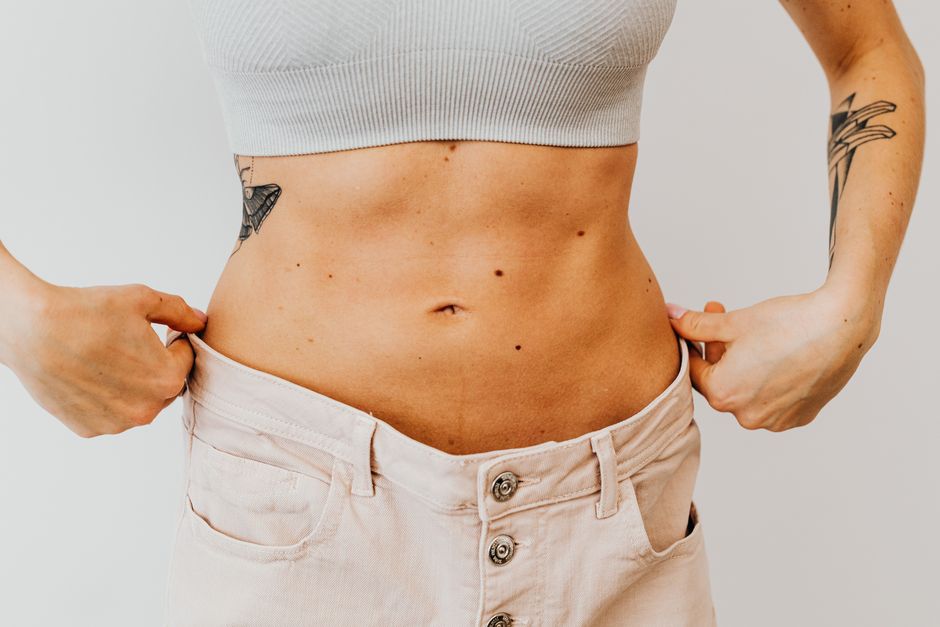
You pinch the skin on your belly and pull it away from your body. What you feel — soft and thick, or thin and papery — tells you something about what is actually underneath. The pinch test is a simple way to get a rough sense of whether you are feeling fat, loose skin, or both. It is not a medical test and it cannot measure anything precisely. But used correctly, it can help you understand why a certain area of your body looks the way it does.
What Is the Pinch Test and How Do You Do It?
The pinch test involves grabbing a fold of skin and the tissue just beneath it, then pulling it away from the muscle underneath. You use your thumb and index finger. You pinch, hold for a moment, and pay attention to how thick the fold feels and how easily it lifts.
The idea is simple. If you can grab a thick, substantial fold, fat is likely part of what you are holding. If the fold is thin and you can lift it easily with very little tissue between your fingers, you may be feeling mostly skin.
To do it consistently:
- Pinch in the same spot each time — usually the lower belly, upper arm, or thigh
- Pull straight away from the muscle, not sideways
- Do it standing or lying down, but pick one position and stick with it
- Wait at least a few seconds before judging what you feel
The test works best as a comparison tool. Pinch the same area over weeks or months. If the fold gets thinner, something is changing. If it stays thick and soft, fat is still there. If it stays thin but the skin hangs, you are likely looking at loose skin.
One important limitation: the pinch test cannot separate skin from fat with precision. What you are grabbing is a fold that includes skin, subcutaneous fat, and connective tissue all at once. You are making a rough estimate, not getting a measurement.
How To Tell Loose Skin From Fat The Pinch Test Way
The key difference comes down to thickness and elasticity. Fat feels thick and soft. Loose skin feels thin and lacks bounce.
When you pinch an area with fat underneath, the fold is substantial. There is a cushiony quality to it. When you let go, it springs back into place fairly quickly. The skin itself still has elastic recoil.
When you pinch an area that is mostly loose skin, the fold is thin. You may be able to pull it quite far from the body because there is little tissue holding it close. When you release it, it may not snap back the way tight skin does. It may stay slightly tented or settle back slowly.
Another clue: look at the skin itself. Loose skin often appears crepey or wrinkled even when there is not much fat underneath. It may have a duller surface texture. Fat, on the other hand, fills out the skin and gives it a smoother appearance even if there is more of it.
Here is a comparison to keep in mind:
| What You Notice | More Likely Fat | More Likely Loose Skin |
|---|---|---|
| Fold thickness | Thick, substantial | Thin, minimal tissue |
| Feel | Soft, cushiony | Thin, papery |
| Recoil after release | Springs back quickly | Slow to return, may stay tented |
| Skin surface | Smooth, filled out | Crepey, wrinkled |
| How far it pulls from body | Limited by fat thickness | Can pull far with little resistance |
Most people have a mix of both. Fat and loose skin often exist together, especially after significant weight loss or pregnancy. The pinch test gives you a general sense of which is more dominant in a given area.
Why Does Skin Become Loose in the First Place?
Skin loses elasticity for a few well-understood reasons. The most common are aging, weight change, and pregnancy.
Skin gets its stretch from two proteins: collagen and elastin. Collagen gives skin its strength. Elastin allows it to stretch and return to shape. Over time, production of both declines. Sun exposure speeds up that decline. This is why older skin tends to sag even in people whose weight has been stable for years.
Rapid weight loss is another major cause. When you lose a large amount of weight, the fat cells shrink, but the skin that stretched to accommodate them does not always shrink at the same rate. How much skin retracts depends on several factors: how much weight was lost, how fast it came off, your age, your genetics, and how long the skin was stretched.
Pregnancy stretches the abdominal skin significantly. After delivery, some women see their skin return close to its previous state. Others do not. This varies widely and is influenced by genetics, the number of pregnancies, and how much the belly stretched.
Smoking also damages collagen and elastin. Research has consistently shown that smoking accelerates skin aging and reduces skin elasticity. This is one of the better-established effects of smoking on the body.
Can You Tell Fat From Loose Skin Without Pinching?
Yes. Several visual and physical clues can help you distinguish between the two without pinching at all.
Fat moves differently than loose skin. When you shift position or walk, fat jiggles and shifts as a unit. Loose skin tends to hang or drape. It does not have the same fluid movement.
Fat also responds to gravity differently. It sits on the body with some fullness. Loose skin hangs down, especially in areas like the upper arms, lower belly, and thighs. It may look deflated rather than full.
Another method is to tense the muscle underneath. If you flex your abdominal muscles and the area still feels thick and soft, fat is present. If the area flattens and what remains is a thin layer that wrinkles or folds, that is more likely skin.
You can also look at how the skin behaves when you lie down. Fat tends to spread out and flatten. Loose skin may still appear wrinkled or folded even when you are horizontal.
None of these methods are precise. They are observation tools, not diagnostic tests. If you want an accurate measurement of body fat, methods like DEXA scans or hydrostatic weighing are far more reliable. Those require clinical or specialized settings.
What Actually Helps With Loose Skin?
The honest answer is that loose skin is difficult to reverse, and the evidence for most treatments is limited.
For mild looseness, some improvement may occur over time. Skin has some capacity to remodel. After weight loss, it can take a year or more for skin to retract as much as it is going to. This varies widely from person to person. Age matters — younger skin tends to retract better. So does genetics.
Moisturizers can improve the appearance of skin by hydrating the outer layer. They do not restore elastin or collagen. No over-the-counter cream has been shown to tighten loose skin in controlled studies. That includes creams containing collagen, elastin, or peptides. The molecules are too large to penetrate deeply enough to rebuild the skin’s structural support.
Some dermatological procedures may offer modest improvement. Lasers, microneedling, and radiofrequency devices are sometimes used to stimulate collagen production. Results vary, and the evidence for how well they work on significant loose skin is mixed. These procedures are generally more effective for mild skin laxity than for large amounts of hanging skin.
For significant loose skin after major weight loss, surgery (such as a body lift or tummy tuck) is the only method that removes excess skin. This is a major procedure with real risks and a recovery period. It is not a decision to take lightly.
Exercise does not tighten loose skin. Building muscle underneath can improve the appearance of an area by filling it out, but it does not change the skin itself. This is a common misconception worth stating clearly.
When the Pinch Test Is Not Enough
The pinch test is a rough guide. It cannot tell you your body fat percentage. It cannot diagnose a medical condition. It cannot tell you whether you have more fat or skin with any precision.
If you are trying to make decisions about your health — whether to lose weight, whether to see a dermatologist, whether a procedure is right for you — the pinch test is not a substitute for professional assessment. A doctor or dermatologist can evaluate skin elasticity, body composition, and other factors in ways you cannot do at home.
It is also worth saying that how your skin looks is not a measure of your health or your worth. Loose skin after weight loss or pregnancy is common. It reflects what your body has been through, not a failure on your part.
Frequently Asked Questions
How do I know if I’m pinching fat or skin?
If the fold feels thick and cushiony, fat is likely part of what you are holding. If it feels thin and you can pull it far from the body with little resistance, it is more likely mostly skin.
Can the pinch test measure body fat?
No. The pinch test gives a rough sense of tissue thickness but cannot measure body fat percentage. Accurate measurement requires clinical tools like DEXA scans.
Does loose skin ever tighten on its own?
Some skin retraction can occur after weight loss or pregnancy, especially in younger people. The amount and timeline vary widely, and significant loose skin often does not fully resolve without surgery.
Will exercise tighten loose skin?
No. Exercise can build muscle underneath, which may improve how an area looks, but it does not restore skin elasticity or remove excess skin.
