
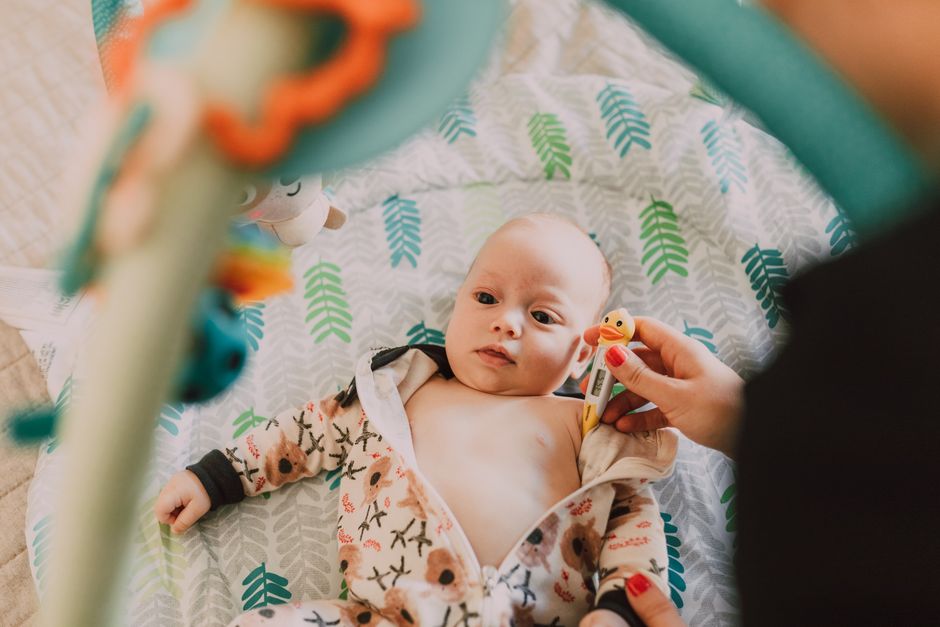
Your baby’s eyes are closed, but their arms and legs keep twitching. Are they awake or asleep? If your baby’s eyes are closed and their body is making small movements, they are almost certainly asleep in what is called active sleep. If their eyes are open, or opening and closing, they are awake. That single detail — whether the eyes are open or closed — is the most reliable way to tell the difference.
New parents often mistake active sleep for waking because the movements look so purposeful. They are not. A sleeping baby can grunt, stretch, smile, and even let out a brief cry without ever surfacing to full wakefulness.
What Is Active Sleep And How Is It Different From Quiet Sleep?
Babies cycle between two main sleep states: active sleep and quiet sleep. Active sleep is the infant version of REM sleep, the stage where dreaming is thought to occur in adults. Quiet sleep is the deeper, stiller stage.
During active sleep, a baby’s brain is highly active. You may see:
- Eyes moving beneath closed lids
- Twitching arms, legs, or face
- Irregular breathing that speeds up and slows down
- Brief smiles, frowns, or sucking motions
- Small grunts, sighs, or a short cry
- Body jerks or startles
Quiet sleep looks very different. Breathing becomes slow and regular. The body is still. The face is relaxed. There is little to no movement. This is the state where a baby is hardest to wake.
Here is the part that surprises many parents: newborns spend roughly half of their total sleep time in active sleep. That is far more than adults spend in REM sleep. As babies grow, the proportion of active sleep gradually drops. By the time a child reaches toddlerhood, sleep architecture looks much closer to an adult’s.
Because active sleep takes up so much of a newborn’s day, you will see it constantly. That is normal. It is not a sign of a sleep problem.
How To Tell If Your Baby Is Awake Or In Active Sleep
The eyes are the clearest signal. Open eyes mean awake. Closed eyes mean asleep. There is very little middle ground in the first few months.
Watch for these signs that your baby is actually awake:
- Eyes open and looking around
- Eyes opening and closing repeatedly
- Focused attention on a face or object
- Rooting toward a nipple or bottle
- Coordinated, deliberate movement
- Body tension that builds rather than fades
And these signs point to active sleep:
- Eyes fully closed, even if moving underneath
- Movements that come and go in bursts
- Movements that stop on their own within seconds
- No response to a face or voice nearby
- Breathing that is irregular but not distressed
One useful test: wait about a minute. Active sleep movements usually fade without intervention. A baby who is truly waking will escalate. Their movements will build, their eyes will open, and they will start to fuss or root.
Why Do Babies Move So Much During Sleep?
Those twitches are not random. Research on infant sleep suggests that these small movements during active sleep may help the developing brain build and refine connections between nerves and muscles. The movements are a normal part of neurological development, not a sign of discomfort.
Active sleep also appears to play a role in how the brain processes new information. In adults, REM sleep is linked to memory consolidation. Something similar is thought to happen in infants, though the exact mechanisms are still being studied.
The irregular breathing that comes with active sleep can alarm parents. Brief pauses and changes in rate are normal during this stage. That said, any pause that lasts longer than 20 seconds, or that comes with a color change, requires immediate medical attention. This is a rare event and should not be confused with the normal breathing variation of active sleep.





Does Active Sleep Mean My Baby Is About To Wake Up?
Not necessarily. Active sleep is a normal stage that babies pass through many times each night. It does not always lead to waking.
That said, active sleep is the stage from which babies most often wake up. If you watch closely, you may notice a pattern: quiet sleep, then active sleep, then either a return to quiet sleep or a full waking. This cycle repeats throughout the night.
Parents often rush to pick up a baby the moment they see movement. In many cases, the baby is still asleep. Picking them up can interrupt the sleep cycle and cause a full waking that would not have happened otherwise. If the eyes are closed and the movements are not escalating, waiting a minute is often the better move.
This is not a rule about sleep training. It is simply an observation about how infant sleep cycles work. Some babies settle back down on their own. Others need help. Both are normal.
What About Newborn Startle Reflexes During Sleep?
Newborns have a startle reflex, also called the Moro reflex. It causes them to throw their arms out and then pull them back in, often followed by a brief cry. This reflex can happen during sleep and can look like waking.
The key difference is duration. A startle during sleep is brief. The baby’s eyes stay closed. The arms return to a relaxed position. Within a few seconds, the baby is still again.
A true waking startle looks different. The eyes open. The cry continues. The body stays tense. The baby does not settle back down without help.
The Moro reflex is present from birth and typically fades by around 4 to 6 months of age. Its presence is a sign of a healthy nervous system. Its absence, or its persistence well beyond 6 months, is something to discuss with a pediatrician.
Can You Always Tell The Difference?
No. Some moments are genuinely ambiguous, especially in the first few weeks. A baby may be in a lighter stage of sleep where they briefly open their eyes, then close them again and drift back down. That is not a full waking.
Premature babies can be even harder to read. Their sleep states are less organized, and the lines between sleep and wakefulness can blur. If you are unsure, watch for a full minute. The pattern usually becomes clear.
It also helps to know your baby’s typical patterns. Some babies are very still sleepers. Others are constantly in motion. Neither is a problem. What matters is whether the baby is getting enough total sleep and whether they are growing and feeding well.
If you are ever concerned about your baby’s breathing, responsiveness, or sleep patterns, contact your pediatrician. Trust your instincts. You know your baby better than any chart or article.
Frequently Asked Questions
Can a baby sleep with their eyes open?
Yes, some babies sleep with their eyes partially open, which is called nocturnal lagophthalmos. It is usually harmless in infants, but mention it to your pediatrician if it happens often or if the eyes look dry.
Why does my baby cry out but stay asleep?
Brief cries during active sleep are common and do not always mean your baby is awake. If their eyes stay closed and the cry fades within a few seconds, they are likely still asleep.
How long does active sleep last in babies?
Active sleep periods typically last around 10 to 20 minutes in newborns, though this varies. They alternate with quiet sleep throughout the night in cycles.
Should I pick up my baby during active sleep?
If their eyes are closed and movements are not escalating, waiting a minute is often better. Picking them up too soon can interrupt sleep and cause a full waking.
