

A punctured lung happens when air leaks into the space between your lung and your chest wall, and the most common signs are sudden sharp chest pain that gets worse when you breathe in, shortness of breath, and a feeling that you cannot get enough air. If you have these symptoms after a chest injury, a medical procedure, or even without an obvious cause, treat it as an emergency and get medical help right away. A punctured lung can become life-threatening quickly, and waiting to see if it improves is not safe.
What Is a Punctured Lung, Exactly?
The medical term for a punctured lung is pneumothorax. It means air has entered the space between your lung and your chest wall — a space that normally holds no air at all.
Your lungs sit inside a sealed cavity lined by two thin membranes called the pleura. Normally, the pressure in that space is slightly negative compared to the air around you. That negative pressure is what keeps your lungs inflated against your chest wall. When air gets into that space, the pressure balance changes, and the lung can partially or fully collapse.
There are several ways this can happen. A broken rib can poke through the lung surface. A stab wound or gunshot wound can tear the chest wall. Sometimes a medical procedure — like placing a central line near the collarbone or a lung biopsy — accidentally lets air in. In other cases, a small blister on the lung surface, called a bleb, bursts on its own with no injury at all. This last type is called a spontaneous pneumothorax, and it tends to happen in tall, thin young men or in people with underlying lung disease like COPD.
Understanding the mechanism matters because it explains the symptoms. Air in the chest cavity pushes against the lung, so breathing becomes harder. That is why shortness of breath is almost always part of the picture.
What Are the First Signs of a Punctured Lung?
The most reliable early sign is sudden, sharp chest pain on one side that worsens when you inhale or cough. Many people describe it as a stabbing sensation rather than a dull ache.
Along with the pain, you may notice:
- Shortness of breath that comes on quickly, even at rest
- A feeling of tightness or pressure in the chest
- Rapid heart rate
- Rapid, shallow breathing
- A dry cough
- Fatigue or feeling faint
The pain is usually one-sided. It does not typically spread to both sides of the chest. Some people feel it in the shoulder or upper back instead of directly over the lung, which can be confusing.
One detail worth knowing: in a spontaneous pneumothorax, symptoms often start when you are at rest, not during exertion. A young person sitting on a couch who suddenly develops sharp chest pain and breathlessness may be experiencing a collapsed lung, not a heart attack. The two can feel similar, and only a doctor can tell them apart.
How Is a Punctured Lung Different From Other Chest Pain?
Chest pain has many causes, and most of them are not a punctured lung. Heart attacks, muscle strains, acid reflux, anxiety, and inflammation around the heart or lungs can all produce chest discomfort. Telling them apart on your own is not realistic. That is a job for a doctor with a stethoscope and an X-ray.
That said, a few patterns point more toward a pneumothorax:
- The pain is sharp and one-sided, not a heavy pressure in the center of the chest
- Breathing in makes it distinctly worse
- Shortness of breath comes on suddenly rather than gradually over days
- There is a recent chest injury, or a recent medical procedure near the chest or neck
Heart attack pain is often described as pressure, squeezing, or heaviness, and it may radiate to the jaw, neck, or left arm. Pneumothorax pain is more often a sharp stab tied to breathing. But these patterns overlap, and some people — especially women and older adults — have atypical heart attack symptoms. When in doubt, call emergency services. Do not try to sort it out yourself.




What Causes a Punctured Lung?
Causes fall into three broad groups: injury, medical procedures, and spontaneous rupture.
Injury is the most obvious. A car accident, a fall, a sports collision, or a stab or gunshot wound can all fracture ribs or tear the chest wall. Rib fractures are a common trigger because a broken rib edge can slice the lung surface.
Medical procedures are a less obvious but real cause. Any needle or instrument placed near the lung or major veins in the chest and neck carries a small risk of letting air into the pleural space. This includes central line placement, lung biopsy, and certain surgeries. Doctors are trained to watch for this, and it is one reason you may be monitored or imaged after these procedures.
Spontaneous pneumothorax happens without any injury. It occurs when a small air blister on the lung surface bursts. It is more common in tall, thin young men and in smokers. It is also more common in people with conditions like COPD, cystic fibrosis, or Marfan syndrome, where the lung tissue is weaker than normal.
In rare cases, a pneumothorax can also happen during scuba diving, high-altitude climbing, or mechanical ventilation, where pressure changes or positive pressure from a breathing machine stresses the lung.
When Does a Punctured Lung Become an Emergency?
A punctured lung becomes life-threatening when it turns into a tension pneumothorax. This is when air keeps entering the chest cavity but cannot escape, building pressure that pushes the lung, the heart, and the major blood vessels out of position.
Signs that a pneumothorax is becoming a tension pneumothorax include:
- Severe shortness of breath that keeps getting worse
- Low blood pressure, dizziness, or fainting
- Bluish lips or fingertips from low oxygen
- Neck veins that look bulging or swollen
- Confusion or agitation
- One side of the chest moving less than the other when breathing
A tension pneumothorax is a medical emergency that requires immediate treatment, usually by inserting a needle or tube to release the trapped air. It can develop within minutes to hours after the initial injury. This is why anyone with a suspected punctured lung should be evaluated in an emergency department, not sent home to “wait and see.”
Even without tension physiology, a large pneumothorax can cause dangerous oxygen levels. Smaller ones may resolve on their own, but only a doctor can determine which is which.
How Do Doctors Diagnose a Punctured Lung?
Doctors diagnose a pneumothorax with a physical exam and imaging. On exam, they listen for breath sounds on each side. A punctured lung often produces quieter or absent breath sounds on the affected side. They may also tap on the chest — a hollow sound can suggest trapped air.
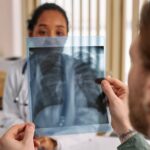
Imaging confirms the diagnosis. A chest X-ray is usually the first test. It can show air in the pleural space and how much the lung has collapsed. In some cases, especially when the X-ray is unclear or the person is unstable, a CT scan gives a more detailed picture. Ultrasound is increasingly used in emergency settings because it is fast and can be done at the bedside.
Doctors also assess how much the lung has collapsed and whether the person is stable. This guides treatment. A small pneumothorax in a stable person may be watched. A large one, or one causing breathing problems, usually needs a procedure to remove the air.
What Does Treatment Look Like?
Treatment depends on the size of the pneumothorax and how stable you are.
For a small pneumothorax in a stable person, doctors may recommend observation with repeat imaging. The body can slowly reabsorb the trapped air over days. Supplemental oxygen may speed this up.
For a larger pneumothorax or one causing symptoms, the standard treatment is to insert a chest tube — a thin tube placed between the ribs to let trapped air escape. This allows the lung to re-expand. The tube stays in for a few days until the air leak seals.
For recurrent spontaneous pneumothorax, surgery may be recommended to seal the leak and prevent future episodes. This is often done with a procedure called video-assisted thoracoscopic surgery.
Recovery time varies. After a chest tube, many people are in the hospital for a few days. Full recovery can take a few weeks. Your doctor will tell you when it is safe to return to normal activities, and that timing depends on your specific case.
One important point: if you have had a spontaneous pneumothorax, your risk of another one is higher than average. Your doctor may advise avoiding scuba diving and, in some cases, flying until cleared. Always follow your own doctor’s guidance rather than general rules.
What Should You Do If You Suspect a Punctured Lung?
Call emergency services or go to an emergency department immediately. Do not drive yourself if you are short of breath or faint. Do not wait to see if it gets better.
While waiting for help, sit upright if that makes breathing easier. Do not try to “pop” or press on your chest. Do not take any medication unless a doctor tells you to.
If you have a known lung condition or have had a pneumothorax before, tell the medical team. That history helps them move faster.
The bottom line: a punctured lung is not something to manage at home. The signs — sudden one-sided chest pain, shortness of breath, rapid heart rate — are your cue to get emergency care. Fast treatment makes a real difference, and the risks of waiting are serious.
Frequently Asked Questions
Can a punctured lung heal on its own?
A small pneumothorax in a stable person can sometimes heal on its own as the body reabsorbs the trapped air. However, only a doctor can determine if it is safe to wait, and larger or worsening cases need treatment.
How quickly do symptoms of a punctured lung appear?
Symptoms usually appear suddenly, often within minutes of the injury or spontaneous rupture. In some cases, they can develop over a few hours, especially after a medical procedure.
Can you have a punctured lung without chest pain?
Yes, some people — especially those with a small pneumothorax — may notice only mild shortness of breath or no pain at all. This is one reason a doctor’s evaluation is important if you have any risk factors.
Is a punctured lung the same as a collapsed lung?
Yes, a punctured lung and a collapsed lung both refer to a pneumothorax, where air in the chest cavity causes the lung to partially or fully collapse. The terms are often used interchangeably.
