
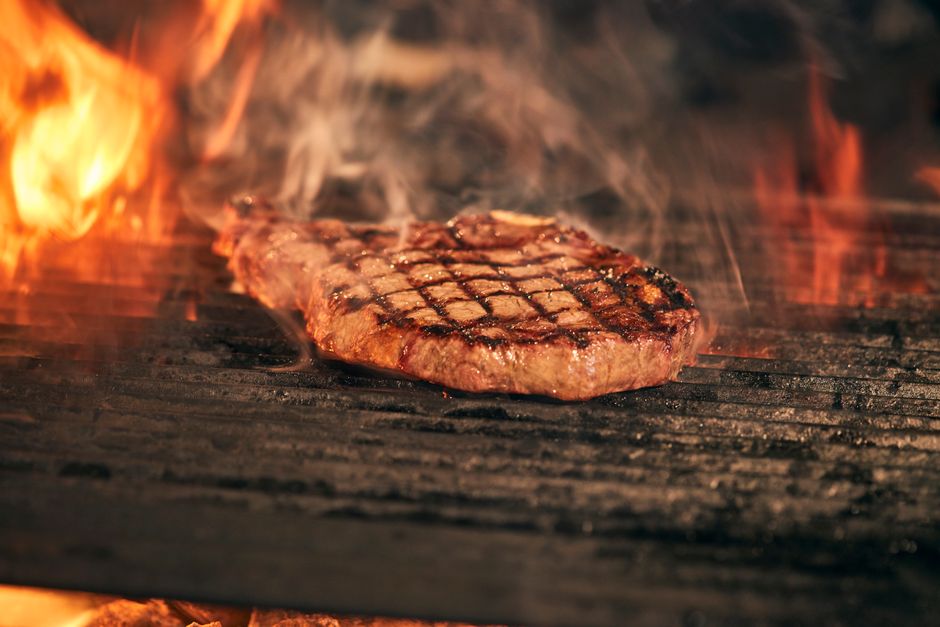
Color is the more reliable signal of the two. A steak that is still deep red or purple in the center and glossy on the surface is undercooked for most people’s preferences, while touch tells you about firmness, which changes with doneness but is easy to misread. The most dependable approach is to use color and texture as your first clues, then confirm with an instant-read thermometer.
How To Tell If Steak Is Undercooked By Touch Or Color
Undercooked steak looks shiny and wet, and the fibers separate easily when you press or pull at them. A properly cooked steak has a matte surface and a center that holds together.
Color shifts as meat cooks because the proteins in muscle tissue change shape when heated. Myoglobin, the pigment that gives raw meat its red color, breaks down as temperature rises. The interior goes from deep purple-red to pink to brownish-gray. This is why the doneness of a steak can be roughly judged by looking at a cut edge.
Touch works on a different principle. As meat cooks, its proteins tighten and squeeze out moisture, so the steak firms up. A raw steak feels soft and squishy. A well-done steak feels stiff. Somewhere in between are the textures people associate with medium-rare and medium.
The problem with touch is that it depends on the thickness of the steak, the cut, and the person doing the pressing. A thin flank steak and a thick ribeye will not feel the same at the same internal temperature. This is why touch is a rough guide at best.
What Does Undercooked Steak Look Like?
An undercooked steak has a wet, glistening surface and a center that is still deep red or purple. When you cut into it, the juices run red rather than pink or clear.
The muscle fibers look soft and slightly translucent. They separate with little resistance. If you press the cut surface with your finger, it feels spongy and gives way easily.
Color is not a perfect gauge either. Lighting changes how red a steak looks. A steak under warm restaurant lighting can appear more done than it is. And some cuts, like those from older animals or certain muscles, carry more myoglobin and stay redder even after cooking.
There is one more wrinkle worth knowing. A phenomenon sometimes called persistent pink color can leave meat looking undercooked even when it is fully cooked. This happens when certain conditions during cooking, such as high heat or exposure to certain gases, lock the pink pigment in place. It is more common in smoked or grilled meats. So color alone can occasionally mislead you in both directions.
What Does Undercooked Steak Feel Like When You Touch It?
An undercooked steak feels soft and yielding, similar to the fleshy part of your palm below the thumb when your hand is relaxed and open. As it cooks, it firms up.
The classic comparison many cooks use is pressing the steak and comparing it to different parts of your hand:
- Relaxed open palm: soft, like a rare steak
- Thumb touching index finger: slightly firmer, like medium-rare
- Thumb touching middle finger: springy, like medium
- Thumb touching ring finger: firm, like medium-well
- Thumb touching pinky: very firm, like well-done
This hand method is popular, but it has real limits. Your hand’s firmness depends on your own muscle tone, and the comparison ignores steak thickness entirely. A thick cut can feel firm on the outside while the center is still raw. Treat the hand test as a starting point, not a final answer.





Why Touch and Color Are Not Fully Reliable
Both touch and color are indirect signals. They tell you something about how the steak is cooking, but neither measures the actual temperature inside the meat.
Color depends on myoglobin, and myoglobin levels vary by animal, cut, and even the specific muscle. Two steaks cooked identically can look different. Cooking method matters too. A steak seared hard on the outside can look brown and done on the surface while the inside is still cool and red.
Touch depends on firmness, and firmness is affected by thickness, fat content, and the cut of meat. A well-marbled ribeye and a lean sirloin will not feel the same at the same internal temperature. The fat in a ribeye stays soft even when the meat around it is cooking through.
Neither method tells you whether harmful bacteria have been killed, either. That is a separate question that only temperature can answer.
How Do You Confirm Doneness Accurately?
An instant-read thermometer is the only reliable way to know if a steak is cooked to your liking and to a safe temperature. Insert the probe into the thickest part of the steak, avoiding bone and fat, and wait for the reading to stabilize.
Internal temperature corresponds to doneness. These ranges are widely used in cooking and food safety guidance:
| Doneness | Internal Temperature | Center Color |
|---|---|---|
| Rare | 120-125°F (49-52°C) | Cool red center |
| Medium-rare | 130-135°F (54-57°C) | Warm red center |
| Medium | 140-145°F (60-63°C) | Warm pink center |
| Medium-well | 150-155°F (66-68°C) | Slightly pink center |
| Well-done | 160°F and above (71°C+) | Brown throughout |
Remember that meat continues to cook after you remove it from the heat. This is called carryover cooking. The internal temperature can rise another 5 to 10 degrees Fahrenheit while the steak rests. If you want a final temperature of 130°F, pull it off the heat closer to 125°F.
For food safety, the USDA recommends cooking whole cuts of beef to a minimum internal temperature of 145°F (63°C) followed by a three-minute rest. This is the temperature at which harmful bacteria are killed. Whole cuts like steaks are generally considered safe at lower temperatures on the inside because bacteria live on the surface, not inside the muscle — unless the meat has been mechanically tenderized or injected, in which case the USDA recommends cooking to 145°F throughout with no lower exception.
Is It Safe to Eat Undercooked Steak?
Whole cuts of beef are different from ground beef. On a whole steak, bacteria like E. coli and Salmonella sit on the surface, where high heat from searing kills them quickly. That is why a steak can be safely eaten rare on the inside while the outside is well seared.
Ground beef is a different story. When meat is ground, surface bacteria get mixed throughout. That is why ground beef should be cooked to 160°F (71°C) and why eating a rare hamburger carries more risk than eating a rare steak.
There are exceptions for whole cuts too. If a steak has been mechanically tenderized, needled, or injected with marinade, bacteria can be pushed into the interior. Those cuts should be cooked to 145°F throughout. Some people are also at higher risk from foodborne illness, including young children, older adults, pregnant women, and people with weakened immune systems. For these groups, the safer choice is to cook steak to at least 145°F.
The honest position is this: eating a rare or medium-rare whole steak is a common practice and generally considered low risk for healthy adults when the surface is properly seared. But low risk is not zero risk, and the only way to eliminate the risk of foodborne bacteria is to cook the meat to a safe internal temperature throughout.
What About the Resting Period?
Resting a steak after cooking does two things. It lets the juices redistribute so they do not run out when you cut, and it allows carryover cooking to finish the job.
A rest of about five minutes is typical for a steak. Thicker cuts benefit from a longer rest. During this time, the internal temperature continues to climb, which means a steak that looked slightly underdone when it came off the heat may be just right by the time you slice it.
This is another reason touch and color can fool you. A steak pulled from the pan at 125°F may read 130°F or higher after resting. If you judged it as undercooked and put it back on the heat, you may end up overcooking it.
Frequently Asked Questions
Is a red center always a sign the steak is undercooked?
No. A red or pink center can persist even in fully cooked meat due to a phenomenon called persistent pink color, especially in grilled or smoked cuts. Color is a clue, not proof, so use a thermometer to confirm.
Can you tell if steak is done just by touching it?
Touch gives you a rough idea of firmness, which rises as meat cooks, but it is unreliable because thickness, cut, and fat content all change how a steak feels. A thermometer is the only accurate way to confirm doneness.
What temperature is steak safe to eat?
The USDA recommends cooking whole cuts of beef to a minimum internal temperature of 145°F (63°C) with a three-minute rest. Whole steaks are often eaten at lower internal temperatures because bacteria live on the surface, but mechanically tenderized or injected cuts should reach 145°F throughout.
Why does my steak look undercooked but the thermometer says it is done?
Myoglobin can stay red even after the meat reaches a safe temperature, so appearance and actual doneness do not always match. Trust the thermometer reading over the color of the center.
