
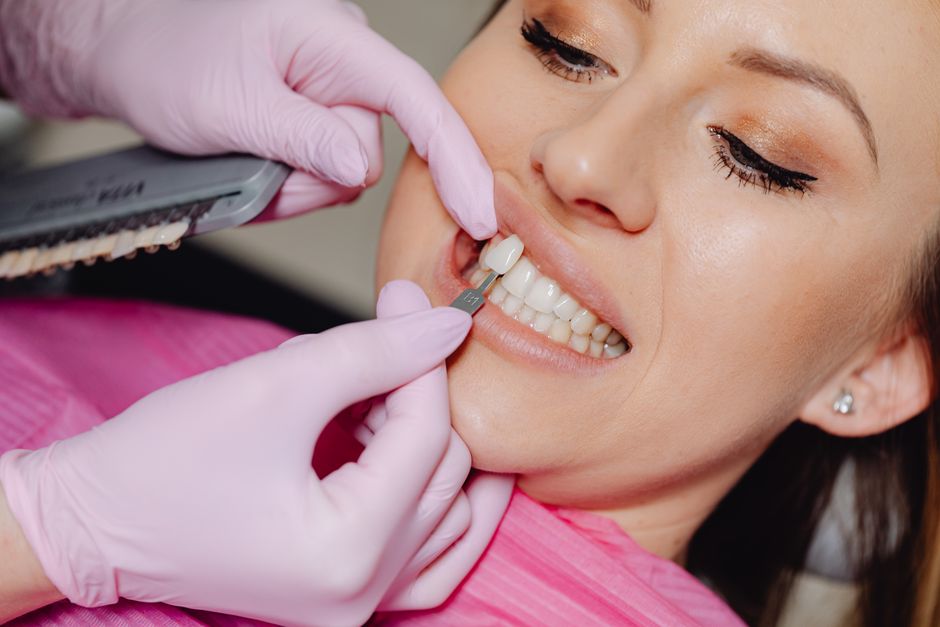
You can often tell someone has veneers by looking closely at the teeth. The most reliable signs are unnaturally uniform shape and color across all front teeth, teeth that look slightly too thick or bulky at the edges, and a gum line that looks opaque or pushed back rather than natural. Other clues include no visible wear on teeth that should show it, a slightly gray or opaque look where the veneer meets the gum, and front teeth that seem to sit slightly forward of the others.
None of these signs is proof on its own. Modern veneers can look remarkably natural, and a skilled dentist can make them very hard to spot. But when several of these clues show up together, the odds go up.
What Are Dental Veneers Made Of?
Veneers are thin shells bonded to the front surface of teeth. Most are made of either porcelain or a composite resin material.
Porcelain veneers are custom-made in a dental lab from a digital or physical mold of your teeth. They are typically about 0.3 to 0.5 millimeters thick, though this varies. Composite resin veneers can be built up directly on the tooth in a single visit or made in a lab.
The material matters for spotting them. Porcelain is translucent in a way that mimics natural enamel, but it does not change over time the way enamel does. Natural teeth darken and wear slowly with age. Porcelain does not. That difference is one of the biggest giveaways.
Composite resin tends to stain and wear more like natural teeth, which can make it harder to tell apart. It also tends to look slightly less lifelike up close under certain lighting.
How To Tell If Someone Has Veneers: 8 Signs
These are the clues dentists and observant people tend to notice. Each one alone means little. Several together are more telling.
1. Teeth That Are Too Uniform
Natural teeth are never perfectly matched. Even in people with healthy, attractive smiles, there are small differences in shade, shape, and size from tooth to tooth. Veneers are often made as a set, so they can look almost identical across all the front teeth.
If every front tooth has the exact same shape and color with no variation, that is a common sign.
2. No Wear on Teeth That Should Show It
Natural teeth wear down over decades. The biting edges of front teeth usually show some flattening, small chips, or slight unevenness by middle age. Veneers cover the front surface and restore a fresh edge.
If someone in their 50s or 60s has front teeth with perfectly crisp, unworn edges, veneers are one possible explanation.
3. A Slightly Bulky or Thick Look
Veneers add a thin layer of material to the front of the tooth. Done well, this is barely noticeable. Done less well, or when the underlying tooth was not reduced enough, the teeth can look slightly puffy or prominent.
You might notice this most in profile. The front teeth can appear to sit a little forward, or the surface can look flatter and less curved than natural enamel.
4. An Opaque or Chalky Appearance
Natural enamel has depth. Light passes into it and reflects back in a way that gives teeth a subtle inner glow. Porcelain can mimic this, but cheaper or thicker veneers sometimes look flat and opaque, almost chalky, especially under bright light.
This is one of the harder signs to describe but one of the easier ones to notice once you know what to look for.
5. A Visible Line or Ridge at the Gum Line
Where the veneer meets the gum, there can sometimes be a slight ledge or step. This happens when the veneer is thicker than the natural tooth surface or when the margin is not perfectly blended.
You may see a faint line, a slight shadow, or a tiny ridge right at the gum line. This is more common with older or thicker veneers.
6. Gums That Look Slightly Pushed Back or Irritated
Sometimes the edge of a veneer sits slightly under the gum or presses against it. This can cause mild gum inflammation or recession over time. The gum tissue may look a little redder or more receded right at the margin of the tooth.
This is not always a sign of a problem. Some people with veneers have perfectly healthy gums. But visible gum changes at the margin are worth noting.
7. Color That Does Not Match the Back Teeth
Veneers usually cover only the front teeth. The back teeth are often left natural. If the front teeth are a bright, even white and the back teeth are a more natural, slightly darker shade, that contrast can be a clue.
Natural teeth usually have a gradual shift in shade from front to back. A sharp difference is more common with veneers.
8. A Very Bright, Even White
Many people choose veneers specifically to get a brighter smile. A very uniform, bright white shade across all front teeth is one of the most common cosmetic goals.
That does not mean bright white teeth are always veneers. Whitening can achieve similar results. But a shade that looks almost too perfect, with no natural variation, is a frequent sign.
Can You Always Tell Veneers Apart From Natural Teeth?
No. Modern porcelain veneers can be very difficult to spot, especially when placed by an experienced dentist who matches the shade, translucency, and shape to the person’s face and remaining teeth.
High-quality veneers are designed to look natural. They can have subtle variations in color, slight translucency at the edges, and a shape that fits the person’s smile. When done well, even a dentist may need to look closely to tell.
The signs above are more reliable when veneers are older, thicker, or less carefully matched. They are less reliable with newer, well-made veneers.
What Veneers Cannot Hide
Veneers cover the front surface of the tooth. They do not change the position of the tooth root or the way the teeth bite together. They also do not change the color of the gums or the back teeth.
If someone has had significant orthodontic work or gum treatment, veneers may be part of a larger cosmetic plan. The veneers themselves are only one piece.
It is also worth knowing that veneers are not reversible in the usual sense. Most porcelain veneers require removing a small amount of enamel first. That enamel does not grow back. This is why the decision to get veneers is a long-term one, and why dentists generally do not recommend them for very young patients whose teeth and gums are still changing.
Why People Get Veneers
People choose veneers for many reasons. Some want to fix chipped, worn, or uneven teeth. Others want to close small gaps or cover deep stains that whitening cannot remove. Some want a more uniform smile for personal or professional reasons.
Veneers are a cosmetic treatment. They are not a medical necessity in most cases. That does not make them frivolous. A person’s reasons for wanting them are their own.
What matters is that the decision is made with a dentist who explains the trade-offs honestly. Veneers require the same daily care as natural teeth, and they can chip or come loose. They also typically need to be replaced eventually, though how long they last varies widely depending on material, care, and the individual.
How to Look Without Being Rude
Most people do not want to be examined. If you are simply curious, the easiest approach is to notice these signs in passing rather than staring.
Good lighting helps. Natural daylight shows translucency and surface texture better than indoor light. Looking at someone from the side can reveal thickness and how the front teeth sit relative to the others.
And keep in mind that none of these signs is definitive. A person with very uniform, bright teeth may simply have good genes, good dental care, or a history of whitening. Veneers are one explanation among several.
Frequently Asked Questions
Can you tell if someone has veneers just by looking?
Sometimes, but not always. Signs like uniform shape, no wear, and a visible gum line can suggest veneers, but high-quality veneers can look very natural.
Do veneers look fake?
They can if they are too thick, too opaque, or too uniform in color. Well-made veneers are designed to mimic natural enamel and are often hard to spot.
What is the most obvious sign of veneers?
Teeth that are perfectly uniform in shape and color with no natural wear are a common clue. A visible line or ridge at the gum line is another.
Can veneers be removed?
They can be removed, but most porcelain veneers require some enamel removal first, and enamel does not grow back. This makes veneers a long-term commitment rather than a reversible one.
