
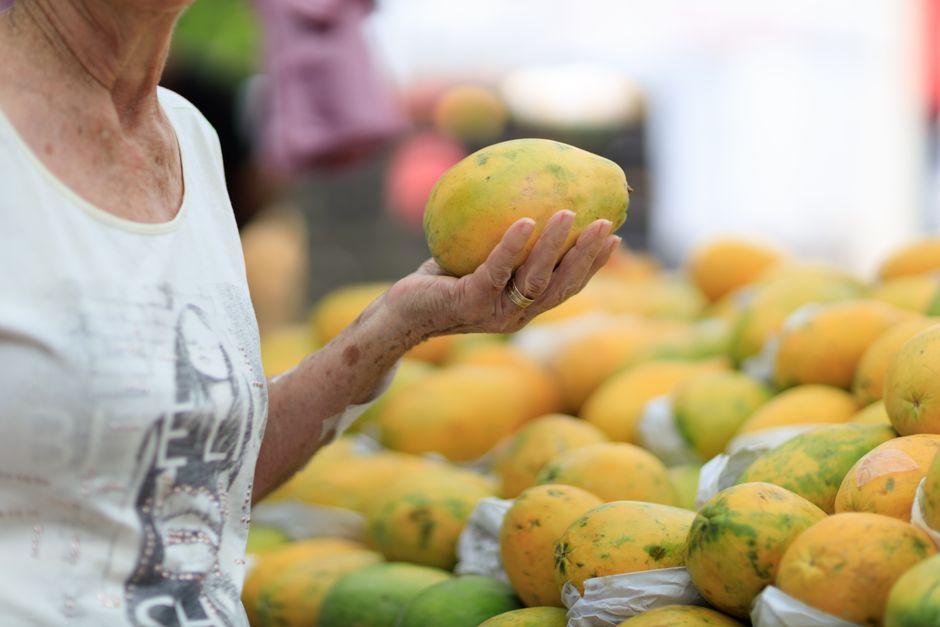
A Keitt mango is ripe when it gives slightly under firm thumb pressure near the stem end, smells sweet and fruity at the stem, and has full, rounded shoulders instead of a narrow, flat profile. Color tells you almost nothing with this variety. Keitt mangoes stay green or green-yellow even when fully ripe, and some develop only a faint blush of pink or red on one side.
That single fact trips up a lot of shoppers. Most mango varieties turn yellow, orange, or red as they ripen, so people wait for a Keitt to change color. It won’t. Judging a Keitt by skin color means you either eat it hard and starchy or leave it on the counter until it rots. The reliable signals are feel, smell, and shape.
Why Do Keitt Mangoes Stay Green When Ripe?
Skin color and ripeness are separate processes in mangoes. The green pigment in the skin, chlorophyll, breaks down during ripening in most varieties, which lets yellow and red pigments show through. In Keitt mangoes, chlorophyll stays largely intact even as the fruit softens and the sugars develop inside.
Keitt is a late-season variety, and it was selected and propagated for that trait. Growers and breeders valued its large fruit, small seed, and long harvest window. The green skin is simply part of how this variety ripens. It is not a sign of immaturity, and it is not a defect.
This matters because the inside of a ripe Keitt is not green. The flesh turns a deep golden-orange, soft, and very juicy. The skin stays green while the flesh underneath is fully ready. If you cut a Keitt and the flesh is pale yellow and firm, the fruit needed more time — but the skin color alone would never have told you that.
How To Tell If A Keitt Mango Is Ripe It Stays Green?
Use your hands and your nose, not your eyes. The three reliable signs are gentle give under pressure, a sweet smell at the stem, and a filled-out shape. Each one reflects a real change happening inside the fruit as starch converts to sugar and cell walls soften.
The squeeze test
Hold the mango in your palm and press gently with your thumb near the stem end, where the fruit meets the stem. A ripe Keitt yields slightly — it feels like a ripe avocado or a soft peach, with a little spring. An unripe one feels hard as a stone. An overripe one feels mushy or leaves a dent that stays.
Press in more than one spot. Mangoes ripen unevenly, and a fruit can be soft on one side and firm on the other. If only one small area gives, it is not ready. If the whole fruit feels uniformly soft, it is likely past its best.
The smell test
Bring the stem end close to your nose and sniff. A ripe Keitt smells sweet, fruity, and slightly floral — like mango, unmistakably. An unripe one smells green or faintly like cut grass. An overripe one smells fermented or boozy, which means it has started to turn.
The stem end is where the aroma compounds concentrate, so that is where the smell is strongest. If you smell nothing at all, give it another day or two.
The shape and stem test
A ripening Keitt fills out. The shoulders — the wider part near the stem — become rounder and fuller rather than narrow and flat. Look at the small stem scar at the top. On a ripening fruit it looks slightly sunken and the skin around it may wrinkle a little. A hard green stem that sits proud of the fruit usually means unripe.
You may also see a few dark speckles or lenticels on the skin. Small speckling is normal and not a sign of spoilage. Large dark sunken patches, soft brown spots, or mold are different and mean the fruit is going bad.
What About The Color? Does Any Color Change Matter?
Color is a weak signal in Keitt, but it is not entirely meaningless. A fully green Keitt can be perfectly ripe, and a Keitt with a pink or red blush can still be hard. The blush develops on the side that faced the sun and reflects light exposure, not ripeness.
What color can tell you is a rough stage. A Keitt that is deep, dark green and rock hard is almost certainly immature. One that has lightened to a yellowish-green, especially near the stem, is further along. But you cannot use color to decide whether to eat it today. Only feel and smell can do that.
This is the part that surprises people most: two Keitt mangoes sitting side by side, one bright green and one with a red blush, can be at exactly the same stage of ripeness. The blush is cosmetic.
How Do You Ripen A Keitt Mango At Home?
Keitt mangoes are often sold firm because they ship better that way. If yours is hard and unscented, leave it at room temperature on the counter. Do not refrigerate it yet. Cold slows ripening and can cause chilling injury in an unripe mango, which shows up as grayish, watery flesh that never develops proper flavor.
To speed things up, put the mango in a paper bag and fold the top loosely. The bag traps ethylene, the natural plant hormone that drives ripening. Adding a ripe banana or apple to the bag raises ethylene further. Check it daily with the squeeze and smell tests.
Ripening usually takes a few days at room temperature, but timing varies with how mature the fruit was when picked and how warm your kitchen is. Once the mango gives slightly and smells sweet, it is ready. At that point you can move it to the refrigerator to hold it for a few more days — refrigeration slows further ripening in an already-ripe mango.
How Should You Store And Cut A Ripe Keitt?
Once ripe, a Keitt keeps in the refrigerator for several days. The flesh may darken slightly and soften more, but the flavor holds. Cut it before it starts to smell fermented or develops soft brown patches.
Keitt mangoes are large and have a thin, flat seed, which makes them easier to cut than many varieties. Stand the fruit on its side and slice down along either side of the seed to get two big cheeks. Score the flesh in a grid without cutting through the skin, then press the skin to turn the cubes outward. Trim the remaining flesh from around the seed.
The skin of a Keitt is edible but can be slightly bitter and fibrous. Most people scoop the flesh and leave the skin. The flesh near the seed is often the sweetest and most fibrous part.
What Are Common Mistakes When Judging Keitt Ripeness?
The biggest mistake is waiting for the skin to turn yellow or orange. It won’t, and by the time you give up waiting, the fruit may be overripe. Judge by touch and smell instead.
Other common errors:
- Refrigerating too early. A hard, unripe Keitt stored cold may never ripen properly and can develop watery, off-flavored flesh.
- Pressing too hard. A firm thumb press bruises the flesh under the skin. Use light pressure, and press in several spots.
- Trusting the label alone. A sticker saying “ripe” is a shipping category, not a guarantee. Always check with your hands and nose.
- Mistaking small speckles for spoilage. Light speckling on the skin is normal. Soft, sunken, or moldy patches are not.
One more point worth knowing: a Keitt that is soft but smells flat or sour is not ripe — it is decaying. Softness without sweetness is a warning sign, not a green light.
Frequently Asked Questions
Can a Keitt mango be ripe while still completely green?
Yes. Keitt mangoes often stay green or green-yellow even when fully ripe, and some never develop any blush. Judge ripeness by gentle give under pressure and a sweet smell at the stem, not by skin color.
How long does it take for a Keitt mango to ripen on the counter?
Usually a few days at room temperature, though timing depends on how mature the fruit was when picked and how warm your kitchen is. A paper bag with a ripe banana can speed it up, and checking daily with the squeeze and smell tests is the safest approach.
Should I put a Keitt mango in the fridge to ripen it?
No. Refrigeration slows ripening and can cause chilling injury in an unripe mango, so ripen it at room temperature first. Once it gives slightly and smells sweet, you can refrigerate it to hold it for a few more days.
What does a ripe Keitt mango smell like?
It smells sweet, fruity, and slightly floral at the stem end. A green or grassy smell means it is unripe, while a fermented or boozy smell means it is overripe.
