
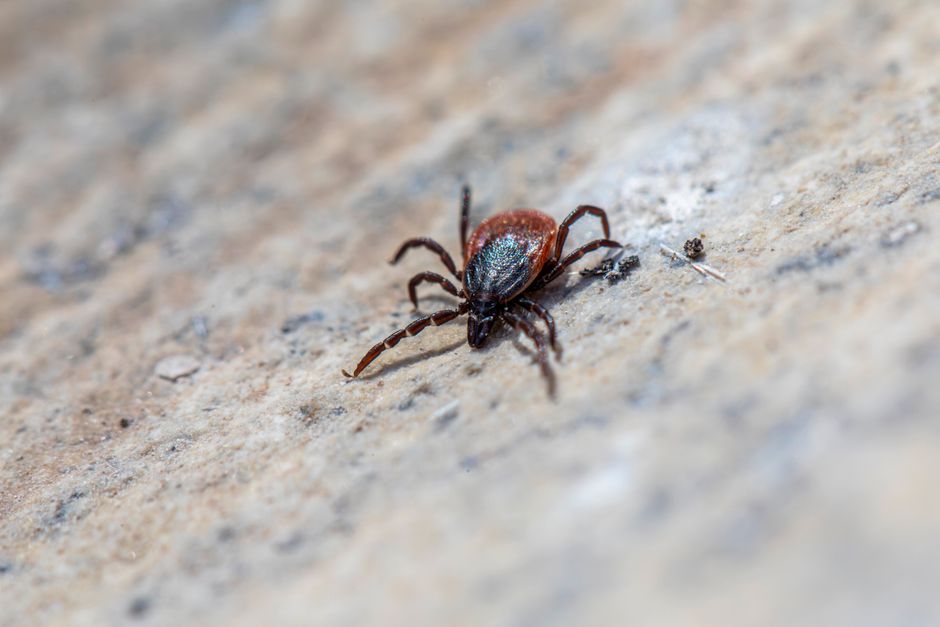
There is no reliable way to tell exactly how long a tick has been attached. The most useful clue is the tick’s own body — an unfed tick is flat and small, while a tick that has been feeding for a day or more becomes visibly engorged as it swells with blood. The problem is that this only gives you a rough range, not a precise clock, and the tick’s species and life stage change the picture too.
That matters because attachment time is one of the factors tied to disease transmission. For Lyme disease specifically, the bacterium that causes it usually needs a tick to stay attached for a while before it can move into the human body. So people understandably want a number. The honest answer is that you can estimate, but you cannot know for certain.
How To Tell How Long A Tick Has Been Attached?
You estimate attachment time by looking at how engorged the tick is. A tick that just attached is flat, dark, and small — often no bigger than a sesame seed or a poppy seed, depending on whether it is a nymph or an adult. As it feeds, its body expands. After roughly a day of feeding, it starts to look noticeably plump. After several days, it can swell to many times its original size and take on a grayish or greenish color.
This swelling is the single best visual indicator you have. But it is a range, not an exact measurement. Two ticks of the same species can look different at the same number of hours depending on temperature, how much blood they have taken, and their life stage.
The size of the tick when you find it tells you more than any other single clue. A tiny, flat tick likely attached recently. A large, round, engorged tick has been feeding for a longer period.
Why the exact number is impossible
Ticks do not leave a timestamp. There is no marker on your skin that records when the bite began. Most people never feel the bite at all, because tick saliva contains compounds that numb the area and prevent itching during feeding. So the moment of attachment usually goes unnoticed.
What you can do is work backward from what you see. If the tick is flat, it probably attached within the last several hours to a day. If it is partly engorged, it has likely been feeding for a day or more. If it is fully engorged, it may have been attached for several days. These are general patterns, not guarantees.
What Does an Engorged Tick Look Like at Each Stage?
The change in a tick’s appearance as it feeds is gradual and fairly predictable in its sequence, even if the timing varies. Here is what you can generally expect to observe.
- Just attached: flat, thin, and dark. Roughly the size of a poppy seed (nymph) or a sesame seed (adult).
- Partially fed: beginning to look plump and rounded. The body is no longer flat.
- Fully engorged: swollen to many times its original size, often resembling a small grape or bean. Color may shift to gray, green, or a pale brown.
The color change is worth noting because it surprises people. A fully engorged tick often does not look like the flat black or brown tick they expect. It can look like a different creature entirely.
One clarification that catches many people off guard: the tick’s size reflects how much blood it has taken, and that is not a perfect proxy for time. A tick that has fed efficiently for two days might look similar to one that has fed more slowly for three. The relationship between size and hours is real but loose.
Why Attachment Time Matters for Disease Risk
Attachment time matters because of how certain tick-borne pathogens move through the tick’s body. For Lyme disease, the bacterium that causes it — Borrelia burgdorferi — typically resides in the tick’s midgut. When the tick begins feeding, the bacterium must travel to the salivary glands before it can be passed into the host. That process takes time.
This is why the general guidance has long been that a tick needs to be attached for a prolonged period before Lyme transmission becomes likely. Estimates commonly cited in public health education place the meaningful risk window at roughly 24 to 48 hours or longer for the bacterium to migrate and be transmitted. A tick removed within the first day or so is generally considered to pose a much lower risk for Lyme specifically.
Two important caveats. First, this timeline is specific to Lyme disease and does not apply equally to all tick-borne illnesses. Some pathogens can be transmitted much faster. Certain other organisms carried by ticks can move into the host within a shorter window, and some tick-borne conditions have been transmitted in a matter of hours in documented cases. So “remove it within 24 hours and you are fine” is not a universal rule.
Second, the 24-to-48-hour figure is a general estimate drawn from research and public health guidance, not a hard cutoff. Transmission risk rises with time but does not jump from zero to certain at a specific hour. If you find an engorged tick, the right move is to remove it and pay attention to your health in the following weeks, regardless of how long you think it was attached.





How Should You Remove a Tick Once You Find It?
Remove the tick as soon as you find it. The method matters more than the timing of your discovery.
Use fine-tipped tweezers. Grasp the tick as close to your skin as possible, as near to the head or mouthparts as you can get. Pull upward with steady, even pressure. Do not twist or jerk, which can cause the mouthparts to break off and stay in the skin.
Do not use folk remedies. Do not apply petroleum jelly, nail polish, rubbing alcohol, or a hot match. Do not try to burn the tick off. These approaches are not supported by evidence, and some of them can cause the tick to regurgitate its stomach contents into the bite, which may increase the chance of transmitting pathogens.
After removal, clean the bite area and your hands with rubbing alcohol, an iodine scrub, or soap and water. If you want to keep the tick, place it in a sealed container or a small amount of alcohol. Some public health departments and labs accept tick submissions for identification and testing, though this varies by location.
If you develop a rash, fever, or feel unwell in the weeks after a bite, contact a healthcare provider and tell them about the tick. A rash that expands over days, sometimes forming a ring pattern, is worth showing to a clinician.
What Factors Change How Fast a Tick Feeds?
Several things influence how quickly a tick becomes engorged, which is part of why the visual estimate is imperfect.
- Life stage: nymphs are much smaller than adult ticks, so a fed nymph may still look small even after feeding for a while.
- Species: different tick species feed at different rates and reach different engorged sizes.
- Temperature and environment: feeding behavior can vary with conditions.
- How long it has actually been attached: the obvious one, and the one you are trying to estimate.
Because of these variables, two people can find ticks that look completely different yet have been attached for a similar amount of time. The visual method is a rough guide, not a measurement.
Can You Prevent Ticks From Attaching in the First Place?
Reducing the chance of a bite is more reliable than trying to guess attachment time after the fact. Ticks live in grassy, brushy, and wooded areas, and they tend to wait on vegetation for a host to brush past.
Practical steps include wearing long sleeves and pants in tick habitat, tucking pants into socks, using an EPA-registered insect repellent, and checking your body carefully after being outdoors. Showering soon after coming inside can help you find ticks before they settle in. Checking pets matters too, since they can carry ticks indoors.
Knowing where ticks tend to attach helps with the body check. They often seek out warm, hidden areas — behind the knees, in the armpits, in the groin area, along the hairline, and behind the ears. A careful full-body check after time outdoors is the most dependable way to catch a tick early.
One clarification worth keeping in mind: a tick that has not yet attached cannot transmit anything. Finding and removing a crawling tick before it settles in carries no disease risk from that tick.
When Should You Talk to a Doctor?
Contact a healthcare provider if you develop symptoms after a tick bite. Watch for a rash that grows over several days, fever, chills, fatigue, headache, muscle aches, or joint pain in the weeks following a bite. These symptoms can overlap with many other conditions, which is why telling your provider about the tick exposure is important.
You do not need to wait for symptoms to ask a question. If you are unsure whether you were bitten, or if you removed an engorged tick and want guidance, a clinician can help you decide on next steps. Testing and treatment decisions are best made with a medical professional who knows your situation.
Frequently Asked Questions
How can you tell if a tick has been attached for 24 hours?
A tick attached for about a day usually looks partly engorged — no longer flat, but plump and rounded. There is no way to confirm the exact number of hours, so this is a rough visual estimate rather than a precise measure.
Does a flat tick mean it just attached?
A flat tick likely attached recently, often within hours. However, a nymph can stay relatively small even after feeding, so a flat appearance is not a guaranteed sign of a fresh bite.
How long does a tick need to be attached to transmit Lyme disease?
Public health guidance generally places the meaningful risk window for Lyme transmission at roughly 24 to 48 hours or longer. This estimate applies to Lyme specifically and does not apply equally to all tick-borne illnesses.
What should you do if you find an engorged tick?
Remove it right away with fine-tipped tweezers, pulling steadily upward close to the skin, then clean the area. Watch for symptoms over the following weeks and contact a healthcare provider if any appear.
