
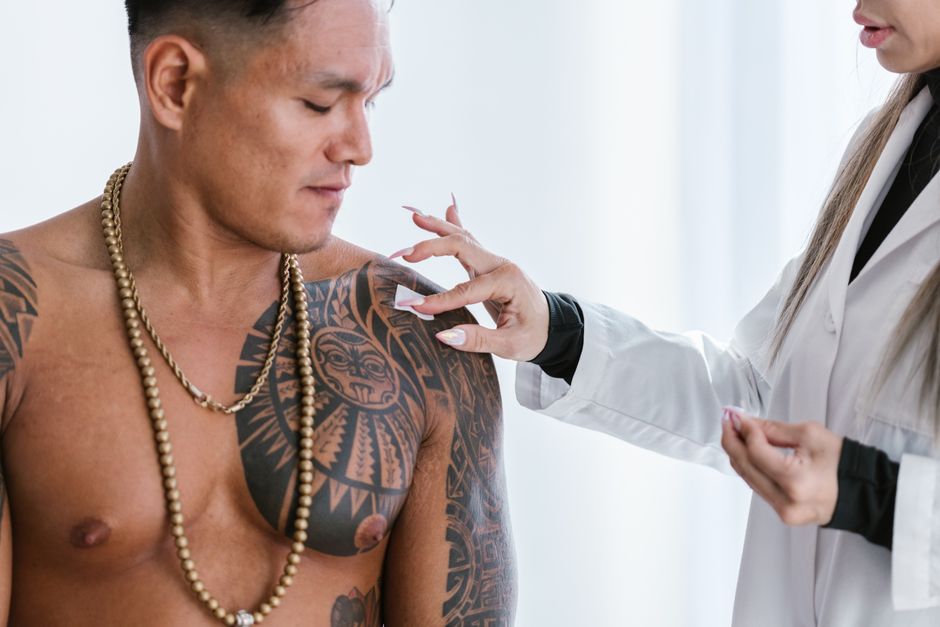
Getting rid of a tattoo is a medical procedure, not a cosmetic errand. No cream, scrub, or home remedy removes tattoo ink. Professional laser removal is the only method with consistent evidence behind it, and it works by breaking ink particles into fragments small enough for your immune system to clear. Complete removal usually takes several sessions spread over months, and results vary by ink color, skin tone, and how old the tattoo is.
How To Take Out Tattoo: What Actually Works
Q-switched and picosecond lasers are the standard of care for tattoo removal. Both deliver very short pulses of light that the ink absorbs. That energy shatters large ink particles into tiny ones, which the body’s immune cells then carry away over weeks.
The key variable is wavelength. Different lasers target different colors because each color absorbs light at different wavelengths. Black ink responds to the widest range of lasers and is generally the easiest to remove. Green, blue, and yellow inks are harder because fewer wavelengths target them well. Some clinics use multiple lasers on a single tattoo for this reason.
Picosecond lasers use pulses measured in trillionths of a second. Some studies suggest they clear ink in fewer sessions than older nanosecond devices, but the evidence is not uniform across all tattoo types. Many dermatologists now prefer them, though the difference in outcomes is not dramatic for every tattoo.
What about surgical removal?
Small tattoos can be cut out and closed with stitches. This is a real option, but it leaves a surgical scar and only works for tattoos small enough to close without tension. It is not practical for large pieces.
Dermabrasion and chemical peels were used historically. Both damage skin significantly and carry scarring risk. They have largely been abandoned in favor of lasers.
Why Home Remedies and Removal Creams Do Not Work
Tattoo ink sits in the dermis, the layer of skin beneath the surface. That is the whole problem for anything you apply to the outside of your skin. Creams, ointments, and salves do not penetrate deep enough to reach the ink, and even if they did, they have no mechanism to break ink particles apart.
No clinical evidence confirms that any topical product removes a tattoo. Products marketed for this purpose are not regulated as treatments and have not been shown to work in controlled studies.
Home methods carry real risk. Salabrasion, which means rubbing the skin with salt, and similar abrasive techniques damage tissue and invite infection and scarring. Acid-based products sold online have caused chemical burns. The FDA has warned about tattoo removal creams and home kits that make unsupported claims.
There is one thing worth understanding about how tattoos fade on their own. Your immune system is already slowly clearing ink — that is why old tattoos look softer. Laser treatment accelerates a process your body already runs. Nothing you rub on your skin can do that.
How Many Sessions Will You Need?
Most tattoos need multiple sessions, and the range is wide. Professional tattoos often require somewhere between six and twelve sessions, though some clear faster and some take considerably longer. Amateur tattoos tend to clear in fewer sessions because the ink is usually less dense and sits shallower.
Several factors push the number up or down:
- Ink color: black clears most reliably; green, blue, and yellow are harder
- Ink density: heavily saturated tattoos take longer
- Age of tattoo: older tattoos have already faded somewhat and often respond faster
- Location: tattoos on the torso and arms tend to clear better than those on fingers, toes, and ankles, where circulation is lower
- Skin tone: darker skin needs careful laser selection to avoid pigment changes
- Scarring: tattoos with existing scar tissue may not clear completely
Sessions are typically spaced several weeks apart. The gap is not arbitrary — your immune system needs time to clear the fragments the laser just created. Treating again too soon adds risk without adding benefit.
Does Laser Tattoo Removal Hurt?
Most people describe it as similar to a rubber band snapping against the skin. It is uncomfortable but brief. Each laser pulse lasts a fraction of a second.
Clinics commonly use local numbing cream or injections for larger or more sensitive tattoos. Cooling devices during treatment are also standard. Most people tolerate the procedure without sedation.
Expect some swelling, redness, and tenderness afterward. Blistering can occur and is generally not a sign of a problem, though it should be reported to your clinician. Most people return to normal activity quickly, but the treated area needs sun protection while it heals.
Risks and Side Effects You Should Know
Laser tattoo removal is generally safe when performed by a trained clinician, but it is not risk-free.
The most common concerns are pigment changes. Hypopigmentation means the skin lightens in the treated area. Hyperpigmentation means it darkens. Both can occur, and darker skin tones carry a higher risk when the wrong laser or settings are used. Many cases improve over time, but some are long-lasting.
Scarring is possible, particularly with aggressive settings, repeated treatments in a short window, or a history of keloid scarring. Infection is uncommon but possible if wounds are not kept clean.
There is also a less obvious risk worth knowing. Some inks contain substances that can trigger an allergic reaction when the laser breaks them up. Reactions to red ink in particular are documented. If you have ever had a reaction to a tattoo, tell your clinician before treatment.
People who are pregnant, breastfeeding, or taking medications that affect healing or light sensitivity should discuss timing with a clinician. Guidance here is individualized rather than standardized, so no general rule applies to everyone.
Choosing a Provider: What to Look For
Laser tattoo removal is a medical procedure, and it belongs in a medical setting. Dermatology practices and dedicated laser clinics with physician oversight are the safest bet. Walk-in studios offering cheap removal with unclear credentials are a risk to your skin.
Ask direct questions before booking:
- Who performs the treatment, and what is their training?
- Which laser or lasers do you use, and why that one for my tattoo?
- How do you adjust settings for my skin tone?
- What is your experience treating my ink colors?
- What do you charge per session, and is a consultation included?
Cost matters, but the cheapest option is often the most expensive in the end. Poor settings can cause scarring or fail to clear ink, and fixing that is harder than doing it right the first time. A patch test on a small area is a reasonable request before committing to a full course.
Can a Tattoo Be Fully Removed?
Complete removal is achievable for many tattoos, but not all. Black ink on lighter skin has the best odds. Multicolored tattoos, very dense ink, and tattoos over scar tissue are less predictable.
Many people reach a point where the tattoo is faint enough to be effectively invisible or easily covered. Others choose to lighten a tattoo and cover it with a new design, a process called cover-up. That is a legitimate goal and often more realistic than a guarantee of perfect clearance.
No clinician can promise complete removal before treatment begins. Anyone who does is overpromising. A realistic conversation about likely outcomes, based on your specific tattoo, is a better sign of a good provider than a confident guarantee.
Frequently Asked Questions
Can I remove a tattoo at home?
No. No home method has been shown to remove tattoo ink, and abrasive or acid-based products can cause burns, infection, and scarring. Professional laser treatment is the only method with consistent evidence behind it.
How many laser sessions does it take to remove a tattoo?
Most professional tattoos need several sessions, often in the range of six to twelve, though this varies widely. Amateur tattoos and older, faded tattoos usually clear in fewer sessions.
Does laser tattoo removal leave a scar?
It can, though scarring is uncommon when treatment is done with appropriate settings by a trained clinician. People with a history of keloid scarring face a higher risk and should discuss it during consultation.
Which tattoo colors are hardest to remove?
Green, blue, and yellow inks are generally the hardest because fewer laser wavelengths target them well. Black ink responds to the widest range of lasers and is usually the most predictable to remove.
