
Taking care of a newborn comes down to a few core tasks: feeding on demand, helping the baby sleep safely, keeping them clean and warm, and watching for signs that something is wrong. Newborns eat every two to three hours, sleep 14 to 17 hours across a full day, and need to be placed on their back to sleep in their own space. Most of what a new parent does in the first weeks is repetition of these basics, plus a lot of close observation.
Here is what the established guidance actually says about each part, and where the honest limits of that guidance lie.
How To Take Care Of A Baby Newborn Basics?
Newborn care rests on four pillars: feeding, sleep, hygiene, and monitoring. Get these right and most of the rest is patience.
Feeding
Newborns have small stomachs and digest milk quickly, so they feed often. Expect 8 to 12 feedings in 24 hours in the first weeks. That applies whether you breastfeed or use formula.
For breastfeeding, the American Academy of Pediatrics and the World Health Organization both recommend exclusive breastfeeding for about the first 6 months, with continued breastfeeding alongside solid foods afterward. That is the general direction of the guidance, though individual circumstances vary and formula is a safe, complete source of nutrition when breastfeeding is not possible or not chosen.
With formula, follow the mixing instructions on the container exactly. Do not water it down to stretch it, and do not add extra powder. Both can cause serious problems. Ready-to-feed and powdered formulas differ in preparation, so read the specific label.
Watch for hunger cues rather than the clock: rooting, hand-to-mouth movements, lip smacking, and fussing. Crying is a late hunger cue. Watch for fullness too — turning away, slowing down, or falling asleep at the breast or bottle.
Wet and dirty diapers are the practical proof that feeding is working. In the first days a newborn may have only a few wet diapers. That number rises as milk intake increases. A pediatrician can tell you what to expect on which day.
Sleep
Safe sleep is the single most important safety habit in the first year. The evidence here is strong and consistent.
- Place the baby on their back for every sleep, including naps.
- Use a firm, flat surface with a fitted sheet — a crib, bassinet, or play yard that meets current safety standards.
- Keep the sleep space bare. No pillows, blankets, bumpers, stuffed animals, or wedges.
- Room-share, meaning the baby sleeps in the same room as you but on a separate surface, ideally for the first 6 to 12 months.
- Avoid overheating. Dress the baby in about one more layer than you would wear.
Newborns sleep 14 to 17 hours total in a 24-hour period, but in stretches of only a few hours at a time. They have not yet developed a day-night rhythm. That rhythm usually emerges over the first few months, and it is not something you can train into a newborn.
One clarification worth stating plainly: “sleeping through the night” is not a newborn milestone. It is a developmental stage that arrives at different ages for different babies. A newborn who wakes to feed is behaving normally.
Hygiene and cord care
Newborns do not need daily baths. Two to three times a week is generally enough, with sponge baths until the umbilical cord stump falls off. The stump usually separates within one to three weeks. Keep it clean and dry, and let it fall off on its own.
Until the stump is gone and any circumcision has healed, sponge baths are the safer choice. Once healed, a shallow bath in warm water with mild, fragrance-free soap works. Never leave a baby alone in water, even for a moment.
Clean the diaper area at every change with plain water or a gentle wipe. For girls, wipe front to back to reduce the chance of introducing bacteria from the rectum toward the urethra.
Temperature and clothing
Newborns lose heat faster than adults. A good rule is one extra layer beyond what you are comfortable wearing. Check the back of the neck or the chest rather than the hands or feet — a newborn’s hands and feet are often cool even when the baby is warm enough.
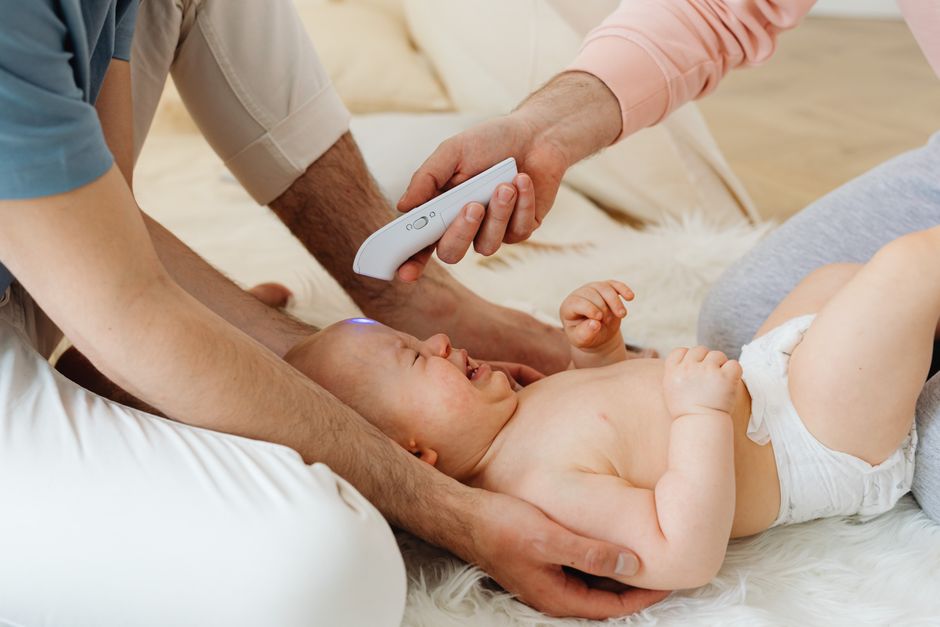
Signs of overheating include flushed skin, sweating, and irritability. Signs of being too cold include cool skin and lethargy. A rectal temperature is the most accurate way to check a newborn’s temperature. A reading of 100.4°F (38°C) or higher in a newborn is a medical emergency. Call your doctor or go to an emergency room right away.
When Should You Call The Doctor?
Newborns can get sick fast, and the signs are often subtle. Trust your instincts and call if something feels wrong.
Call right away for any of these:
- Rectal temperature of 100.4°F (38°C) or higher, at any age in the first three months
- Refusing to feed, or feeding far less than usual
- Fewer wet diapers than expected, or dark urine
- Trouble breathing — grunting, flaring nostrils, or pulling in around the ribs
- Unusual sleepiness, or difficulty waking for feeds
- Persistent crying that cannot be soothed, or a high-pitched cry
- Yellowing of the skin or eyes that is spreading or getting worse
- Vomiting that is forceful or green
- A rash that does not fade when you press on it
Newborn jaundice is common and usually harmless, appearing in the first few days and fading over one to two weeks. But jaundice that appears in the first 24 hours, spreads quickly, or persists past two weeks needs medical review. Do not try to treat jaundice at home with sunlight — this is not an established treatment and carries risks.
How Do You Know If Feeding Is Going Well?
Diaper output and weight gain are the two most reliable signals. Weight is the clearer one over time.
Newborns normally lose some weight in the first days after birth, then regain it. Most are back to their birth weight by around two weeks. After that, steady gain is the goal. Your pediatrician tracks this at well-baby visits and can flag any concern early.
For wet diapers, the count rises over the first week. A newborn may have only one or two wet diapers on day one, with the number increasing each day. By the end of the first week, expect roughly six or more wet diapers a day. Stool frequency varies widely — some babies go after every feed, others less often. Both can be normal in a breastfed baby.
If you are ever unsure whether your baby is getting enough, that is a question for your pediatrician, not something to guess at. A weight check takes minutes and settles the question.
What About Crying And Soothing?
All newborns cry. It is their main way of communicating, and it does not mean you are doing something wrong.
Crying tends to increase in the first weeks, peak around six to eight weeks, and then decline. Some babies develop a pattern of intense evening crying that pediatricians call colic. The cause is not well understood, and there is no single treatment that reliably resolves it. What helps is a calm, consistent response: feeding, changing, holding, swaddling, gentle motion, and white noise at a low volume.
Swaddling can help calm a newborn, but it must be done safely. Keep the wrap snug around the arms and loose around the hips so the legs can bend. Stop swaddling once a baby shows signs of rolling, because a swaddled baby who rolls onto their stomach cannot push back up.
If crying becomes overwhelming, it is completely acceptable — and important — to put the baby safely in the crib and step away for a few minutes. Never shake a baby. Shaking can cause permanent brain injury or death. If you feel you are losing control, call someone for help immediately.
What Should You Not Do With A Newborn?
Some common practices are genuinely unsafe. Others are simply unnecessary.
- Do not put anything in the crib besides a fitted sheet.
- Do not let a newborn sleep in a car seat, swing, or bouncer outside of a moving vehicle.
- Do not use home remedies for jaundice, including sun exposure.
- Do not give a newborn water, juice, or honey. Honey carries a risk of infant botulism before age one.
- Do not give any medication, including over-the-counter remedies, without a doctor’s guidance.
- Do not prop a bottle. Always hold the baby during feeding.
- Do not leave a newborn unattended on any surface above the floor, even for a second.
Vitamin D is one exception worth knowing. Breastfed infants generally need a vitamin D supplement because breast milk does not supply enough. The standard recommendation is 400 international units (IU) per day starting soon after birth. Formula-fed babies usually get enough from formula, but the amount depends on how much formula they drink. Ask your pediatrician what applies to your baby.
What Does The First Checkup Involve?
Newborns are usually seen by a pediatrician within a few days of leaving the hospital, then again at about two weeks, and then at regular well-baby visits. These visits track weight, length, head circumference, feeding, sleep, and development.
This is also when vaccines begin. Hepatitis B is typically given at birth, and the main vaccine series starts at around two months. The schedule is set by public health authorities and updated periodically, so confirm current timing with your pediatrician rather than relying on an old handout.
Bring your questions to these visits. Write them down as they come up, because it is easy to forget in the room. No question about a newborn is too small to ask.
Frequently Asked Questions
How often should a newborn eat?
Most newborns feed 8 to 12 times in 24 hours, roughly every two to three hours. Feed on hunger cues rather than a strict schedule, since crying is a late sign of hunger.
Is it safe for a newborn to sleep in bed with me?
No. The established guidance is that newborns sleep on a separate, firm surface in the same room as a parent, not in the adult bed. Bed-sharing raises the risk of sleep-related death.
When does the umbilical cord stump fall off?
It usually separates within one to three weeks after birth. Keep it clean and dry, and let it come off on its own rather than pulling it.
What temperature is a fever in a newborn?
A rectal temperature of 100.4°F (38°C) or higher is a fever in a newborn and requires immediate medical attention. Call your doctor or go to an emergency room right away.
