
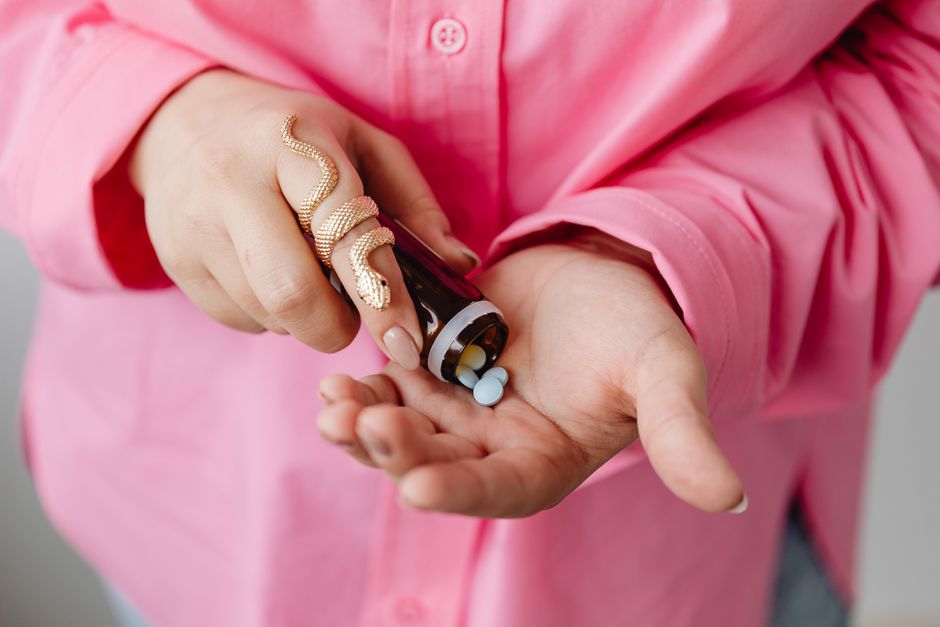
Most people can learn to swallow large pills, and the technique is simpler than it sounds. The key is to use the right head position, drink enough water, and avoid the two mistakes that cause most gagging: throwing your head back and trying to swallow a pill dry. If you can swallow a bite of food, you already have the muscle coordination to swallow a tablet. The problem is usually technique, not anatomy.
Why Do Big Pills Get Stuck in Your Throat?
Pills rarely actually stick in the throat. What you feel is the pill resting in your pharynx or esophagus, triggering a sensation that makes you want to gag or cough.
The throat is not a simple tube. It is a junction where the airway and the food pipe cross. When you swallow, a flap of tissue called the epiglottis covers your windpipe so food and liquid go down the esophagus instead of into your lungs. This is called the swallow reflex, and it happens automatically once you start the motion.
The trouble with pills is that they do not behave like food. A piece of bread or a grape gets chewed and mixed with saliva, forming a soft bolus your throat can grip and move. A hard tablet is smooth, dry, and rigid. It does not compress or conform. That makes it harder for your throat muscles to push it along.
Size matters, but not as much as you might think. Research suggests that pill size, shape, and surface coating all affect how easily people can swallow them. A large round tablet tends to be harder to swallow than a smaller oblong one, partly because round pills are harder to orient correctly in the mouth.
Anxiety also plays a real role. If you have had a bad experience with a pill, your body may tense up the muscles around your throat before you even start. That tension makes swallowing harder, which confirms the fear, which makes the next attempt worse. Breaking that cycle is often the biggest part of the solution.
How To Swallow Big Pills Without Gagging
The single most effective change is your head position. Most people tilt their head back when swallowing a pill, but this actually narrows the opening of the esophagus and makes it easier for the pill to float toward the airway.
Instead, try the chin-tuck method. Tuck your chin slightly toward your chest as you swallow. This widens the upper esophageal opening and uses gravity to help move the pill down.
Here is a step-by-step approach that works for many people:
- Put the pill on the middle of your tongue, not the back of your throat.
- Take a sip of water and hold it in your mouth without swallowing.
- Tuck your chin toward your chest.
- Swallow the water and pill together in one motion.
- Take another sip of water right after to make sure everything goes down.
Water temperature can help. Some clinicians suggest using lukewarm or slightly warm water rather than cold, because cold water can tighten the throat. This is not strongly supported by clinical trials, but many people find it makes a difference.
Do not use the “throw your head back” technique. It feels natural, but for most pills it works against you. The only exception is capsules, which float. For capsules, tilting your head slightly forward may help them sink toward the back of your throat where they can be swallowed more easily.
What If You Cannot Swallow the Pill Whole?
Before you crush, cut, or chew any pill, check with a pharmacist. Some medications are designed to release slowly over many hours, and crushing them can release the entire dose at once. That can cause serious harm.
Common examples of medications that should generally not be crushed include extended-release tablets, enteric-coated tablets, and some capsules. The coating or the slow-release structure is part of how the drug works safely.
If your medication is safe to split, a pill splitter can help. Ask your pharmacist specifically: “Can I cut or crush this?” They have the information and can tell you in seconds.
For pills that cannot be altered, there are other options:
- Ask if a liquid version exists.
- Ask if a smaller tablet strength is available that you could take more than once.
- Ask if a chewable or dissolvable form exists.
- Ask if a different medication in the same class would work.
Do not assume a pill is safe to crush just because it looks like a simple tablet. Some tablets that look plain have a special coating you cannot see.




Does Putting a Pill in Food Help?
Sometimes, yes. But it depends on the medication.
Some pills can be taken with a spoonful of applesauce, yogurt, or pudding. The thicker texture helps carry the pill down and masks the sensation of something hard in your mouth. This works well for many people who struggle with the gag reflex.
But some medications must be taken on an empty stomach, and food can change how much of the drug your body absorbs. Others interact with specific foods. Grapefruit is a well-known example that affects how the body breaks down certain drugs.
If you want to take a pill with food, ask your pharmacist first. They can tell you whether food affects absorption for your specific medication.
One more caution: do not hide a pill in a food your pet or a child might eat by mistake. And do not crush a pill into a hot drink, because heat can break down some medications.
What About a Pill Swallowing Spray or Lubricant?
Products marketed as pill-swallowing sprays or lubricants are sold online and in some pharmacies. They typically coat the throat or the pill to make it slide down more easily.
The evidence for these products is limited. No large human trials have confirmed that they work better than water alone. Some people report that they help, and there is no strong reason to think they are harmful for most people.
If you have tried the basic techniques and still struggle, a spray might be worth a try. But it should not replace the fundamental fixes: correct head position, enough water, and a relaxed throat.
For people with a genuinely severe swallowing problem, a speech-language pathologist can teach specific exercises. This is a real clinical specialty, and it is not just for people who have had a stroke. Some adults have a condition called dysphagia, where the swallow reflex does not work normally. That needs medical evaluation, not a home remedy.
When Should You See a Doctor About Pill Swallowing?
Occasional difficulty with pills is common and usually not a sign of anything serious. But some symptoms need medical attention.
See a doctor if you have:
- Pain when you swallow, especially if it is getting worse.
- A feeling that food or pills are stuck in your chest, not just your throat.
- Choking or coughing during or right after swallowing.
- Weight loss you cannot explain.
- Vomiting after swallowing.
- Difficulty swallowing that is new or getting worse over time.
These can be signs of a swallowing disorder or another medical condition that needs evaluation. Difficulty swallowing is not something to ignore, especially if it is new.
If you have a condition like Parkinson’s disease, multiple sclerosis, or a history of stroke, tell your doctor about any swallowing difficulty. These conditions can affect the swallow reflex, and there are specific treatments and strategies that can help.
Tips That Actually Make a Difference
Practice with something small first. If you are nervous about a large pill, try swallowing a piece of candy or a small piece of bread using the chin-tuck method. This builds confidence without the pressure of medication.
Use a full glass of water, not a sip. A larger volume of water gives the pill more to ride on and reduces the chance it will stick.
Do not use a straw. Straws change the way you swallow and can make it harder to coordinate the pill with the water.
Take a deep breath before you swallow. Holding your breath or breathing fast makes the throat tense. A slow breath in and out before you put the pill in your mouth can help relax the muscles.
If you take multiple pills, take them one at a time. Do not try to swallow three pills at once. That increases the chance one will get stuck or go down the wrong way.
Some people find that swallowing a pill with a thick liquid like a smoothie or kefir works better than water. The texture helps carry the pill down. This is not a clinical recommendation, but it is a common practical tip that many people find helpful.
Finally, if a specific pill is consistently hard to swallow, talk to your doctor or pharmacist. There may be a different formulation, a different brand, or a different medication that works just as well and is easier for you to take. You do not have to struggle with the same pill every day.
Frequently Asked Questions
What is the best way to swallow a large pill?
Put the pill on your tongue, take a sip of water, tuck your chin toward your chest, and swallow. The chin-tuck position widens the esophagus and helps the pill go down more easily than tilting your head back.
Can I crush a pill to make it easier to swallow?
Only if your pharmacist or doctor says it is safe. Extended-release, enteric-coated, and some other tablets can release too much medication at once if crushed, which can be dangerous.
Why do I gag when I try to swallow pills?
Gagging is usually caused by the pill touching the back of your throat or by anxiety that tenses your throat muscles. Placing the pill in the middle of your tongue and relaxing your throat before swallowing can help reduce the reflex.
Do pill-swallowing sprays really work?
The evidence is limited, and no large human trials have confirmed they work better than water. Some people find them helpful, but they should not replace basic techniques like correct head position and drinking enough water.
