
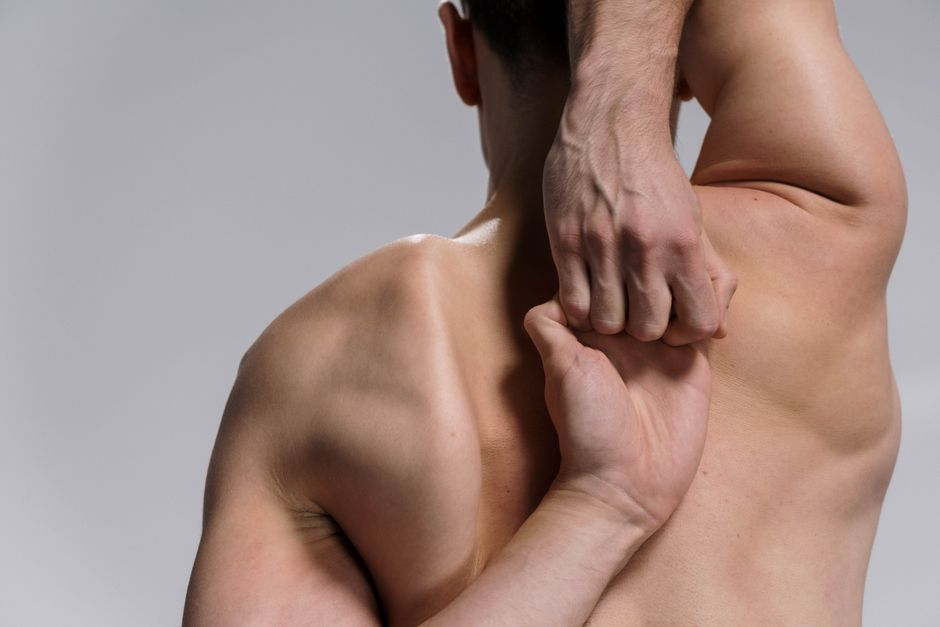
Your trapezius muscles run from the base of your skull down to the middle of your back and across your shoulders. When they get tight, you feel it in your neck, between your shoulder blades, and sometimes as tension headaches. Stretching them regularly can reduce that stiffness, but the way you stretch matters. You need to target the upper, middle, and lower traps separately because they do different jobs.
What Are the Traps and Why Do They Get Tight?
The trapezius is one large muscle with three distinct sections. The upper traps lift your shoulders and help turn your head. The middle traps pull your shoulder blades together. The lower traps pull your shoulder blades down.
Tightness usually settles in the upper traps. This happens from hours of looking at a screen, holding a phone between your ear and shoulder, or carrying heavy bags on one side. Stress also plays a role because you unconsciously shrug your shoulders when anxious. Over time, that constant low-level tension makes the muscle fibers stay partially contracted.
The middle and lower traps often get weak rather than tight. When they are weak, the upper traps overwork and tighten even more. Stretching alone helps, but strengthening the lower traps is part of the long-term fix.
How To Stretch Your Traps: The Basic Upper Trap Stretch
Sit or stand tall with your spine straight. Reach one hand behind your back and grab your wrist with the opposite hand. Gently pull the arm toward the opposite side. Then tilt your ear toward the shoulder on the side you are pulling away from.
For example, to stretch your right upper trap, pull your right wrist with your left hand. Tilt your head to the left. You should feel a pull along the right side of your neck and shoulder. Hold for 30 seconds. Repeat on the other side.
Do not pull hard. The stretch should feel like a gentle tug, not pain. If you feel sharp pain or tingling in your arm, stop and ease off.
A variation adds a slight chin tuck. Before tilting your head, pull your chin straight back as if making a double chin. Then tilt. This targets the deeper neck muscles along with the traps.
The Levator Scapula Stretch for the Side of the Neck
The levator scapula sits next to the upper traps and often gets tight at the same time. It connects the top of your neck to the top of your shoulder blade. People confuse it with the traps because the tightness feels similar.
To stretch it, sit tall and turn your head 45 degrees to one side. Then tuck your chin slightly toward your chest. Place one hand on the back of your head and gently apply downward pressure. You should feel the stretch on the opposite side of your neck, near where the neck meets the shoulder.
Hold for 30 seconds and switch sides. This stretch is especially useful for people who carry tension in the back of the neck.





Middle Trap Stretch: Opening the Chest and Shoulders
The middle traps pull your shoulder blades together. Tightness here feels like a knot between your shoulder blades. But the middle traps are often tight because the chest muscles in front are short. A good middle trap stretch involves opening the front of the body.
Stand in a doorway. Place your forearms on the door frame at shoulder height. Step one foot forward and lean your body through the doorway. You should feel a stretch across the front of your chest and shoulders. This indirectly relieves tension in the middle traps because it allows the shoulder blades to move back into a neutral position.
Hold for 30 seconds. Keep your back straight and do not arch your lower back. If the doorway is too wide, use a wall corner instead.
Lower Trap Stretch: Reaching Up and Away
The lower traps pull the shoulder blades down. They rarely get tight on their own. Instead, they get overstretched and weak when you slouch forward. Stretching them requires a different movement than the upper traps.
Kneel on the floor or stand with your feet hip-width apart. Extend both arms overhead and clasp your hands together. Reach up and slightly back, keeping your ribs down. You should feel a stretch along the sides of your torso and under your shoulder blades.
Hold for 20 to 30 seconds. Keep your neck long and avoid shrugging your shoulders up toward your ears. This stretch also opens the lats, which connect to the lower traps and share the same job of controlling the shoulder blade.
How Often Should You Stretch Your Traps?
Stretching once a day is enough for most people. If your traps feel especially tight, you can stretch twice a day — once in the morning and once before bed. Each stretch should be held for 30 seconds. Shorter holds of 10 to 15 seconds are less effective for releasing muscle tension.
Do not bounce. Bouncing activates the stretch reflex and makes the muscle tighten instead of relax. Move slowly into the stretch, breathe out as you deepen it, and hold steady.
Stretching is not a substitute for changing your posture. If you sit at a desk all day, the stretches will only help temporarily unless you also adjust your workstation. Your monitor should be at eye level, your elbows at 90 degrees, and your feet flat on the floor. Taking a 2-minute break to stand and move every hour also helps more than any single stretch.
When Stretching Is Not Enough
Sometimes tight traps are not just a muscle problem. The muscle can develop trigger points — small, hyperirritable spots that refer pain to other areas. A trigger point in the upper trap can cause pain at the temple or behind the eye. Stretching may not release these spots. Pressure from a massage ball or a skilled therapist often works better.
If the tightness is accompanied by numbness, tingling, or weakness in your arm, see a healthcare provider. These symptoms can indicate a pinched nerve in the neck, not simple muscle tightness. Similarly, if stretching makes the pain worse or if you have had a recent neck injury, get evaluated before continuing.
Heat can help before stretching. A warm shower or a heating pad for 10 minutes increases blood flow and makes the muscle more pliable. Ice is better for acute pain from a recent injury but does not help chronic tightness the way heat does.
Common Mistakes That Make Trap Stretching Less Effective
The most common mistake is shrugging the shoulder while stretching. When you tilt your head to the side, the shoulder on that side often creeps up toward your ear. That shortens the muscle and reduces the stretch. Consciously press the shoulder down before you tilt your head.
Another mistake is holding your breath. People naturally hold their breath when they feel a stretch. Breathing slowly and deeply signals the nervous system to relax. Exhale as you move deeper into the stretch.
Finally, do not stretch cold muscles aggressively. A light warm-up — even just rolling your shoulders for 30 seconds — prepares the tissue. Stretching a cold muscle increases the risk of strain.
Frequently Asked Questions
How long should I hold a trap stretch?
Hold each trap stretch for 30 seconds. Shorter holds are less effective for releasing chronic muscle tension.
Can tight traps cause headaches?
Yes, tight upper traps can refer pain to the head and contribute to tension-type headaches. Stretching and posture correction often reduce this type of headache.
Should I stretch traps that feel sore?
Mild soreness is fine to stretch gently, but sharp pain is not. If stretching increases pain or causes numbness, stop and consult a healthcare provider.
Is it better to stretch or strengthen the traps?
Both are needed. Tight upper traps respond to stretching, while weak middle and lower traps respond to strengthening exercises like rows and shoulder blade squeezes.
