
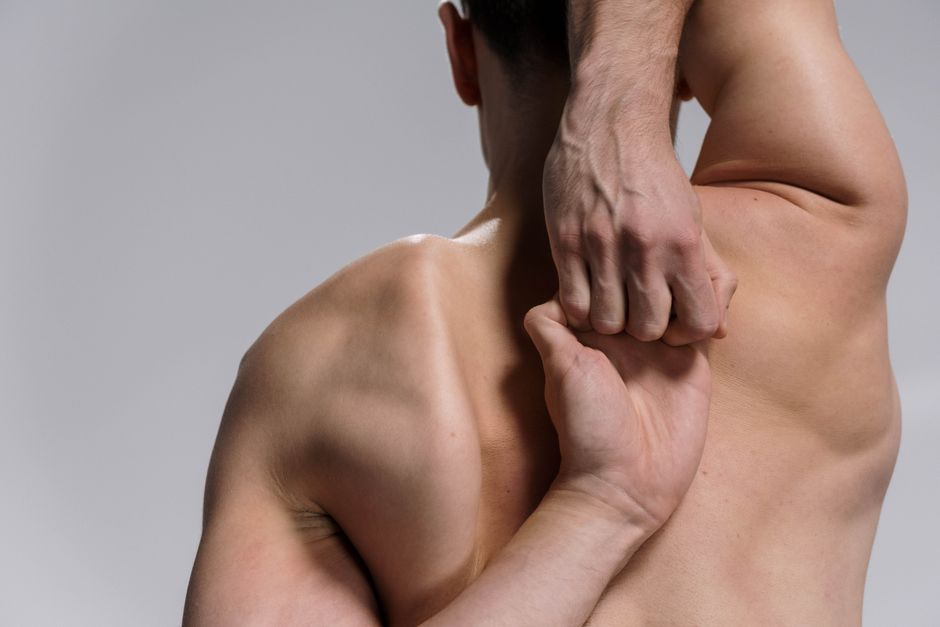
Your trapezius muscles run from the base of your skull across your shoulders and down your upper back. When they tighten, they can cause headaches, neck stiffness, and that familiar burning ache between your shoulder blades. Stretching them correctly — with slow, controlled movements and no bouncing — can reduce tension and improve how your neck and shoulders feel. The key is knowing which stretches target the traps specifically and which ones can make tightness worse.
What Are Your Trapezius Muscles and Why Do They Get Tight?
The trapezius is a large, diamond-shaped muscle that spans your upper, middle, and lower back. It has three sections — upper, middle, and lower — and each does a different job.
The upper traps lift your shoulders and help tilt your head back. The middle traps pull your shoulder blades together. The lower traps help rotate and stabilize your shoulder blades when you raise your arms.
These muscles get tight for predictable reasons. Sustained desk posture keeps the upper traps in a shortened position for hours. Stress causes many people to unconsciously raise their shoulders. Carrying a heavy bag on one side, cradling a phone between your ear and shoulder, and sleeping in awkward positions all load the upper traps unevenly.
One detail worth knowing: tightness in the upper traps is often accompanied by weakness in the lower traps. Stretching alone may not fix the problem if the underlying strength imbalance remains. Research on neck and shoulder posture suggests that both stretching and strengthening are usually needed for lasting relief, though individual results vary.
How To Stretch Traps To Loosen Tight Trapezius Muscles
These stretches target the upper and middle trapezius. Move slowly into each one. Hold where you feel a gentle pull — not pain. Breathe normally throughout.
Upper trap stretch (seated or standing)
- Sit or stand tall with your arms relaxed at your sides.
- Gently tilt your right ear toward your right shoulder.
- Rest your right hand lightly on the left side of your head for a slight overpressure — do not pull.
- Hold for 20 to 30 seconds. Switch sides.
- Repeat 2 to 3 times per side.
Cross-body shoulder stretch
- Bring your right arm across your chest at shoulder height.
- Use your left hand to gently pull the right arm closer to your chest.
- Keep your shoulders down — do not let the right shoulder shrug up.
- Hold for 20 to 30 seconds. Switch sides.
Chin tuck
- Sit or stand with your head level.
- Slowly draw your chin straight back toward your spine, as if making a double chin.
- Hold for 5 seconds. Release.
- Repeat 10 times.
The chin tuck is not a traditional stretch. It activates the deep neck flexors and helps counteract the forward head position that loads the upper traps. Some physical therapists consider it a foundation exercise for neck tension, though evidence on its standalone effectiveness is limited.
What Stretches Should You Avoid With Tight Traps?
Aggressive neck stretches can do more harm than good. Avoid any movement that involves forcing your head down, back, or to the side with strong pressure. Circular neck rolls are widely taught but can compress structures in the cervical spine, especially if you have an underlying disc issue or arthritis.
Bouncing or pulsing at the end of a stretch triggers a reflex that makes the muscle contract rather than relax. Hold steady instead.
If you feel sharp pain, numbness, tingling, or electric sensations down your arm during any stretch, stop immediately. Those symptoms suggest nerve involvement and need a medical evaluation, not more stretching.





Why Do Stretches Alone Sometimes Not Work?
Stretching temporarily lengthens muscle fibers and reduces the sensation of tightness. But if the conditions that caused the tightness remain — poor desk setup, stress, weak lower traps, or an uneven load — the muscle will tighten again.
A more complete approach includes:
- Strengthening the lower and middle traps with exercises like prone Y-raises or band pull-aparts.
- Adjusting your workstation so your monitor is at eye level and your elbows rest near 90 degrees.
- Taking movement breaks — standing and moving briefly every 30 to 45 minutes.
- Managing stress since psychological tension directly increases muscle tone in the neck and shoulders.
Some clinicians also recommend soft tissue work such as massage or dry needling for persistent trigger points. Evidence for dry needling is mixed — some trials show benefit over sham treatment and others do not. Massage has more consistent evidence for short-term relief, though the effect is temporary.
How Long Does It Take To Loosen Tight Traps?
Many people feel some relief immediately after a stretching session. That relief may last from minutes to a few hours. Lasting change typically takes weeks of consistent practice combined with posture and strength work.
There is no single timeline that applies to everyone. How long your traps have been tight, your daily posture, your stress level, and whether you address the underlying causes all affect how quickly you improve. If tightness has been present for months or years, expect gradual change rather than a quick fix.
If your symptoms are not improving after several weeks of consistent stretching and posture changes, or if they are getting worse, see a healthcare provider. Persistent neck pain with headaches, arm weakness, or sleep disruption deserves a proper evaluation.
When Should You See a Doctor for Tight Traps?
Muscle tightness from posture or stress is common and usually responds to stretching and lifestyle changes. Certain signs point to something more serious.
See a healthcare provider if you have:
- Pain that radiates down your arm or into your hand
- Numbness, tingling, or weakness in your arm or fingers
- Severe headaches that start in the neck
- Neck stiffness with fever
- Pain after a fall or injury
- Tightness that worsens despite stretching
These symptoms can indicate nerve compression, disc problems, or other conditions that require medical assessment. Stretching is not the right treatment for those situations.
Can You Stretch Traps Too Much?
Yes. Overstretching can irritate the muscle and surrounding tissue. Signs you are pushing too far include pain during the stretch, soreness that lasts more than a day, and increased tightness after stretching.
A gentle pull that eases within a few seconds is the right intensity. If you have to tense up or hold your breath to tolerate the stretch, it is too aggressive.
People with certain conditions — cervical spine instability, recent neck surgery, or osteoporosis with prior fractures — should talk to their doctor or physical therapist before starting any neck stretching routine.
Frequently Asked Questions
How often should I stretch my traps?
Most people can stretch their traps daily, holding each stretch for 20 to 30 seconds and repeating 2 to 3 times per side. If you feel soreness or increased tightness, reduce frequency and intensity.
Can tight traps cause headaches?
Yes. The upper trapezius connects to the base of the skull, and tightness there is commonly associated with tension-type headaches. Stretching and posture correction may reduce their frequency for some people.
Is heat or ice better for tight trapezius muscles?
Heat is generally more helpful for chronic muscle tightness because it increases blood flow and helps the muscle relax. Ice is better suited for acute injuries or inflammation, which is a different situation from everyday tension.
Should I stretch traps before or after exercise?
Gentle stretching before activity can help you move more comfortably, while longer holds after exercise are better for improving flexibility. Static holds of 20 to 30 seconds are not recommended immediately before heavy lifting or sports that require maximum strength.
