
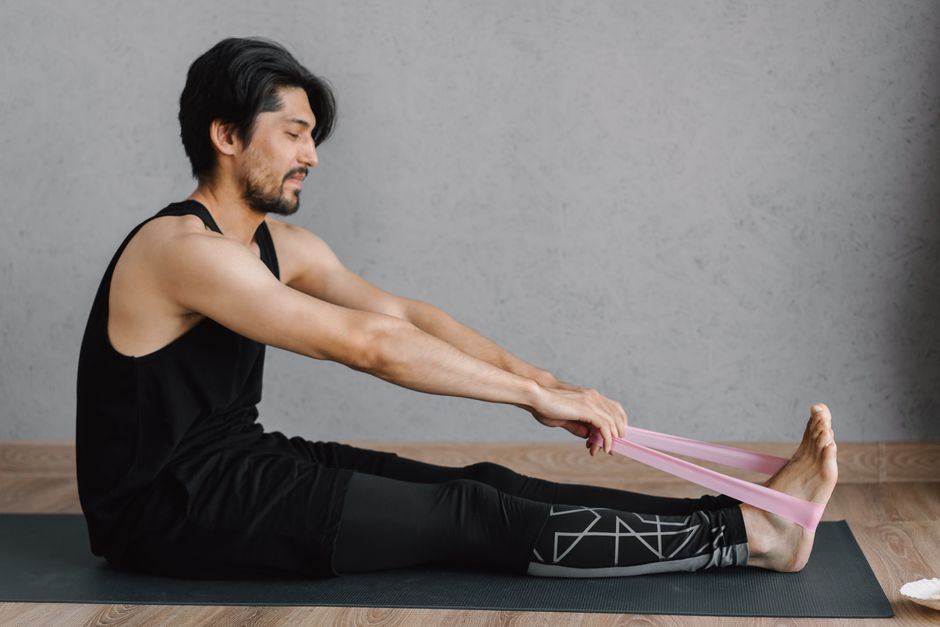
You cannot stretch the iliotibial band, and trying to do so is the wrong goal. The IT band is a thick strip of connective tissue, not a muscle, so it does not lengthen the way a hamstring or calf muscle does. The relief people actually get from “IT band stretches” comes from loosening the muscles and fascia around it — the glutes, hip flexors, and the tissue along the outer thigh. That is what these moves really do, and it is what makes them work.
What Is The IT Band And Why Does It Hurt?
The iliotibial band is a band of tough connective tissue that runs down the outside of your thigh. It starts at a muscle near the hip called the tensor fasciae latae, blends with tissue from the gluteus maximus, and attaches just below the knee on the outer shin bone.
Its job is to help stabilize the hip and knee during movement. When you walk, run, or climb stairs, the band passes back and forth over a bony bump on the outside of the knee. That repetitive rubbing is the source of most IT band pain.
Here is the part that surprises people. The band itself is not flexible and not very elastic. Studies using ultrasound and cadaver tissue have found it is extremely stiff — far stiffer than muscle. Stretching it like a rubber band does not meaningfully lengthen it. What tightens and irritates the area is usually the muscle and tissue around it, plus how you move.
Pain typically shows up in two places. At the outside of the knee, where the band rubs over the bone. Or at the outer hip, where the tensor fasciae latae and glutes attach. Both are common in runners, cyclists, and anyone who suddenly increases how much they walk or climb.
How To Stretch The It Band For Hip And Knee Relief
The moves below target the muscles and fascia around the band rather than the band itself. Hold each stretch where you feel a gentle pull, not sharp pain. Aim for roughly 20 to 30 seconds per side and repeat two to three times. These are general ranges used in physical therapy; a clinician can adjust them to your situation.
Breathe normally. Do not bounce. If a move causes sharp pain at the knee or hip, stop and back off.
Standing Cross-Body Stretch
Stand near a wall for balance. Cross your affected leg behind your other leg and plant the foot. Lean your hips away from the affected side until you feel a stretch along the outer hip and thigh. Keep both feet flat. This is the classic “IT band stretch” most people picture.
Seated Figure-Four Stretch
Sit in a chair. Place the ankle of the leg you want to stretch across the opposite knee. Sit tall, then lean forward from the hips until you feel a pull in the outer hip and buttock. This one is gentle and easy to control, which makes it a good starting point if you are sore.
Side-Lying Stretch
Lie on your side with the leg you want to stretch on top. Let it drop forward and down toward the floor, or use your top hand to guide it. You should feel a stretch along the outer thigh. Keep the bottom leg bent for stability.
Foam Rolling The Outer Thigh
This is not a stretch, but it is one of the most useful tools for this area. Lie on your side with a foam roller under the outer thigh, between your hip and knee. Support your weight with your forearms and roll slowly. Pause on tender spots for a few breaths.
Be honest about what rolling does. It does not permanently lengthen the band. Some research suggests it can temporarily reduce how tight the tissue feels and improve short-term comfort. The effect is real but modest and short-lived — useful before activity, not a fix on its own.
Why Stretching Alone Often Isn’t Enough
Stretching feels good, but the evidence that it resolves IT band pain on its own is limited. The problem is usually mechanical. Weak hip muscles let the leg rotate inward during activity, which increases friction at the knee. Stretching does not correct that.
This is where strength work matters more than stretching. The gluteus medius — the muscle on the side of your hip — controls how your thigh moves. When it is weak, the whole leg drifts inward. Many physical therapy programs for IT band pain focus on building hip and glute strength rather than stretching the band.
A reasonable approach combines both. Use the stretches and rolling above to ease tightness, then add strength work to address the cause. Single-leg bridges, side-lying leg lifts, and step-downs are common starting points. A physical therapist can tailor these to your body and activity.
What Does An IT Band Stretch Actually Do?
It changes how the surrounding tissue feels, not the length of the band. That distinction matters because it sets realistic expectations.
- It relaxes the muscles around the band. The tensor fasciae latae and glutes can hold tension that makes the outer thigh feel tight.
- It may calm irritated tissue temporarily. Gentle movement can reduce the sensation of tightness for a while.
- It does not lengthen the band. The connective tissue is too stiff for a stretch to change its length meaningfully.
- It is not a cure for the underlying cause. Movement patterns and muscle strength drive most IT band problems.
People often feel looser after stretching, and that relief is genuine. It just comes from the muscles and nervous system, not from the band getting longer.
When Should You See A Doctor For IT Band Pain?
Most outer knee and hip pain improves with rest, activity adjustment, and the exercises above. But some situations need a professional look.
See a clinician if pain is sharp and persistent, if you cannot put weight on the leg, if there is swelling, or if the pain does not improve after a few weeks of sensible self-care. Outer knee pain can also come from other causes, including a meniscus problem or joint issues, so an exam helps sort out what is actually going on.
Do not push through sharp pain to “break up” the band. That idea is a myth, and forcing it can make irritation worse. Mild discomfort during a stretch is fine. Sharp pain is a signal to stop.
How Can You Prevent IT Band Pain From Coming Back?
Consistency beats intensity. The habits that help most are unglamorous but effective.
Increase your training load gradually rather than in big jumps. Sudden spikes in mileage or hill work are a common trigger. Keep your hip and glute strength up with a short routine a few times a week. And pay attention to early tightness — addressing it when it is mild is easier than waiting until it is sharp.
If you run, avoid dramatic changes in surface and footwear all at once. Give your body time to adapt to one change before adding another. These steps will not guarantee you never feel tightness again, but they address the mechanics that drive most cases.
Frequently Asked Questions
Can you actually stretch the IT band?
No. The IT band is stiff connective tissue, not muscle, and it does not lengthen meaningfully with stretching. What people call IT band stretches really loosen the muscles and tissue around it.
How long does it take for IT band pain to go away?
Many people notice improvement within a few weeks of rest, activity changes, and strengthening. Recovery varies widely depending on the cause and how much you rest, so a clinician can give you a more specific timeline.
Should I foam roll my IT band every day?
Rolling daily is generally fine for most people and may ease short-term tightness. Keep pressure comfortable and avoid rolling directly over the bony outer knee.
Is it better to stretch or strengthen for IT band pain?
Strengthening the hip and glute muscles addresses the usual cause, while stretching eases tightness. Most programs combine both, with strength work as the foundation.
