
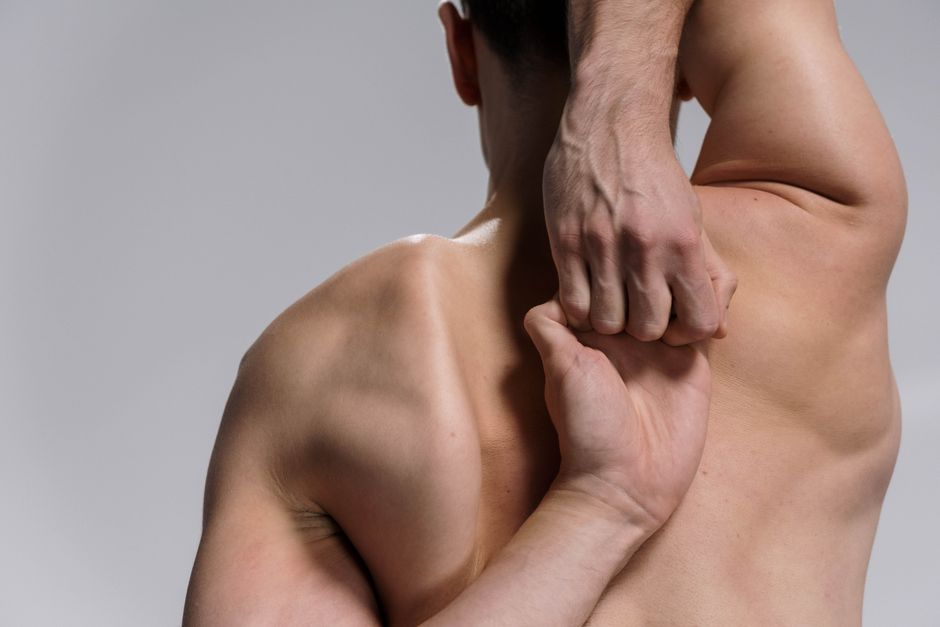
The middle trapezius runs between your shoulder blades and pulls your shoulder blades back toward your spine. You stretch it by reaching one or both arms forward across your body while keeping the shoulder blade still, which pulls the shoulder blade away from the spine and lengthens the muscle. You should not stretch it if you have an acute muscle strain, unexplained sharp pain, numbness or tingling down the arm, or a recent shoulder or spine injury that has not been cleared by a clinician.
Most people who feel tightness between the shoulder blades do not actually need a stretch. They need the opposite. The middle trapezius is usually weak and overstretched from hours at a desk, not short and tight. That distinction changes everything about how you should treat it.
What Does The Middle Trapezius Actually Do?
The trapezius is one large muscle with three parts. The upper part lifts your shoulder. The lower part lowers it. The middle part sits between them and does one main job: it pulls the shoulder blade toward the spine, a movement called retraction.
That retraction matters any time you pull something toward you, row a boat, or hold your shoulders back against gravity. The middle fibers also help rotate the shoulder blade upward when you raise your arm overhead. It works alongside the rhomboids, which sit just beneath it and do a similar job.
Here is the part most people miss. Muscles do not only get short and tight. They can also get long and weak. When you sit with your shoulders rounded forward for hours, the middle trapezius is held in a lengthened position. Over time it becomes less effective at pulling the shoulder blade back. The tightness you feel between the shoulder blades is often the sensation of a muscle working hard while being weak, or of the surrounding tissue guarding.
Stretching a muscle that is already long and weak tends to make the feeling worse, not better. This is why some people stretch their upper back for weeks and feel no improvement.
How To Stretch Middle Trapezius Step By Step
The middle trapezius is stretched by moving the shoulder blade away from the spine while the arm stays relatively still. You do not need to force this. The muscle has a short range of motion, and a small, controlled movement is enough.
Try this seated or standing version:
- Sit or stand tall with your arms relaxed at your sides.
- Reach one arm across the front of your chest, toward the opposite side, keeping the elbow slightly bent.
- Use your other hand to gently draw the reaching arm closer to your chest until you feel a stretch between the shoulder blade and the spine on the reaching side.
- Hold for about 20 to 30 seconds. Breathe normally.
- Release slowly and repeat on the other side.
For a two-arm version, clasp your hands in front of you and push them forward while letting your upper back round slightly. This spreads the shoulder blades apart and lengthens the middle trapezius on both sides at once.
You can also do a doorway version. Stand in a doorway, place both forearms on the frame at shoulder height, and gently lean forward until you feel a stretch across the upper back. Keep the movement small.
A few practical points apply to all of these:
- Stop at the first clear stretch. Pushing into pain does not speed anything up.
- Keep your shoulders down. Shrugging up during the stretch shifts the work to the upper trapezius.
- Do not bounce. Hold steady and breathe.
- Two to three rounds per side is plenty. More is not better.
If a stretch causes tingling, numbness, or pain that shoots down the arm, stop. Those are not normal stretch sensations and point to something other than muscle tightness.
When Should You Not Stretch The Middle Trapezius?
Skip stretching if you have an acute strain, and skip it if the pain has qualities that suggest a nerve or joint problem rather than a muscle problem. Stretching an injured muscle or an irritated nerve can make things worse.
Specific situations where stretching is not appropriate:
- Acute strain. A sudden pull or tear needs rest and gentle movement, not stretching. Give it time to heal first.
- Nerve symptoms. Numbness, tingling, weakness, or pain that travels down the arm can point to a nerve issue in the neck or shoulder. Stretching will not fix this and may aggravate it.
- Recent injury or surgery. Follow the guidance of the clinician managing your recovery.
- Sharp or pinpoint pain. A specific spot that hurts sharply with movement is different from a broad tight feeling and deserves assessment.
- Pain that worsens with stretching. If a stretch reliably makes things worse, that is a signal to stop, not to push through.
Persistent upper back pain, pain that wakes you at night, or pain with other symptoms such as fever or unexplained weight loss should be checked by a clinician. Those patterns are not typical of simple muscle tightness.
Why Stretching Often Does Not Fix The Tightness
The tight feeling between the shoulder blades usually comes from posture and weakness, not from a short muscle. Stretching addresses a problem most people do not have.
Think about what happens during a long day at a computer. Your arms stay in front of you. Your shoulders drift forward. The middle trapezius is held long and mostly inactive. Meanwhile the chest muscles in front shorten and pull the shoulders further forward. The result is a shoulder blade that sits too far from the spine and a middle trapezius that is weak in that position.
When you stretch, you pull the shoulder blade even further from the spine. You are adding length to a muscle that already has too much. For some people this feels good for a few minutes because it changes the sensation, but the underlying issue remains.
The more useful approach for most people is to strengthen the middle trapezius and open the chest. That means exercises that pull the shoulder blades together against resistance, plus stretches for the front of the body.
What To Do Instead If The Goal Is Less Tightness
Strengthening the middle trapezius and stretching the chest muscles addresses the pattern behind most between-the-shoulder-blades tightness. This is the approach most physical therapists take for postural upper back complaints, though it is worth being clear that the evidence for posture correction alone is not strong.
Simple strengthening options:
- Rows. Pull a resistance band or cable toward your body while squeezing the shoulder blades together. Keep the shoulders down.
- Prone Y or T raises. Lie face down and lift the arms into a Y or T shape, squeezing the shoulder blades together.
- Band pull-aparts. Hold a band in front of you and pull it apart, drawing the shoulder blades toward the spine.
For the chest, a doorway stretch works well. Place a forearm on the door frame with the elbow at shoulder height and gently turn your body away to open the front of the shoulder.
Movement variety matters too. Standing up and changing position regularly through the day does more for the middle trapezius than a single stretch session. The muscle was not designed to hold one position for hours.
It is worth saying plainly that the research on posture and upper back pain is mixed. Not everyone with rounded shoulders has pain, and not everyone with pain has rounded shoulders. Strengthening helps many people, but it is not a guaranteed fix, and the evidence does not support any single approach as clearly superior.
How Often Should You Stretch Or Strengthen?
For stretching, two to three sessions a day with short holds is reasonable if you have a genuine reason to stretch. For strengthening, most general guidance suggests a few sessions per week with rest days between, since muscles need recovery to adapt.
There is no single correct number that applies to everyone, and no clinical guideline sets an exact stretching frequency for the middle trapezius specifically. The general principle is consistency over intensity. A little done regularly beats a lot done once.
Watch how your body responds. If a routine leaves you feeling better and more mobile over a week or two, it is probably suited to you. If it leaves you sorer or no better, change the approach.
Frequently Asked Questions
How do you stretch the middle trapezius?
Reach one arm across your chest and gently pull it closer with the other hand until you feel a stretch between the shoulder blade and spine. Hold about 20 to 30 seconds and repeat on the other side.
Should you stretch a tight middle trapezius?
Often no. The middle trapezius is frequently weak and overstretched rather than short, so strengthening it and stretching the chest usually helps more than stretching the upper back.
When should you avoid stretching your upper back?
Avoid stretching with an acute strain, numbness or tingling down the arm, sharp pinpoint pain, or a recent injury that has not been assessed. These point to problems that stretching will not fix.
How long does it take to feel a difference?
Some people notice a change in how their upper back feels within a week or two of consistent strengthening and movement. There is no reliable timeline that applies to everyone, and results vary widely.
