
Stretching your arm muscles comes down to a simple rule: you cannot stretch a muscle that is actively contracting. To stretch the biceps, triceps, and forearms, you lengthen the muscle to the point of mild tension, hold it there, and let the muscle relax into the position. That is it. The rest is knowing which positions actually lengthen each muscle group and how long to hold them.
Your upper arm has two main muscle groups on opposite sides. The biceps sits on the front, the triceps on the back. The forearms run from the elbow to the wrist and control your grip and finger movement. Each group needs a different position to stretch properly. Pulling your arm one way will not stretch all three.
This guide covers how to stretch each group, how long to hold, when to stretch, and the mistakes that make arm stretching useless or even counterproductive.
How To Stretch Arm Muscles Biceps Triceps Forearms
Each muscle group needs its own position because each one crosses different joints and moves your arm in a different direction. To stretch a muscle, you move the joint in the opposite direction of what that muscle does.
The biceps bends your elbow and turns your palm up. So to stretch it, you straighten your elbow and turn your palm down. The triceps straightens your elbow, so to stretch it you bend your elbow and bring your hand toward your shoulder. The forearm muscles bend and straighten your wrist and fingers, so wrist movement in the opposite direction stretches them.
Biceps stretch
Stand facing a wall or doorway. Place your palm flat against the surface with your arm straight and your thumb pointing down. Slowly turn your body away from that arm until you feel a stretch along the front of your upper arm. Hold it there.
The key detail is the palm position. Rotating your palm to face down or slightly behind you is what makes this stretch work. If your palm faces up, you will feel almost nothing in the biceps.
Triceps stretch
Raise one arm overhead. Bend your elbow so your hand drops behind your head toward your upper back. Use your other hand to gently pull the bent elbow toward your head. You should feel the stretch along the back of your upper arm.
Keep your ribs down and avoid arching your lower back. If you arch, you are cheating the stretch by moving your shoulder instead of lengthening the triceps.
Forearm stretch
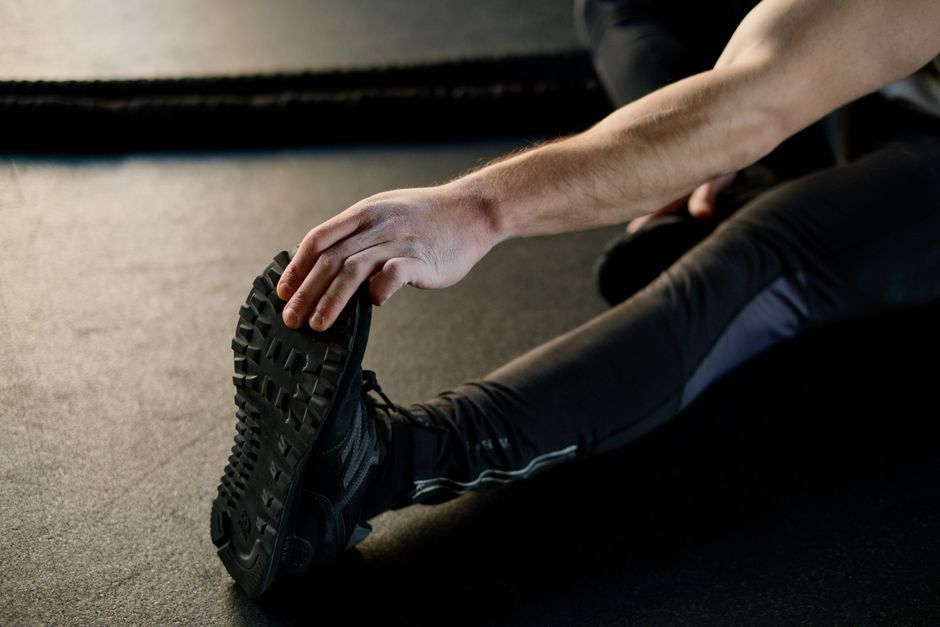
Extend one arm straight in front of you with your palm facing down. Use your other hand to gently press your wrist and fingers downward until you feel a stretch on the top of your forearm. Then flip your palm up and gently press the fingers down and back to stretch the underside of the forearm.
Your forearm has muscles on both sides, so you need both positions. Stretching only one side leaves half the forearm untouched.
How Long Should You Hold An Arm Stretch?
Hold each stretch for about 30 seconds. That duration is widely used in clinical and athletic settings and is a reasonable target for most healthy adults.
Shorter holds of 10 to 15 seconds can work, but the effect tends to be smaller. Longer holds beyond 60 seconds do not appear to add much benefit for general flexibility and mostly just take more time.
Repeat each stretch two to four times per arm. That gives you a total of roughly one to two minutes per muscle group. For most people, that is plenty.
Breathe normally the whole time. Holding your breath raises muscle tension and works against the stretch. If you cannot breathe easily, you are pushing too hard.
Should You Stretch Before Or After A Workout?
Stretch after your workout, not before. This is one of the most useful things to understand about arm stretching, and it goes against what many people were taught.
Static stretching means holding a muscle in a lengthened position for a period of time. Done right before strength training or sports, it can temporarily reduce how much force a muscle can produce. Research on this effect is fairly consistent, though the drop is usually small and short-lived. For most casual exercisers it will not matter much. For anyone lifting heavy or performing, it can.
Before a workout, use dynamic movement instead. Arm circles, shoulder rolls, and light practice reps with no weight warm the tissue and prepare the joints without reducing output.
After a workout is when static stretching fits best. Your muscles are warm, blood flow is higher, and you are not about to ask them for maximum effort. This is also when many people find stretching feels easiest.
Stretching on rest days or in the evening works fine too. There is no rule that it must follow a workout. The main point is to avoid long static holds immediately before heavy or explosive activity.



Common Arm Stretching Mistakes
Most failed arm stretches come down to a few repeatable errors.
- Bouncing. Bouncing in and out of a stretch triggers a reflex that tightens the muscle you are trying to lengthen. Hold still instead.
- Stretching to the point of pain. A stretch should feel like mild to moderate tension, not sharp pain. Pain means you have gone too far.
- Locking the elbow hard. Jamming a joint fully straight can stress the elbow itself rather than the muscle. Keep a slight softness at the joint.
- Shrugging the shoulder. Letting your shoulder creep up takes the stretch out of the arm and puts it into your neck.
- Skipping the forearms. People stretch biceps and triceps and ignore the forearms, which are often the tightest part of the arm for anyone who grips things all day.
One more point worth knowing: stretching does not permanently lengthen a muscle. What it does is increase your tolerance for the stretched position. That is why flexibility fades if you stop. It is a trainable response, not a one-time fix.
Who Should Be Careful With Arm Stretching
Stretching is generally low risk for healthy adults. Certain situations call for more caution.
If you have had a recent arm, elbow, or shoulder injury, or you are recovering from surgery, check with a clinician before stretching that area. The same applies if you have a joint condition or a history of dislocation.
Stop immediately if you feel sharp pain, numbness, tingling, or a joint that feels unstable. Those are not normal stretch sensations and point to something that needs assessment.
People with hypermobile joints, meaning joints that move beyond a normal range, should be cautious with aggressive stretching. For these individuals, building strength and control around the joint is often more useful than pushing for more range.
If you are pregnant, no specific clinical guidelines exist for arm stretching as a distinct category. General gentle stretching is commonly done, but if you have any concerns, ask your healthcare provider.
Do You Need To Stretch Your Arms At All?
You do not have to stretch to be healthy. That is worth saying plainly, because stretching is often presented as mandatory when it is not.
What stretching can do is help maintain or improve range of motion in the arms and wrists. If your daily life or sport demands reaching, gripping, or overhead movement, having that range matters. If your arms already move freely and you have no restrictions, stretching is optional.
Strength training through a full range of motion also builds flexibility. A controlled biceps curl or triceps extension taken through a complete arc works the muscle in a lengthened position under load. For many people, this builds usable range as effectively as static stretching, and some evidence suggests loaded stretching may be at least as good for flexibility.
So the honest position is this: stretching is a tool, not a requirement. It helps if you have tightness or need more range. It is not a magic fix for soreness, and it will not prevent injury on its own. The evidence that stretching prevents injury is weak and mixed, despite how often the claim is repeated.
If your goal is simply looser, more comfortable arms, a few minutes of the stretches above after activity is a reasonable routine. If your goal is performance or strength, put your effort into training and use stretching to support recovery and range.
Frequently Asked Questions
How long should you hold an arm stretch?
Hold each stretch for about 30 seconds and repeat two to four times per arm. Shorter holds still help but tend to produce a smaller effect.
Should you stretch before or after lifting weights?
Stretch after lifting, not immediately before. Long static holds right before strength work can briefly reduce how much force your muscles produce.
Can you stretch biceps and triceps at the same time?
No, they sit on opposite sides of the upper arm and move the elbow in opposite directions. Each one needs its own position to lengthen properly.
Does stretching your arms actually make them more flexible?
It increases your tolerance for the stretched position, which is what most people feel as flexibility. That effect fades if you stop stretching regularly.
