
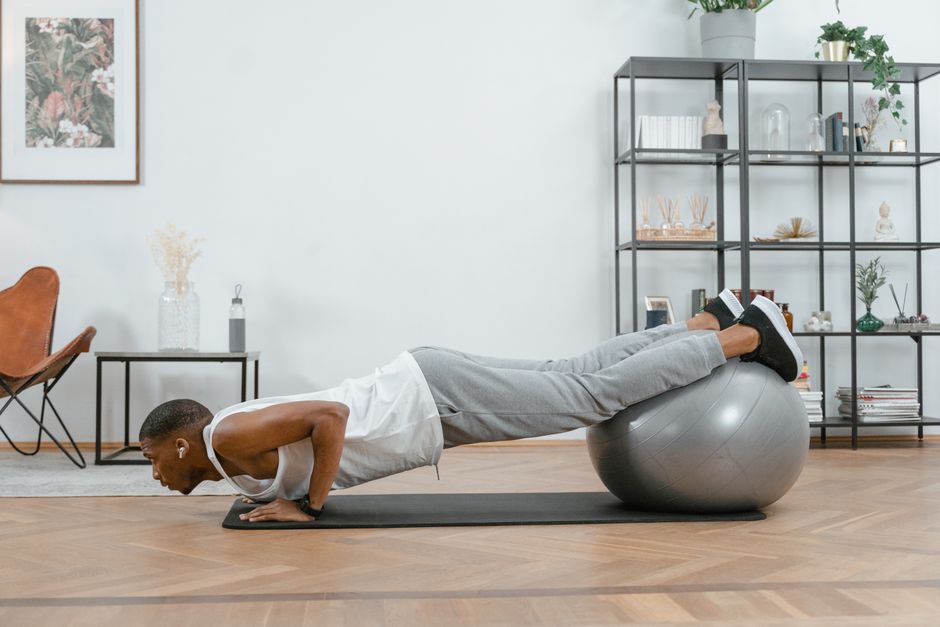
You cannot isolate the upper abs with a separate exercise. The rectus abdominis is one continuous sheet of muscle running from your breastbone to your pelvis, crossed by fibrous bands, and it contracts as a single unit. What you can do is build the whole muscle with controlled spinal flexion, lower your body fat enough for definition to show, and train consistently. Those three things are what actually produce a visible upper core.
What Do We Actually Mean By The “Upper Abs”?
The rectus abdominis is one muscle, but it has a distinct upper portion. It attaches at the sternum and the lower ribs, and it’s divided into segments by bands of connective tissue called tendinous intersections. Those bands are what create the “six-pack” look. They are fixed by genetics — you can’t train them into existence or change their number.
Here’s the part most people get wrong. You can’t shorten or isolate just the top of the muscle through exercise choice. When the rectus abdominis contracts, it contracts along its length. A crunch and a leg raise both activate the same muscle — the difference is how much the upper or lower attachment is stabilized during the movement.
What varies is the demand on different portions based on body position. Exercises where your shoulders lift toward your hips emphasize the upper region because the upper attachment is what pulls the ribcage down toward the pelvis. That’s a real difference in emphasis, but it’s a difference in mechanical demand, not isolation.
The upper portion does tend to respond to training. Some research suggests the upper rectus abdominis shows higher muscle activation during certain flexion-based movements compared with the lower portion, though the differences are modest and depend heavily on technique. The practical takeaway: train the whole core, and include movements that emphasize upper spinal flexion.
How Do You Strengthen Upper Abs With Exercise?
Controlled spinal flexion is the foundation. Your abs bend your spine forward and resist it bending backward. Exercises that create flexion against resistance — or that force the muscle to hold a stable position — are what build it.
The key is quality over volume. Slow, controlled reps with a full contraction beat fast, sloppy ones. If your hips or lower back are doing the work, your abs aren’t.
Exercises That Emphasize The Upper Region
- Crunches: Lie on your back, knees bent, and curl your shoulder blades off the floor by shortening the distance between your ribcage and pelvis. Exhale as you lift. Keep your chin slightly tucked.
- Cable or band crunches: Kneel facing a cable stack or anchored band and curl your torso down. This adds progressive resistance, which is how muscle grows over time.
- Reverse crunches: Lie on your back and draw your knees toward your chest while lifting your hips slightly off the floor. This trains lower-region control but still recruits the whole muscle.
- Dead bugs: Lie on your back with arms up and knees bent at 90 degrees. Slowly extend one arm and the opposite leg while keeping your lower back pressed to the floor. This builds anti-extension strength.
- Hollow body holds: Lie on your back, press your lower back into the floor, and lift your shoulders and legs slightly. Hold. This is a whole-core isometric.
Progressive overload matters here as much as it does for any other muscle. If you do the same twenty crunches every day, your abs will adapt and stop changing. Add resistance, slow the tempo, or increase range over time. Two to three sessions per week is a reasonable starting point, and the muscle needs recovery just like any other.
One clarification worth making: spot reduction doesn’t work. Training your abs hard won’t burn fat specifically from your stomach. Fat loss is a whole-body process driven by a calorie deficit. Exercise builds the muscle underneath; it doesn’t strip the fat on top of it.
Why Won’t My Abs Show Even When I Train Them?
Definition comes from the ratio of muscle to body fat, not from exercise volume alone. You can have strong, well-developed abs that nobody sees because a layer of subcutaneous fat covers them. For most people, visible abdominal definition requires a body fat percentage in a range that varies by sex and genetics — commonly cited as roughly the mid-teens for men and low-to-mid twenties for women, though individual variation is significant.
This is where honesty matters. Some people carry fat differently around the midsection, and genetics influence where you store it and where you lose it first. Two people with identical training and similar body fat can look very different.
Fat loss requires a sustained calorie deficit. No exercise, supplement, or device reliably removes fat from one area. The evidence on spot reduction is consistent: it doesn’t happen in any meaningful way. Your diet drives fat loss; your training shapes what’s underneath.
Don’t chase an extreme body fat level to see abs. Very low body fat carries real costs — hormonal disruption, reduced energy, and in some cases loss of menstrual function in women. A defined core is not worth compromising your health, and for many people a moderate, sustainable body fat with a strong core looks and functions better than a shredded but fragile one.
What Role Does Core Stability Play Beyond Aesthetics?
The rectus abdominis is only part of your core. The deeper muscles — the transversus abdominis, the internal and external obliques, and the muscles along your spine — work together to stabilize your trunk. Training only the visible “six-pack” muscle leaves the rest underdeveloped.
Core stability matters for everyday movement, lifting, and reducing injury risk during activity. Anti-rotation and anti-extension exercises train this function. Think planks, Pallof presses, bird dogs, and carries. These don’t produce the burn of a crunch, but they build the control that supports everything else you do.
Breathing matters too. Your diaphragm is a core muscle. Learning to brace your trunk while breathing — rather than holding your breath — is a skill that carries into lifting and daily life. Some clinicians and strength coaches emphasize this coordination heavily, and while the research on injury prevention outcomes is not definitive, the mechanical principles are well established.
How Should You Structure Ab Training For Results?
Train your core like any other muscle group: with enough resistance to challenge it, enough rest to recover, and enough consistency to adapt. A simple structure works well.
- Two to three sessions per week, on non-consecutive days.
- Two to three exercises per session, covering flexion, anti-extension, and anti-rotation.
- Two to four sets of each, with controlled reps taken close to but not always to failure.
- Progress by adding resistance, slowing tempo, or increasing range over weeks.
Don’t neglect the rest of your training. Compound movements like squats, deadlifts, and overhead presses recruit your core heavily and build total-body strength. A strong core developed through heavy lifting alongside direct ab work tends to look and perform better than crunches alone.
Recovery is not optional. Muscles grow during rest, not during the workout. If you’re sore, give it a day. Overtraining the abs won’t speed results and can leave you with nagging discomfort.
What Mistakes Keep People From A Defined Core?
The most common mistake is training abs endlessly while ignoring diet. No amount of crunches will reveal muscle that’s covered by fat you haven’t addressed. Exercise and nutrition have to work together.
Second is ego lifting with poor form. Yanking your neck, swinging your legs, or using momentum shifts the work away from your abs and onto your hip flexors and lower back. Slow down and feel the contraction.
Third is expecting fast results. Muscle growth and fat loss both take time — weeks to months, not days. Consistency over months is what produces visible change. Anyone promising a defined core in a week is selling something.
Fourth is ignoring recovery and variety. Doing the same routine forever stalls progress. Your body adapts to what you ask of it, so you have to keep asking more.
Finally, don’t buy into gadgets and programs that claim to target upper abs specifically. The muscle doesn’t work that way, and the marketing rarely matches the physiology. Simple, progressive, consistent training beats any device.
Frequently Asked Questions
Can you isolate your upper abs?
No — the rectus abdominis is one continuous muscle that contracts as a unit. You can emphasize the upper region with flexion-based movements, but you cannot train it in isolation.
How long does it take to see ab definition?
It varies widely based on starting body fat, training consistency, and genetics. Most people need weeks to months of combined training and fat loss before definition becomes visible, and there is no reliable shortcut.
Do crunches alone give you a six-pack?
No. Crunches build the muscle, but visible abs require low enough body fat for the muscle to show. Diet and overall fat loss are essential alongside training.
Is it bad to train abs every day?
Daily high-intensity ab training is generally not recommended because muscles need recovery to grow. Two to three sessions per week with rest between is a more effective approach for most people.
