
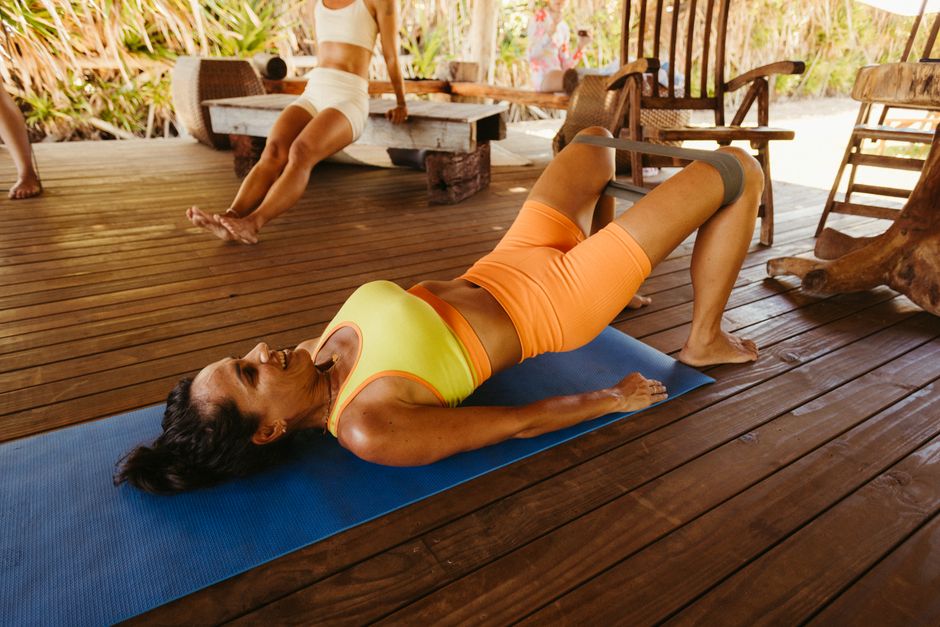
Your glutes and hamstrings are the two biggest muscle groups on the back of your body, and they work as a team. The best way to strengthen them is to train both with exercises that load the hip as it extends and bends: hip thrusts and glute bridges for the glutes, Romanian deadlifts and Nordic hamstring curls for the hamstrings, plus split squats and step-ups that hit both at once. Two to three sessions a week, done with control and gradually increasing resistance, is enough to make real progress.
The reason these two groups belong in the same conversation is simple. Your gluteus maximus — the largest muscle in your body — drives your hip forward. Your hamstrings cross both the hip and the knee, so they help extend the hip and bend the knee. When one side is weak, the other tends to take over. Training them together keeps that balance intact and lowers the odds of the nagging hamstring and lower-back problems that show up when one link in the chain is doing more than its share.
Why Do Glutes And Hamstrings Need To Be Trained Together?
They share a job. Both the glutes and the hamstrings extend the hip — the motion of pushing your leg backward or driving your body upright from a bent position. Walking, climbing stairs, standing up from a chair, and sprinting all depend on that motion.
The hamstrings have a second role the glutes do not: they bend the knee. That dual job makes them vulnerable. During a sprint or a sudden stretch, the hamstring is lengthening at the hip while shortening at the knee at the same time. Researchers call this a “stretch under load,” and it is the situation where hamstring strains most often happen. Strong, well-trained hamstrings handle that stress better.
There is a practical wrinkle many people miss. The gluteus maximus is a powerful hip extensor, but it is also an external rotator and a stabilizer. Some people have trouble “feeling” their glutes during exercise — a sensation trainers call poor mind-muscle connection. That feeling is not a reliable measure of whether a muscle is working. What matters is the movement pattern and the load. If your hip is extending against resistance, your glutes are contributing whether you feel a burn or not.
Training both groups together also makes sense for time. Most compound lower-body movements recruit both. You get more done per session, and you build the coordination between them that daily life and sport actually require.
What Are The Best Exercises To Strengthen Glutes And Hamstrings?
No single exercise covers everything. The strongest approach combines a few movement patterns, because the glutes and hamstrings respond to different kinds of loading. Here is how the main exercises break down.
- Hip thrusts and glute bridges — the most direct glute builders. Your upper back is supported and you drive your hips upward against resistance. These load the glutes heavily at the top of the range, where the gluteus maximus works hardest.
- Romanian deadlifts — a hip-hinge movement that stretches and loads the hamstrings as you lower the weight with a slight knee bend and a flat back. It is one of the most effective hamstring exercises because it works them while lengthened.
- Nordic hamstring curls — a bodyweight exercise where you anchor your ankles and lower your torso forward slowly, resisting with your hamstrings. Research on soccer players has found these reduce hamstring injury rates, which is why many sports programs use them. They are hard. Start with partial range.
- Split squats and step-ups — single-leg movements that hit the glutes and hamstrings while also challenging balance. Working one leg at a time exposes and corrects side-to-side differences.
- Hip hinges with a kettlebell or dumbbell — a simpler way to practice the hinge pattern before loading it heavily.
You do not need all of these. A workable weekly plan might pair one hip-dominant lift (hip thrust or Romanian deadlift) with one single-leg movement and one hamstring-focused exercise. Rotate the variations over time so you keep progressing.
How Do You Actually Perform These Exercises Safely?
Form is not about looking tidy. It is about putting load where you intend it and protecting your lower back, which is the structure most likely to complain when a hip hinge goes wrong.
For a hip thrust, sit with your upper back against a bench, feet flat and about shoulder-width apart. Tuck your chin slightly and drive through your heels until your hips are level with your torso. Squeeze at the top, then lower with control. Do not arch your lower back to get higher — stop where your hips are in line with your body.
For a Romanian deadlift, stand holding a weight in front of your thighs. Push your hips backward as if closing a car door behind you, letting the weight slide down your legs. Keep a soft bend in your knees and a flat back. You should feel a stretch in your hamstrings. Stop lowering when your back starts to round, then drive your hips forward to stand.
For a Nordic curl, kneel with your ankles anchored under something sturdy. Keeping your hips straight, lower your torso forward as slowly as you can control, then catch yourself with your hands and push back up. If full range is too hard, lean forward only a little at first. This exercise produces a lot of soreness the first few times. Start with a small number of repetitions.
Two rules apply to all of them. Move with control rather than momentum, and add resistance gradually. Soreness in the muscle the next day is normal. Sharp pain, joint pain, or pain that persists beyond a few days is a reason to stop and, if it continues, to see a clinician.




How Often Should You Train Glutes And Hamstrings?
Two sessions a week is the minimum most people need to see change. Three is often better if you can recover from it. Muscle grows in response to repeated, gradually increasing demand, and it needs rest between sessions to rebuild.
Spread the sessions out. Training the same muscles hard on back-to-back days gives them little time to recover. A common pattern is to train them twice a week with at least one full rest day between, or to fold them into a broader full-body routine on non-consecutive days.
Progression matters more than frequency. If you do the same exercises with the same resistance for months, your body adapts and stops changing. Add a little weight, an extra repetition, or a slightly harder variation every week or two. Small, steady increases beat big jumps that leave you too sore to train again.
Beginners often see noticeable strength gains within a few weeks, mostly from the nervous system learning the movements. Visible muscle change takes longer — commonly several weeks to a few months of consistent training. That timeline varies a lot between people, and no program can promise a specific result by a specific date.
What If You Have Knee Or Back Pain?
Discomfort during exercise is common, and it does not always mean you should stop. But pain is a signal worth taking seriously, and the right response depends on what is causing it.
People with knee pain often tolerate hip thrusts and Romanian deadlifts well, because these load the hip without deep knee bending. Step-ups and split squats can be adjusted by limiting how far you lower. People with lower-back sensitivity should be especially careful with hip hinges — a rounded back under load is the classic way to strain the lower back. Practicing the hinge with no weight first, or with a light weight, builds the pattern before loading it.
None of this replaces an assessment. If pain is sharp, comes with numbness or tingling down the leg, or does not settle with rest, see a clinician before continuing. A physical therapist can identify what is driving the pain and adapt exercises to your situation. General exercise advice is not a substitute for that.
Do You Need Weights, Or Will Bodyweight Work?
Bodyweight training builds strength in the beginning, and for some people it is enough. Glute bridges, step-ups, and hip hinges done with control all work without equipment. As you get stronger, though, bodyweight alone often stops providing enough resistance to keep the muscles adapting.
That is when added load helps. A dumbbell, kettlebell, resistance band, or barbell lets you keep increasing the demand. You do not need a gym. A single adjustable dumbbell or a set of resistance bands covers most of the exercises here. The Nordic curl is a useful exception — it is genuinely hard with no equipment at all, which is part of why it works.
One clarification worth keeping in mind: a muscle does not need to be sore to have been trained effectively. Soreness reflects novelty more than quality. If you are adding resistance over time and the movements feel controlled, you are progressing even on days you do not feel wrecked afterward.
Frequently Asked Questions
What is the single best exercise for glutes and hamstrings?
There is no single best exercise, because the two muscles respond to different loading. The Romanian deadlift is one of the most effective for hamstrings, and the hip thrust is one of the most effective for glutes. Using both covers the group well.
How long does it take to strengthen glutes and hamstrings?
Most people notice strength gains within a few weeks as the nervous system adapts. Visible muscle change usually takes several weeks to a few months of consistent training, and the exact timeline varies between people.
Can I strengthen glutes and hamstrings at home without equipment?
Yes. Glute bridges, step-ups, and bodyweight hip hinges build strength at first. As you get stronger, adding a dumbbell, band, or other resistance helps keep the muscles adapting.
Are Nordic hamstring curls safe for beginners?
They are effective but demanding, and they cause significant soreness at first. Beginners should start with a small range of motion and few repetitions, and build up gradually rather than attempting full range immediately.
