
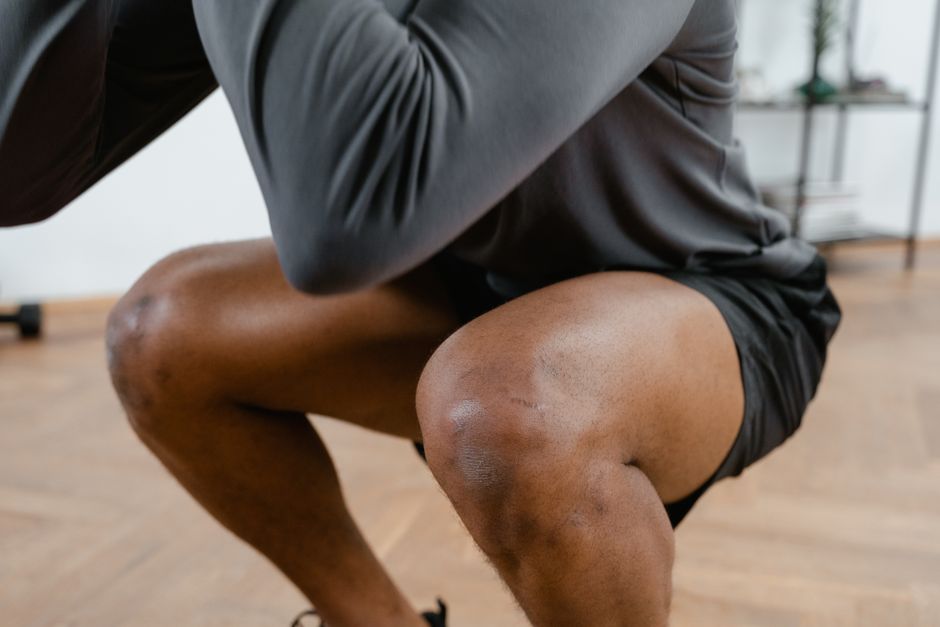
You can squat with bad knees. The key is loading the movement in a way your knee can tolerate, not forcing a textbook squat that irritates it. That usually means a shallower depth, a wider or narrower stance, slower tempo, and less weight at first. Pain that stays mild and settles within a day is a signal to continue. Sharp pain, swelling, or pain that worsens over days is a signal to stop and get the knee assessed.
Squatting is not inherently bad for knees. Research consistently shows that structured strength training, including squat patterns, is used in rehabilitation for knee osteoarthritis and patellofemoral pain. The knee is a joint built to bend under load. The problem is usually how the load is applied, not the movement itself.
Why Do Squats Hurt Bad Knees In The First Place?
Knee pain during a squat usually comes from how force is distributed across the joint, not from the squat existing. The knee sits between the hip and the ankle. When either end moves poorly, the knee absorbs the difference.
Three things commonly drive squat-related knee pain:
- Depth beyond current tolerance. Going deeper bends the knee further and increases the load on the patellofemoral joint — the space between the kneecap and the thigh bone. That joint is a common source of pain in squats.
- Knee travel relative to the foot. When the knee drifts far forward over the toes with a heavy load, the patellofemoral joint takes more stress. Some forward travel is normal. Excessive forward travel under load is often the issue.
- Weakness or poor control at the hip. If the hip muscles that control inward collapse of the knee are weak, the knee can drift inward during the squat. That position concentrates stress on one side of the joint.
There is also a less obvious factor. Pain sensitivity itself changes how the joint behaves. A knee that has been painful for a while can become more sensitive to normal loads. That does not mean the joint is damaged. It means the nervous system has turned up the volume. Gradual, tolerable loading is how that sensitivity usually calms down.
How To Squat With Bad Knees Safely And Pain Free
Start with a squat you can do without pain, then build from there. The version below works for most people with knee pain, but it is a starting point, not a prescription for every knee condition.
1. Set your stance
Stand with feet roughly shoulder-width apart, toes turned out slightly. A slightly wider stance with more turnout often reduces knee stress because it gives the hip more room to move. Narrower stances load the knee differently and suit some people better. Try both and keep the one that feels cleaner.
2. Control the depth
Squat only as deep as you can go without pain. For many people with knee pain, that is a partial squat — thighs stopping well above parallel. Depth is not a virtue. It is a variable you can adjust. As the knee tolerates more, depth usually increases on its own.
3. Sit back, don’t just drop down
Push your hips back as you lower, as if reaching for a chair behind you. This shifts load toward the hip and reduces how far the knee travels forward. Keep your chest up and your heels down. If your heels lift, your stance may be too narrow or your ankles too stiff.
4. Track the knees over the middle toes
Watch that your knees stay lined up with your middle toes. They should not collapse inward. A mirror or a phone recording helps here — most people cannot feel this drift happening.
5. Slow down
Lower over about three seconds, pause briefly, then stand. Slow tempo reduces momentum and gives you control. It also makes a light load feel more substantial, which matters when you are rebuilding tolerance.
6. Start light and progress slowly
Bodyweight, a box squat to a chair, or a light goblet squat holding a weight at your chest are reasonable starting points. Add load or depth only when the current version is pain-free during and after. Progress over weeks, not days.
What If A Full Squat Still Hurts?
Change the exercise instead of abandoning the pattern. Several variations reduce knee stress while still training the legs.
- Box squat. Lower to a chair or box and stand back up. The box limits depth and gives a target, which reduces guesswork.
- Wall sit at a shallow angle. Hold a partial squat against a wall for time. This builds quadriceps endurance with controlled load.
- Spanish squat. A strap or band behind the knees supports part of the load, letting you squat with less knee stress.
- Step-ups and split squats. Single-leg work trains the same muscles with different joint angles. Some knees tolerate these better than two-legged squats.
- Hip hinge patterns. Romanian deadlifts and similar movements train the posterior chain with minimal knee bend.
Swapping variations is not giving up. It is how rehabilitation actually works — find the version the joint tolerates, then build capacity from there.
How Do You Know If Knee Pain During Squats Is Serious?
Most squat-related knee pain is not dangerous. Some signs warrant a medical assessment before you continue.
See a clinician if you have:
- Sharp, stabbing pain inside the joint rather than a dull ache around it
- Swelling that appears within hours of squatting
- The knee locking, catching, or giving way
- Pain that persists at rest or wakes you at night
- Pain after a specific injury — a twist, a fall, or a direct blow
These do not confirm a diagnosis on their own. Several different knee conditions can produce overlapping symptoms, and only an examination can sort them out. A physical therapist or physician can assess which structure is involved and whether squatting needs to be modified or paused.
Does Squatting Damage Knees Over Time?
No good evidence shows that properly loaded squatting damages healthy knees. Research on resistance training in older adults has generally found it safe and beneficial for strength and function when programmed appropriately.
That said, the evidence is not unlimited. Long-term studies on heavy squatting specifically are limited, and most of what exists comes from strength-training populations rather than people with existing knee disease. The honest position is that squatting within tolerance appears safe and is used in clinical rehabilitation, while extreme loading in unprepared knees is a different question that has not been well studied.
One clarification worth making: soreness after squatting is not damage. Delayed muscle soreness is normal after new or harder training. Joint pain that lingers or worsens is a different signal and should change what you do.
What Else Helps Knees Tolerate Squatting?
Strength in the muscles around the knee is the main lever. The quadriceps absorb load as the knee bends. The glutes control the knee’s alignment. Both respond to consistent, progressive training.
Other factors that matter:
- Ankle mobility. Stiff ankles force the knee forward. Calf stretches and ankle mobility work can reduce that.
- Hip strength. Side-lying leg raises, band walks, and single-leg work support knee tracking.
- Recovery. Sleep and adequate protein intake support muscle adaptation. Neither replaces training, but both affect how well you respond to it.
Braces and sleeves are commonly used during squatting. Some people find a knee sleeve improves comfort and confidence. The evidence that sleeves change joint mechanics or prevent injury is limited. They are a comfort tool, not a treatment.
Frequently Asked Questions
Should I squat if my knees hurt?
Often yes, if the pain is mild and settles quickly. Pain that is sharp, causes swelling, or worsens over days means you should stop and get the knee assessed.
How deep should I squat with bad knees?
Only as deep as you can go without pain. Many people with knee pain start with a partial squat and increase depth gradually as tolerance improves.
Are squats bad for knee arthritis?
No. Strength training including squat patterns is used in rehabilitation for knee osteoarthritis and is generally recommended for maintaining function, provided the load is adjusted to what the person tolerates.
Should my knees go past my toes when squatting?
Some forward knee travel is normal and unavoidable. The goal is to control it rather than eliminate it, keeping the knees lined up over the middle toes throughout the movement.
