
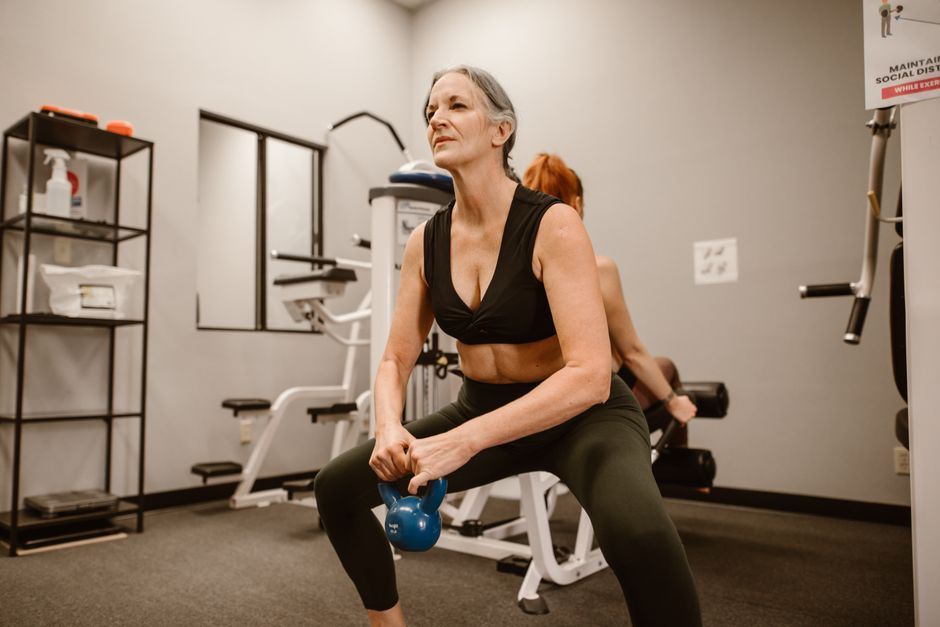
Squatting deeper is rarely about pushing harder. It is usually about giving your body the range of motion it needs at the ankle and hip. Improving ankle dorsiflexion and hip mobility allows your torso to stay upright while your knees track forward safely. The fastest path to a deeper squat is consistent, specific mobility work paired with practice at the depth you can currently manage.
Why Can’t I Squat Deep No Matter How Hard I Try?
The squat is a test of joint mobility, not just leg strength. If your ankles and hips lack the necessary range, your body physically cannot lower you into a deep position without falling backward or rounding your lower back.
Ankle dorsiflexion is the ability to bring your shin forward over your foot. You need roughly 15 to 20 degrees of dorsiflexion to reach a full depth squat. Most people have significantly less. When the ankle is stiff, your knees cannot travel forward enough, so your torso compensates by leaning forward. This shifts the load onto your lower back and makes depth impossible.
Hip mobility is equally important. Your hip joint needs to flex deeply — bringing your thighs toward your torso — while your pelvis stays relatively neutral. Tight hip flexors, glutes, or a restricted hip capsule all block this motion. When the hips cannot open, the lower back rounds to fake the depth. That is not a squat; it is a fold.
How To Improve Ankle Mobility For A Deeper Squat
Ankle mobility work targets the joint capsule, the calf muscles, and the Achilles tendon. The goal is to create more space for the shin to travel forward over the foot.
One of the most effective drills is the banded ankle mobilization. Loop a resistance band around a squat rack at ankle height. Place the band just above your ankle joint, directly over the top of your foot. Step forward so the band pulls your ankle forward. Now drive your knee over your toes while keeping your heel flat on the floor. Hold the end position for a few seconds, then release. Repeat for 10 to 15 reps per side before squatting.
A simpler version works without a band. Stand facing a wall with your toes a few inches away. Lunge forward so your knee touches the wall while your heel stays down. If your heel lifts, move closer to the wall. If it is easy, step farther back. This drill gives you immediate feedback on your current range.
You can also perform a weighted ankle rock. Hold a dumbbell at your chest and sit into a half-kneeling position. Rock your weight forward over the front foot, driving the knee past the toes while keeping the heel planted. The added weight helps stretch the calf complex more effectively than bodyweight alone.
Hip Mobility Drills That Actually Work
Hip mobility is about opening the joint capsule and releasing tight muscles around the pelvis. The 90/90 stretch is one of the most direct ways to improve this. Sit on the floor with both legs bent at 90 degrees — one leg in front of you, one behind. Your front shin points forward, your back shin points backward. Keep your torso tall and gently lean forward over the front leg. Hold for 30 to 60 seconds per side. This targets the external and internal rotation of the hip, both of which are essential for squat depth.
The couch stretch targets the hip flexors, which are almost always tight in people who sit during the day. Kneel facing a wall or couch. Place the top of your back foot against the wall, with your knee on the floor. Your back shin should be vertical against the wall. Squeeze your glute on that side and gently push your hips forward. You should feel a stretch in the front of your hip and thigh. Hold for 30 to 60 seconds per side.
Deep squat holds are also a mobility drill in themselves. Hold onto a sturdy post or the edge of a squat rack and lower yourself into your deepest squat. Use the support to control the descent, then relax into the bottom position. Let your body hang there for 30 to 60 seconds. Over time, your nervous system adapts to this end range and allows you to go deeper without support.





How To Practice Squatting Deeper With Proper Form
Mobility work creates the range, but you still need to teach your body to use it. Practicing the squat pattern itself is non-negotiable.
Start with a goblet squat. Hold a dumbbell vertically against your chest with both hands. The front-loaded weight acts as a counterbalance, pulling your torso slightly forward and making it easier to keep your heels down. This naturally encourages a more upright torso and deeper descent. Lower yourself as far as you can while keeping your spine neutral. Do not let your lower back round at the bottom.
Box squats are another excellent tool. Place a box or bench behind you at a height you can currently reach with control. Sit down onto the box, pause, then stand back up. Gradually lower the box height over several weeks. This builds confidence in the bottom position and teaches you to control the descent rather than dropping into it.
When you squat, focus on spreading the floor with your feet. This external rotation cue helps open the hips and keeps your knees tracking in line with your toes. Point your toes slightly outward — about 15 to 30 degrees — and push your knees outward as you descend. This creates space for your torso to drop between your thighs.
Common Mistakes That Block Squat Depth
Several habits silently sabotage your progress. The most common is lifting your heels off the floor. If your heels rise, you are compensating for ankle stiffness instead of fixing it. Keep your heels planted even if it means squatting to a higher depth for now.
Another mistake is letting your knees cave inward. This usually indicates weak glutes or poor hip control. Push your knees outward on every rep. If you cannot maintain that position, lighten the load or reduce the depth until you can.
Rounding your lower back at the bottom is also a problem. Some rounding is normal at maximal depth, but excessive flexion shifts stress to the spine. If you cannot reach depth without your back curling, you are not ready for that depth yet. Use a box or a counterbalance until your hips open up enough to maintain a neutral spine.
How Often Should You Do Mobility Work?
Consistency beats intensity with mobility. Doing 10 minutes of targeted work daily will produce better results than one hour once a week. This is because joint capsules and soft tissues adapt slowly to new ranges. Daily exposure signals to your body that this range is safe and worth keeping.
Perform your mobility drills immediately before squatting. This is when the tissues are warmest and most responsive. A quick 5 to 10 minute routine targeting the ankles and hips is enough to see measurable improvements within a few weeks. On rest days, a longer session can help reinforce the new range.
Do not expect overnight changes. Joint mobility takes time — often several weeks of consistent work before you notice a meaningful difference. The people who see the fastest results are those who squat frequently and do their mobility work religiously.
When To Consider Other Factors
Sometimes mobility is not the limiting factor. Your squat stance width and foot angle play a significant role. Experiment with a wider stance — some people need their feet nearly shoulder-width or beyond to achieve depth. Others need a narrower stance. Try both and find what feels most stable.
Footwear matters too. Squatting in running shoes with thick, cushioned heels makes depth harder because the compressible sole absorbs force and raises your heel. Squat barefoot or in flat-soled shoes like Converse or weightlifting shoes. This brings your foot closer to the floor and improves stability.
If you have tried consistent mobility work for several months with no change, consider a structural limitation. Some people have bony anatomy — like a longer femoral neck or a differently shaped ankle joint — that physically restricts squat depth. This is not a failure of effort. It is simply a difference in body structure. In this case, a slightly higher squat or a heel-elevated squat may be a reasonable long-term adaptation.
Frequently Asked Questions
How long does it take to improve ankle mobility for squats?
Most people see noticeable improvements within 3 to 6 weeks of daily mobility work. Consistency matters more than session length.
Can tight hips cause knee pain when squatting?
Yes, restricted hip mobility can force the knees to compensate, which may lead to discomfort or strain. Improving hip range often reduces stress on the knees.
Should I squat with a heel elevation to go deeper?
Heel elevation is a temporary tool, not a permanent fix. It masks ankle mobility issues instead of solving them, so use it sparingly while you work on your actual range.
Is it normal to feel a stretch in the groin when squatting deep?
Yes, a mild stretch in the inner thighs is common and indicates your hips are opening. Sharp pain is not normal and should be evaluated.
