
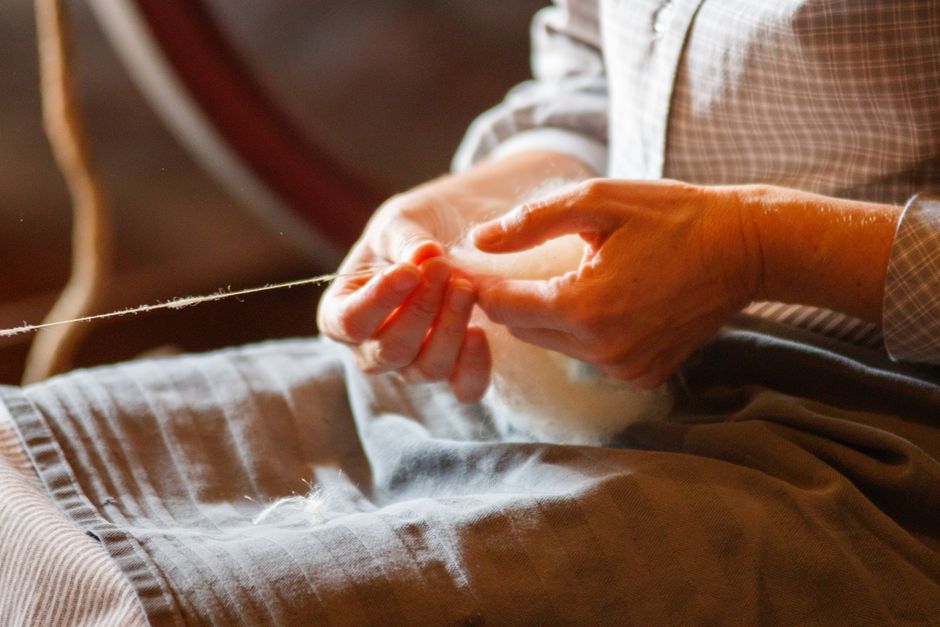
Spinning thread by hand turns loose fibers into a continuous, twisted strand strong enough to sew, weave, or knit. You do it in four stages: prepare and align the fibers, draw a small amount of fiber forward while adding twist, wind the finished thread onto a spindle or bobbin, and repeat. The tool can be as simple as a weighted stick or as complex as a treadled spinning wheel, but the basic motion is the same.
This is an old craft with a simple core. Once you understand what twist does to fiber, the steps make sense and your hands can learn them.
What Is Hand Spinning and How Does Twist Hold Fibers Together?
Twist is the whole mechanism. Loose fibers slide past each other and pull apart easily. Add twist and they lock into a strand that resists breaking.
Here is the part people often miss. Twist does not make fibers stick. It makes them press against each other. As the strand twists, the fibers wind into a helix, and friction between them holds the thread together. More twist means more friction and a stronger, denser thread. Less twist gives a softer, loftier yarn that can drift apart under tension.
Twist also has a direction. Spin the spindle clockwise and you get what spinners call a Z-twist. Spin counterclockwise and you get an S-twist. You can see the slant if you look closely at a finished thread. Direction matters mainly when you ply two or more strands together. Plying usually goes in the opposite direction from the single, which balances the twist so the finished yarn does not kink.
Two properties control how the thread behaves:
- Draft is how much fiber you pull forward per unit of twist. Thin draft makes fine thread; thick draft makes bulky yarn.
- Take-up is the rate the finished thread winds onto the spindle or bobbin. If take-up outpaces your drafting, the thread pulls thin or breaks.
Learning to spin is mostly learning to keep draft and take-up in balance. That balance is a feel, not a formula, and it comes with practice.
What Supplies Do You Need to Start Spinning Thread by Hand?
You need fiber, a tool to hold twist, and something to wind onto. Everything else is optional.
A drop spindle is the most common starting tool. It is a shaft with a weighted whorl, and it costs little. A spinning wheel does the same job faster but costs far more and takes longer to learn. Many people start on a spindle and move to a wheel later.
For fiber, wool is the usual first choice because its natural crimp and surface scales help the fibers grip each other. Cotton, flax, and silk are all spinnable but demand more skill. Beginners often find cotton especially hard because its short fibers need more twist to hold together.
You will also want a leader, a short length of finished yarn tied to the spindle to start your new thread, and a pair of hand cards or a flick brush to open and align the fiber before spinning.
How To Spin Thread By Hand Step By Step?
These steps apply to a drop spindle, the simplest setup. A wheel follows the same logic with your feet driving the twist.
Step 1: Prepare the Fiber
Tease the wool apart so the fibers are loose and airy. Remove any vegetable matter, short noils, and tangles. If you are using a batt or roving, pull off a length about as thick as your wrist. You are opening the fiber so the twist can travel through it evenly.
Step 2: Attach a Leader
Tie a length of scrap yarn to the spindle shaft just below the whorl. This is your leader. It gives the new fiber something to grab onto so twist has somewhere to go.
Step 3: Join the Fiber to the Leader
Overlap the end of your prepared fiber with the end of the leader. Pinch the join between thumb and forefinger. Spin the spindle and let a little twist run into the join. You now have a continuous strand.
Step 4: Draft and Add Twist
This is the heart of spinning. Hold the fiber with your back hand and pinch the growing thread with your front hand. Spin the spindle, then let twist travel up into the drafted fiber. Pull a small amount of fiber forward with your back hand as the twist takes hold. The classic beginner method is called park and draft: spin the spindle, park it against your leg or let it hang still, then draft with both hands. It is slower but lets you feel the twist before it runs away from you.
Step 5: Wind On
When you have a comfortable length of thread, stop spinning. Wind the finished thread onto the shaft, leaving a short working length to keep spinning from. Repeat drafting, twisting, and winding until the spindle is full.
Step 6: Set the Twist
Freshly spun yarn wants to kink and twist back on itself. Winding it into a skein and washing it in lukewarm water helps the fibers relax into their new shape. This step is called setting the twist. It makes the thread calmer and more stable to work with.
How Do You Control Thread Thickness and Consistency?
Thickness comes from how much fiber you draft per inch of twist. Thin thread means drafting a small amount of fiber and letting twist enter slowly. Thick yarn means drafting more fiber at once.
Consistency is harder than thinness. Uneven thread comes from uneven drafting, not from the spindle. If one section is thick and the next is thin, your hands are pulling different amounts of fiber forward. The fix is to slow down and draft in smaller, more even increments.
Watch for two common problems. Over-twist makes thread that coils back on itself and feels wiry. Under-twist makes thread that drifts apart and will not hold. Both are correctable by adjusting how fast you let twist into the fiber.
Drop Spindle vs Spinning Wheel: What Is the Difference?
Both tools add twist to fiber. The difference is speed, cost, and how much your hands have to do at once.
| Feature | Drop Spindle | Spinning Wheel |
|---|---|---|
| Cost | Low | High |
| Portability | Fits in a bag | Stays in one place |
| Learning curve | Gentle | Steeper |
| Speed | Slow | Fast |
| Hands free for drafting | Partly | Mostly |
On a spindle, you spin, then draft, then wind, cycling through the steps. On a wheel, your feet drive the twist continuously so your hands can draft without stopping. That is why a wheel is faster once you have learned it. It is also why the wheel can feel overwhelming at first, since twist keeps arriving whether or not your hands are ready.
Neither tool makes better thread. Skill does. A patient spinner on a spindle can produce finer, more even thread than a hurried spinner at a wheel.
What Are the Most Common Beginner Mistakes?
Most beginner trouble traces back to a few predictable habits.
- Drafting too much fiber at once. This makes thick, lumpy yarn. Pull smaller amounts.
- Letting twist run into the fiber supply. If twist travels past your front hand into the undrafted fiber, the whole mass locks up. Keep a firm pinch to control where twist stops.
- Spinning too fast. Speed feels productive but outruns your hands. Slow down until draft and twist stay balanced.
- Skipping fiber preparation. Tangled or compacted fiber drafts unevenly no matter how good your technique is.
- Ignoring the finished yarn. Check your thread now and then by letting it hang free. If it kinks hard, you have too much twist. If it pulls apart, too little.
One clarification worth knowing: hand spinning is not only for wool or for yarn. The same principles spin cotton for sewing thread, flax for linen, and silk. The fiber changes, the mechanics do not.
How Long Does It Take to Learn to Spin Thread by Hand?
Most people can produce a rough, continuous thread within their first session on a drop spindle. Producing even, consistent thread takes weeks to months of regular practice.
There is no fixed timeline, and skill depends on how often you practice. Short, frequent sessions tend to build the feel faster than long, occasional ones. The craft rewards patience more than talent.
Frequently Asked Questions
Can you spin thread by hand without a spindle?
Yes. You can draft and twist fiber between your fingers and thigh, a method sometimes called thigh spinning. It produces a usable thread but is slower and harder to keep even than using a spindle.
What fiber is easiest to spin for beginners?
Wool is generally the easiest because its natural crimp and surface texture help fibers grip each other. Cotton and flax are harder for beginners because they need more twist to hold together.
Why does my hand spun thread keep breaking?
Breaking usually means too little twist or uneven drafting. Add more twist and draft smaller amounts of fiber so the strand stays consistent.
Do you have to wash hand spun thread after spinning?
Washing is common to set the twist and relax the fibers. It is not strictly required, but unwashed yarn tends to kink and twist back on itself more.
