
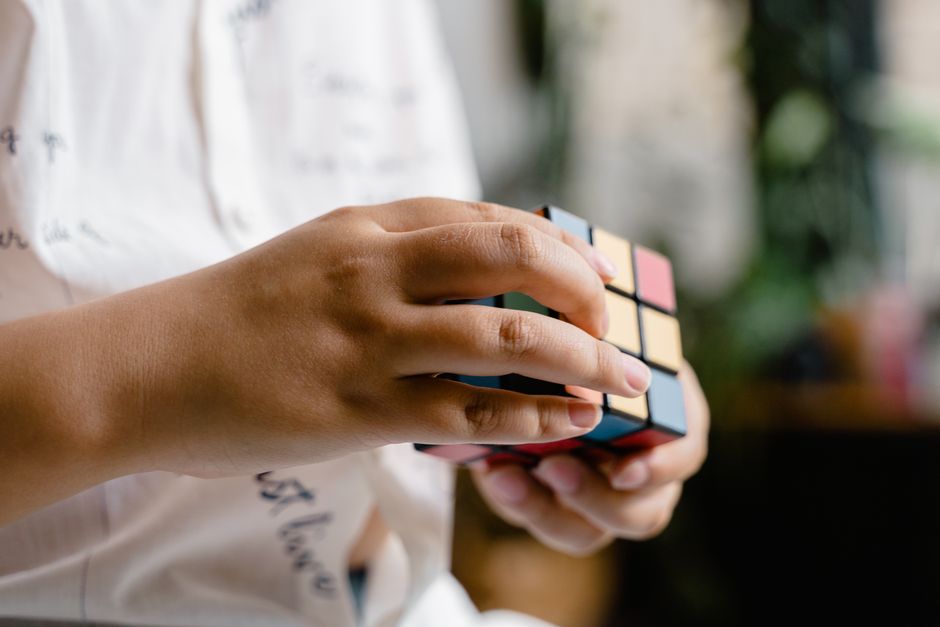
A 3×3 cube puzzle has 43 quintillion possible arrangements, but you do not need to memorize them all. You solve it in layers, using a small set of repeatable move sequences that move pieces without breaking what you already fixed. Beginners typically learn this in about seven steps, starting with a cross on one face and finishing with the top layer corners.
How To Solve A Cube Puzzle Step By Step For Beginners?
You solve the cube in layers, not face by face. That single idea is what makes it possible.
Most beginners assume you complete one color at a time, then move to the next. That approach fails because turning the cube to finish a second color scrambles the first. The layer method avoids this problem entirely. You build the bottom layer, then the middle layer, then the top layer. Every step preserves the work below it.
Here are the seven steps in order:
- Make a cross on the bottom face
- Insert the four bottom-layer corners
- Insert the four middle-layer edges
- Make a cross on the top face
- Orient the top-layer edges
- Position the top-layer corners
- Orient the top-layer corners
That sequence is sometimes called the beginner’s method. It is not the fastest method, and it was never meant to be. It is the method with the fewest algorithms to memorize, which is why it remains the standard starting point.
What Does the Notation Mean Before You Start?
Cube notation is a shorthand for turns, and you cannot follow a single tutorial without it. Each letter names one face. The letter alone means turn that face clockwise. A letter followed by an apostrophe means turn it counterclockwise.
Here is the full set of face letters:
- U — the top face
- D — the bottom face
- L — the left face
- R — the right face
- F — the front face
- B — the back face
Clockwise is defined as if you were looking directly at that face. So R means turn the right face clockwise when you look at it from the right side. This trips up almost every beginner at first, because R and L are viewed from opposite directions.
A number after a letter tells you how many quarter turns to make. R2 means turn the right face twice, which is a half turn. R’ means one counterclockwise quarter turn.
One more thing worth knowing early. A single quarter turn of any face moves eight pieces at once. You are never moving just one piece. Every algorithm you learn is a way of moving many pieces so that only the ones you want end up in a new place.
How Do You Build the Bottom Cross?
Start by picking a color for the bottom face. White is the traditional choice because it is easy to see, but any color works. The goal is four edge pieces forming a plus sign around the center, with each edge matching the center of the side it touches.
This is the step where beginners make the most common mistake. They build a white cross on top and call it done. But a cross only counts if the side colors line up too. The white-and-red edge must sit between the white center and the red center. If the side colors are wrong, the cross is wrong.
There is no algorithm for this step. You solve it by looking and thinking. Turn the cube so the white center faces down. Find a white edge piece on the top layer. Rotate the top layer until the edge’s side color matches its center, then turn that face twice to drop the edge into place.
If a white edge is stuck in the middle layer, turn the face it sits on once to move it up to the top layer, then handle it normally. This step usually takes people a few minutes the first time and seconds after a day of practice.





How Do You Insert the Bottom Corners?
With the cross done, you fill in the four corners of the bottom layer. Each corner piece has three colors, and it belongs in the one spot where all three of those colors meet.
Hold the cube with the white cross on the bottom. Find a white corner piece in the top layer. Position it directly above the slot where it belongs. Then repeat one short sequence until the corner drops into place. The standard sequence is R’ D’ R D.
You may need to run it one, three, or five times depending on how the corner is twisted. That is normal. Do not stop halfway.
A corner can also be stuck in the bottom layer in the wrong spot or the wrong way around. If that happens, run the same sequence once to pop it out to the top layer, then solve it properly. This step feels slow at first. It speeds up fast.
How Do You Solve the Middle Layer?
The middle layer has four edge pieces and no corners. Each edge has two colors, and it belongs between the two matching centers.
Find an edge in the top layer that does not contain the top color. Line up its side color with the matching center. Now you will use one of two sequences, depending on whether the edge needs to go left or right.
To send it right: U R U’ R’ U’ F’ U F. To send it left: U’ L’ U L U F U’ F’.
These two sequences are mirror images of each other. Learn them as a pair and you will remember them faster.
Sometimes an edge is already in the middle layer but flipped or in the wrong slot. There is no direct fix. Run either sequence once to push it up to the top layer, then place it correctly. This is the same trick you used for stuck corners, and it shows up again and again in cube solving.
How Do You Make the Top Cross?
Now you flip your thinking. You are no longer placing pieces. You are changing the orientation of pieces already in place.
Look at the top face. You will see one of four patterns: a dot, a small L shape, a horizontal line, or the full cross. The sequence F R U R’ U’ F’ moves you along this path. Run it from a dot and you get a line or an L. Run it again and you get the cross.
Position matters here. For the L shape, hold it so the two arms point up and to the left. For the line, hold it horizontal. Get the orientation wrong and the sequence will not produce the cross, which is a common source of frustration.
How Do You Finish the Top Layer?
Three steps remain, and they are the ones people find hardest to keep straight. Take them one at a time.
First, orient the top edges so the cross colors match the side centers. The sequence R U R’ U R U2 R’ cycles three top edges without disturbing anything below. You may need to run it once or twice.
Second, move the top corners into their correct positions, even if they are twisted. The sequence U R U’ L’ U R’ U’ L cycles three corners. Once the corners are in the right spots, only their rotation is left.
Third, twist the corners so the top face is solid. Hold the cube so an unsolved corner is in the front-right-top position. Repeat R’ D’ R D until that corner is correct. Then turn only the top layer to bring the next unsolved corner into the same position. Repeat.
Here is the part that confuses everyone. While you are twisting the last corners, the rest of the cube will look scrambled. This is expected. Do not panic and do not try to fix it mid-sequence. Finish all the corners and the cube resolves itself.
How Long Does It Take to Learn?
Most beginners can solve the cube without help within a few days of practice. The first solve might take an hour. The tenth might take ten minutes. Speed comes later, and it comes from repetition, not from learning more algorithms.
Two things slow beginners down more than anything else. The first is giving up on a step and starting over from a scrambled cube. Push through instead. The second is trying to memorize every sequence before touching the cube. Learn one step, practice it until it is automatic, then move on.
If you want to go faster later, the next step up is a method called CFOP, which is what most speedcubers use. It requires far more algorithms. There is no reason to touch it until the beginner’s method feels easy.
Frequently Asked Questions
Can you solve a cube puzzle without memorizing algorithms?
You can solve the first two layers through logic alone, but the last layer generally requires at least a few memorized sequences. No widely taught beginner method avoids algorithms entirely.
What is the easiest cube puzzle for a beginner?
A 2×2 cube is the simplest to learn because it has no fixed centers and far fewer pieces. Many people start there before moving to the standard 3×3.
Why does the cube look scrambled while I fix the last corners?
The final corner sequence temporarily disturbs solved pieces and restores them once all corners are complete. Finishing every corner resolves the cube.
How many algorithms do you need for the beginner’s method?
The beginner’s method uses roughly five to seven short sequences, depending on how you count them. That is far fewer than advanced methods require.
