
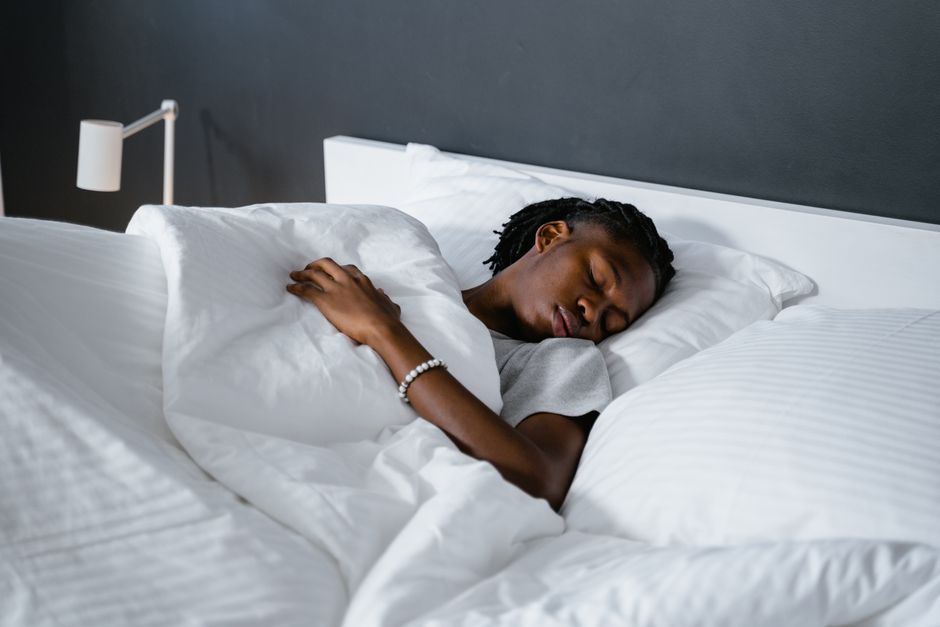
Sleeping with two pillows often leads to a stiff, sore neck by morning. The problem is rarely the number of pillows—it is how they are positioned and how your head and neck are supported. To sleep with two pillows without neck pain, you need to create a setup that keeps your head, neck, and spine in a straight, neutral line from your head down to your hips. One pillow should support your head, while the other supports the natural curve of your neck or fills the space between your shoulder and head. The goal is not to elevate your head sharply, but to fill the gap created by your body’s position.
Why Two Pillows Cause Neck Pain
Neck pain from two pillows happens because the head is pushed too far forward or tilted too far to one side. When you lie on your back, stacking two pillows under your head forces your chin toward your chest. That position stretches the muscles and ligaments at the back of your neck. When you lie on your side, two pillows often lift your head too high, bending your neck sideways toward the mattress.
Your neck has a natural forward curve. This curve is called cervical lordosis. When you sleep, your goal is to maintain that curve as close to its waking position as possible. If your head is propped too high, the curve flattens. If your head drops too low, the curve over-bends. Both positions strain the joints, muscles, and nerves in the neck over several hours.
Another factor is pillow firmness. Two soft pillows can compress into a flat, useless pad that offers no support. Two firm pillows can create a ramp that forces your head into an unnatural angle. The material matters as much as the height.
How To Sleep With Two Pillows Without Neck Pain: The Basic Setup
The key is to use the two pillows for different jobs. They should not simply be stacked on top of each other. Each pillow has a separate purpose.
For side sleepers, the bottom pillow supports your head. The top pillow supports your arm or is tucked under your waist. Your head pillow should be firm enough that your neck stays straight. When you lie on your side, your ear should be in line with your shoulder. If your ear drops toward your shoulder, the pillow is too low. If your ear rises above your shoulder, the pillow is too high.
For back sleepers, one pillow goes under your head. The second pillow goes under your knees. This does not directly support your neck, but it changes the angle of your pelvis and lower back. That small change reduces the pull on your neck muscles and helps your whole spine stay relaxed. If you are a back sleeper who feels you need two pillows under your head, you likely need a different mattress or a different single pillow that is properly sized for you.
For stomach sleepers, two pillows are almost never a good idea. Sleeping on your stomach forces your head to rotate to one side for the entire night. Adding pillows makes that rotation worse. If you sleep on your stomach, use a very flat pillow or no pillow at all under your head. Place a thin pillow under your pelvis to reduce lower back strain.
Positioning Two Pillows for Side Sleepers
Side sleeping is the most common position, and it is also where two pillows can cause the most trouble. The simplest fix is to place one pillow under your head and the other between your knees.
The pillow between your knees keeps your top leg from dropping forward and twisting your pelvis. When your pelvis twists, your lower back twists, and that tension travels up your spine to your neck. A pillow between the knees keeps your hips square and your spine in a straight line.
Your head pillow should be the one that matches your shoulder width. A simple test: lie on your side without a pillow and have someone look at you from behind. The space between your ear and your shoulder is the height your pillow needs to fill. If your shoulder is broad, you may need a firmer or higher pillow. If your shoulder is narrow, a lower pillow works better.
Some side sleepers find that using two pillows under the head works if one is a thin, soft pillow placed on top of a firmer base pillow. The firm pillow provides height. The soft pillow molds around your head and ear, reducing pressure points. This works only if the combined height still keeps your neck straight.
Positioning Two Pillows for Back Sleepers
Back sleepers who want to use two pillows should place one under the head and one under the knees. This is the most evidence-based approach for reducing strain on the cervical spine.
The pillow under your head should be relatively thin. It needs to fill the space between the back of your head and the mattress without pushing your chin forward. A cervical pillow or a contoured pillow is designed for this purpose, but a well-chosen standard pillow can work too.
The pillow under your knees is what makes the two-pillow setup work for back sleepers. Elevating your knees slightly relaxes your hip flexors and takes tension off your lower back. When your lower back is relaxed, your neck does not have to compensate. Some people find that a rolled towel under the knees works just as well as a pillow.
If you feel the need to stack two pillows under your head when sleeping on your back, that is a sign your mattress is too soft or too firm. A mattress that does not support your natural curves forces you to use pillows to fix the angle. No pillow arrangement can fully correct a mattress that does not suit your body.
Choosing the Right Pillows for This Setup
Not all pillows work well in a two-pillow system. The material changes how the pillow behaves under your head.
- Memory foam molds to your head and neck but can feel firm in cold rooms. It provides consistent support through the night.
- Latex is firm and bouncy. It holds its shape well and resists flattening. Good for side sleepers who need height.
- Down or feather is soft and moldable but flattens easily. Better as the top pillow in a two-pillow stack, not the base.
- Polyester fiberfill is cheap and soft but compresses quickly. It often needs regular fluffing to keep its shape.
- Buckwheat hulls are firm and adjustable. You can add or remove hulls to change the height. They do not mold like foam but provide solid support.
For a two-pillow setup, the base pillow needs to be firm and supportive. The top pillow can be softer and more moldable. If both pillows are soft, you get no support. If both are firm, you get pressure points.
Signs Your Two-Pillow Setup Is Wrong
Your body tells you quickly if your pillow setup is incorrect. Pay attention to how you feel in the morning and during the night.
Waking up with pain at the base of your skull often means your head was pushed too far forward. Pain on one side of your neck usually means your head was tilted sideways for hours. Numbness or tingling in your arms or hands can mean a nerve is compressed in your neck. Headaches in the morning frequently trace back to poor neck support during sleep.
Another sign is waking up with the pillow on the floor. If you throw your pillow off during the night, your body is telling you it does not support you. The same applies if you constantly wake up and adjust your pillow.
If you wake up pain-free but feel fine, your setup works even if it looks unusual. Comfort and absence of pain are the real measures of success. There is no universal correct pillow height or firmness.
Other Factors That Affect Neck Pain at Night
Pillows are only part of the equation. Your sleeping position and mattress also play major roles.
Side sleepers need a mattress that allows the shoulder and hip to sink in slightly. A mattress that is too firm creates a gap at the waist, which pulls on the spine. A mattress that is too soft lets the hips sink too deep, which tilts the spine.
Back sleepers need a mattress that supports the natural curve of the lower back without being so firm that it creates pressure points. Medium-firm mattresses are the most commonly recommended for back pain, but individual preference matters.
Your daytime posture also influences nighttime neck pain. If you spend hours looking down at a phone or computer, your neck muscles are already strained. Sleeping on a poorly positioned pillow adds to that strain. Fixing your pillow setup helps, but it does not erase the effects of poor daytime posture.
Some research suggests that changing your pillow can reduce neck pain, but the studies vary in quality. There is no single pillow or pillow arrangement that works for everyone. The evidence supports the general principle of keeping the neck in a neutral position, but the exact pillow that achieves this depends on your body.
When To See a Doctor About Neck Pain
Most neck pain from sleeping resolves within a day or two. If you adjust your pillows and the pain persists for more than a week, it is worth checking with a healthcare provider.
Seek medical attention sooner if the pain follows an injury, if it spreads down your arms, if you have numbness or weakness in your hands, or if the pain comes with fever or unexplained weight loss. These symptoms can point to conditions beyond simple sleep posture.
No pillow arrangement can fix neck pain caused by an underlying medical issue. If your pain does not improve with better sleep positioning, the problem may not be your pillow.
Frequently Asked Questions
Is it bad to sleep with two pillows?
Sleeping with two pillows is not inherently bad, but stacking them under your head often pushes your neck into an unnatural angle. Use the second pillow between your knees or under them instead of stacking both under your head.
What is the best position for two pillows to avoid neck pain?
For side sleepers, place one pillow under your head and one between your knees. For back sleepers, place one under your head and one under your knees. This keeps your spine in a neutral line.
Should I sleep with two pillows if I sleep on my back?
Yes, but only one pillow should be under your head. The second pillow goes under your knees to reduce lower back strain, which indirectly helps your neck.
How high should my pillow be to prevent neck pain?
Your pillow height should match the distance between your ear and your shoulder when lying on your side. When lying on your back, your forehead should be slightly higher than your chin, not the reverse.
