
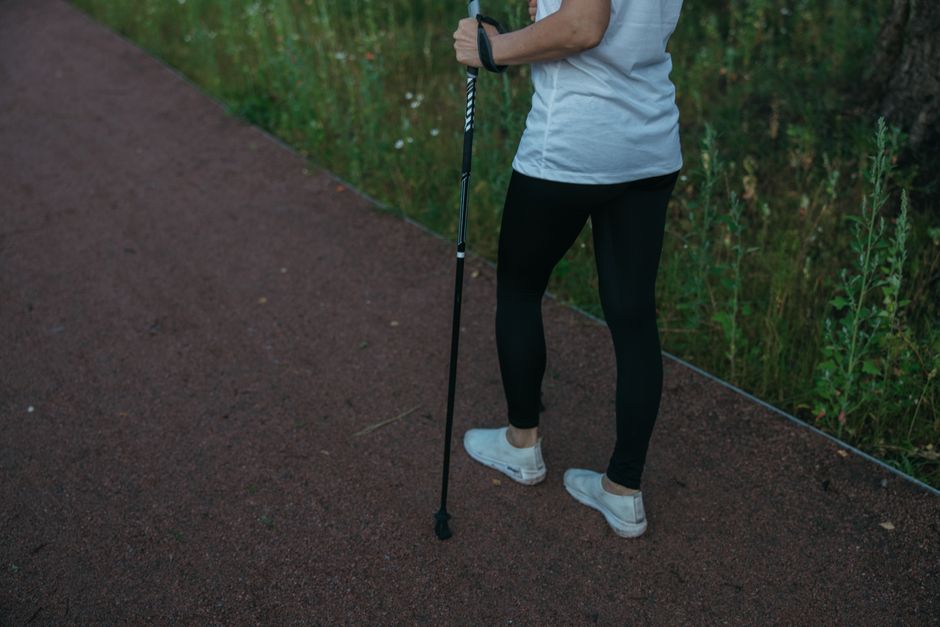
A walking stick sized correctly puts the grip at wrist height when your arm hangs relaxed at your side. That single measurement — from the crease of your wrist to the floor — is the standard starting point for sizing a walking stick, and it works for most adults. If you cannot measure, a rough rule is that the stick should reach roughly the level of your wrist bone when you stand naturally with your arm down.
Get this wrong and the stick stops helping. Too short and you lean forward and hunch. Too tall and you lift your shoulder with every step. The good news is that sizing takes about a minute and needs only a tape measure and a wall.
How To Size A Walking Stick For Your Height
Stand in your normal shoes against a wall. Let your arm hang loose at your side, not stiff, not bent. Have someone measure from the floor to the crease where your wrist bends — the line where your hand meets your forearm. That number is your stick length.
This wrist-crease method is the most widely used approach in clinical and rehabilitation settings. It is not a perfect formula, but it accounts for your arm length, torso length, and leg length all at once, which height alone does not.
Height charts exist as a shortcut, but they are less accurate. Two people who are both 5 feet 8 inches can have very different arm and leg proportions. If you must use height, treat the result as a starting point and adjust from there.
One detail people miss: measure in the shoes you plan to wear. A thick-soled walking shoe can add meaningful height. If you switch between thin sandals and thick boots, your stick may feel different on different days.
What Is The Wrist Crease Method?
The wrist crease method is exactly what it sounds like. You measure to the crease on the inside of your wrist, not to your fingertips and not to the middle of your palm.
Here is the full process:
- Stand tall on a hard floor, not carpet, in your usual walking shoes.
- Let your arm relax at your side. Do not reach or stretch.
- Mark the floor-to-wrist-crease distance with a tape measure or a second person’s help.
- If you are using an adjustable stick, set it to that number and test it.
- If you are cutting a wooden stick, cut slightly long first, then trim.
The reason this landmark is used is practical. When the grip sits at wrist height, your elbow stays slightly bent as you walk. That bend lets you push down and forward without locking your arm or lifting your shoulder.
Some clinicians instead measure to the top of the greater trochanter — the bony bump on the outside of your hip. The two methods usually land within an inch or two of each other. The wrist method is simpler to find on your own.
Do You Need A Different Length For Different Uses?
Yes, and this is where a lot of people get it wrong. The wrist-height rule is for a standard walking stick used for balance and light support. Other uses call for different lengths.
For walking on flat ground with light support, wrist height is the standard. For hills or uneven trails, some hikers prefer a stick a little longer so they can plant it ahead of them going downhill. For going uphill, a slightly shorter stick can feel more natural.
If you are using the stick mainly to take weight off a painful hip or knee, the fit matters more, not less. A stick held on the opposite side of the painful joint is common practice — left hand for a right hip, for example — because it shifts load away from the sore side. This is widely taught, though how much it helps varies from person to person.
Canes with a offset or “derby” handle are shaped so the grip sits forward of the shaft. That design lets the stick sit closer to your foot and can change the effective length you need. If you switch handle styles, recheck the fit.





How Do You Adjust And Test The Fit?
Adjust first, then walk. A stick that feels fine standing still can feel wrong after twenty steps.
Set the length to your wrist measurement. Stand with the stick in the hand opposite your weaker or more painful side. Place the tip about a step’s length ahead of you, roughly in line with your foot, not way out to the side.
Now walk. Watch for these signs that the length is off:
- Too short: you lean forward, your shoulder drops, or you feel like you are falling toward the stick.
- Too tall: your shoulder lifts, your elbow bends a lot, or you have to reach up to grip it.
- Just right: your elbow stays slightly bent, your shoulder stays level, and the stick lands naturally with each step.
Adjustable sticks usually have a push-button or twist-lock. Check that the locking mechanism is fully engaged before you put weight on it. A stick that slips mid-step is a fall risk.
Rubber tips matter too. A worn tip changes the effective length slightly and reduces grip on smooth floors. Replace tips when the tread wears flat.
Does Height Alone Predict The Right Size?
Height alone is a rough guide at best. It ignores arm length, leg length, and posture, and those vary a lot between people of the same height.
Height charts are common in product listings because they are easy to print. They are a convenience, not a clinical standard. If a chart says you need a 36-inch stick but your wrist measurement says 34 inches, trust your wrist measurement.
Posture also matters. If you stand with a forward lean or have a spinal curve, your wrist height may not match a chart built for a straight posture. In that case, a physical therapist can help you find a length that works for your body.
Body changes over time too. Weight gain, weight loss, surgery, or a change in footwear can all shift the right length. Recheck your fit if something feels different.
When Should You Ask A Professional?
Ask a physical therapist or your doctor if you are using a stick because of a recent injury, surgery, or a condition that affects your balance or strength. Getting the length right is only part of the picture — how you use it matters just as much.
A therapist can watch you walk and check your gait, your grip, and whether the stick is actually helping or just adding a new problem. Some people grip too hard, plant the stick too far out, or lean on it in a way that strains the shoulder.
If you have significant balance problems, numbness in your feet, or a history of falls, a single walking stick may not be enough support. A different aid — a rollator, a four-point cane, or a walker — might be safer. That is a decision to make with a clinician, not from a sizing chart.
For most healthy adults using a stick for mild balance support on walks, the wrist-crease method is enough. Measure, adjust, test, and recheck if anything changes.
Frequently Asked Questions
How do I know if my walking stick is the right height?
When you stand with the stick beside you and your arm relaxed, the grip should sit at the crease of your wrist. Your elbow should stay slightly bent as you walk, not locked straight.
Should a walking stick be measured to the wrist or the hip?
Both landmarks are used, and they usually give similar results. The wrist crease is easier to find on your own and is the more common method.
Can I size a walking stick by my height alone?
Height gives a rough starting point but ignores arm and leg length, which vary between people of the same height. Measuring to your wrist is more accurate.
Which hand should hold a walking stick?
Hold it in the hand opposite your weaker or more painful side — left hand for a right hip or knee problem, for example. This is common clinical practice, though how much it helps varies by person.
