
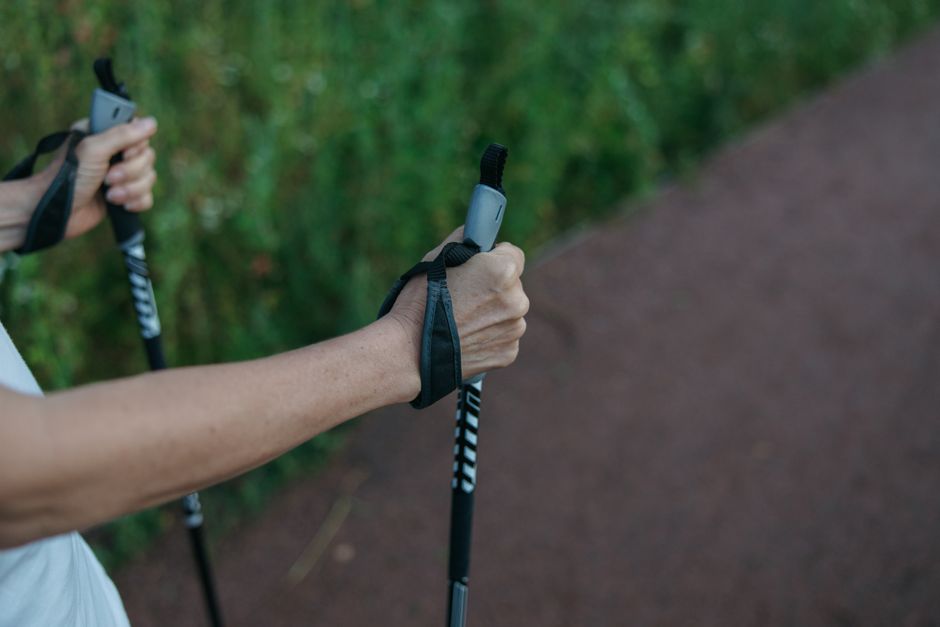
A walking cane that is too short makes you lean forward. One that is too long pushes your shoulder up and throws off your balance. The right fit comes down to one measurement: the distance from the floor to the crease on the inside of your wrist, taken while you stand in your normal shoes with your arm relaxed at your side. That number, in inches, is your cane length. Most adults land somewhere between 30 and 38 inches, but the only number that matters is yours.
How Do You Measure Cane Length at Home?
You can get an accurate measurement in about a minute with a tape measure and a wall. No special tools required.
Stand up straight in the shoes you wear most often. Let your arms hang naturally at your sides. Have someone find the crease on the inside of your wrist — the line where your wrist bends — and measure from that crease straight down to the floor. Do not angle the tape. Keep it vertical.
That distance is your cane length. If you are measuring for someone else, have them stand the same way rather than measuring them while seated. Posture changes the number.
Two details are easy to get wrong:
- Shoes matter. A half-inch heel changes the measurement. Measure in the footwear you actually walk in.
- Arm position matters. A bent elbow shortens the distance. Let the arm hang loose.
If you are ordering online and cannot measure in person, this method still works. Measure at home, then match that number to the cane’s listed length. Many canes are sold in one-inch increments for exactly this reason.
What Is the Wrist Crease Method and Why Does It Work?
The wrist crease method works because it places the top of the cane at the same height as the natural bend point of your wrist. When you grip the handle, your elbow bends at roughly a 15 to 30 degree angle. That slight bend lets your arm absorb shock and swing the cane forward without lifting your shoulder.
If the cane is too short, you have to lean toward it. That shifts your center of gravity and can make you less stable, not more. If it is too long, you have to shrug your shoulder to lift the cane off the ground with each step. Over a long walk, that causes shoulder and neck fatigue.
There is a second check that confirms the measurement. Stand with the cane tip about six inches in front of your foot, on the side that needs support. Rest your hand on the handle. Your elbow should be slightly bent — not locked straight, not bent at a sharp angle. If the elbow looks right, the length is right.
This method is standard in physical therapy and rehabilitation practice. It is not a marketing shortcut. It reflects how the arm and shoulder are built to move.
Does Cane Height Change With Your Shoes or Posture?
Yes, and this trips up a lot of people. A cane sized in flat shoes will feel too short in boots with a heel. The difference is small — often half an inch to an inch — but over a long walk it is noticeable.
Posture matters more than most people expect. If you tend to lean forward, or if you have a condition that affects your spine, your standing height and wrist position change. A cane measured during a good posture day may not fit on a day when you are stooped.
Some clinicians suggest measuring while standing as upright as you comfortably can, then adjusting the cane by one setting if your posture varies. Others recommend a cane that adjusts across a range so you can fine-tune it. Adjustable canes with a push-button or twist-lock mechanism let you change length without buying a new cane.
If your posture changes significantly over time — from a progressive condition, for example — remeasure rather than assuming your old number still fits.





Should You Choose an Adjustable Cane or a Fixed-Length Cane?
Both work. The choice depends on whether your measurement is likely to stay the same.
Adjustable canes are the more practical option for most people. They cost about the same as fixed canes, and they let you fine-tune the height by small increments. The trade-off is a slightly heavier shaft and a small amount of play at the adjustment point. For most walking, that play is not noticeable.
Fixed-length canes are cut to a single measurement. They tend to feel more solid because there is no joint in the shaft. They are a reasonable choice if your height and footwear are stable and you have measured carefully.
One caution with adjustable canes: the adjustment holes are usually spaced about one inch apart. If your ideal length falls between two holes, pick the one that puts your elbow in the correct range, then check the elbow angle again.
| Cane Type | Best For | Trade-Off |
|---|---|---|
| Adjustable | Most users; changing shoes or posture | Slightly heavier; minor play at the joint |
| Fixed-length | Stable height and footwear; solid feel | No adjustment if needs change |
| Folding | Travel and storage | More joints; check locking mechanism |
How Do You Know If Your Cane Is the Wrong Height?
Your body gives clear signals. The most common one is shoulder or neck soreness after walking. That usually means the cane is too tall and you are lifting your shoulder to compensate.
Leaning to one side, or feeling like you are pushing the cane rather than walking with it, suggests the cane is too short. So does a feeling of instability that does not improve with use.
A few other signs worth checking:
- Your elbow is locked straight when you grip the handle — the cane is likely too long.
- Your elbow is bent past 30 degrees — the cane is likely too short.
- You have to lift the cane high off the floor to move it — too long.
- The cane tip drags or catches — check both the length and the tip condition.
If you have been using the same cane for years and your body has changed, remeasure. Bodies change. Canes do not adjust themselves.
Does the Cane Tip Affect Fit and Safety?
The tip does not change the length you need, but it does affect how the cane performs. A worn or hardened tip reduces grip on the floor and can make the cane feel less stable, which some people mistake for a fit problem.
Most canes come with a rubber tip. Rubber grips well on dry indoor surfaces. On ice or wet ground, a metal spike attachment — sometimes called an ice tip — is often used instead. These are widely available and swap onto the same shaft.
Check the tip regularly. If the rubber is cracked, shiny, or worn flat on one side, replace it. A worn tip is a fall risk regardless of how well the cane is sized.
One note on the base: quad canes with four small feet stand on their own but are not automatically more stable than a single-tip cane. Research on which design prevents falls more effectively is limited, and the choice often comes down to the user’s balance, grip strength, and walking surface. Ask a physical therapist if you are unsure.
When Should You Ask a Physical Therapist Instead of Measuring Yourself?
Self-measurement works well for many people. But some situations call for a professional fitting.
If you have had a stroke, a recent surgery, a significant balance disorder, or a condition that affects how you bear weight, a physical therapist can assess your gait and recommend not just the length but the type of cane and how to use it. Gait training — learning the correct step pattern — matters as much as the cane length itself.
If you have fallen more than once, or if you feel unsteady even with a cane, that is a reason to get assessed. A cane that fits correctly still cannot fix a gait problem it was not designed for.
If you are not sure whether you need a cane at all, that is also worth a conversation with a clinician. A cane is a tool for a specific need. It is not a general wellness product, and using one incorrectly can create new problems.
Frequently Asked Questions
What is the correct height for a walking cane?
The correct height is the distance from the floor to the crease on the inside of your wrist, measured while standing in your normal shoes with your arm relaxed. This usually puts your elbow at a 15 to 30 degree bend when you grip the handle.
Should a cane be measured with shoes on or off?
Measure with the shoes you wear most often. A heel changes the floor-to-wrist distance by half an inch or more, which is enough to affect fit.
Can a cane be too tall?
Yes. A cane that is too tall forces you to lift your shoulder with each step, which causes shoulder and neck fatigue. It also makes the cane harder to control.
How do I adjust an adjustable cane to the right height?
Press the push-button or loosen the twist lock, slide the shaft until the top of the handle sits at your wrist crease, then lock it firmly. Confirm by checking that your elbow has a slight bend when you grip the handle.
