
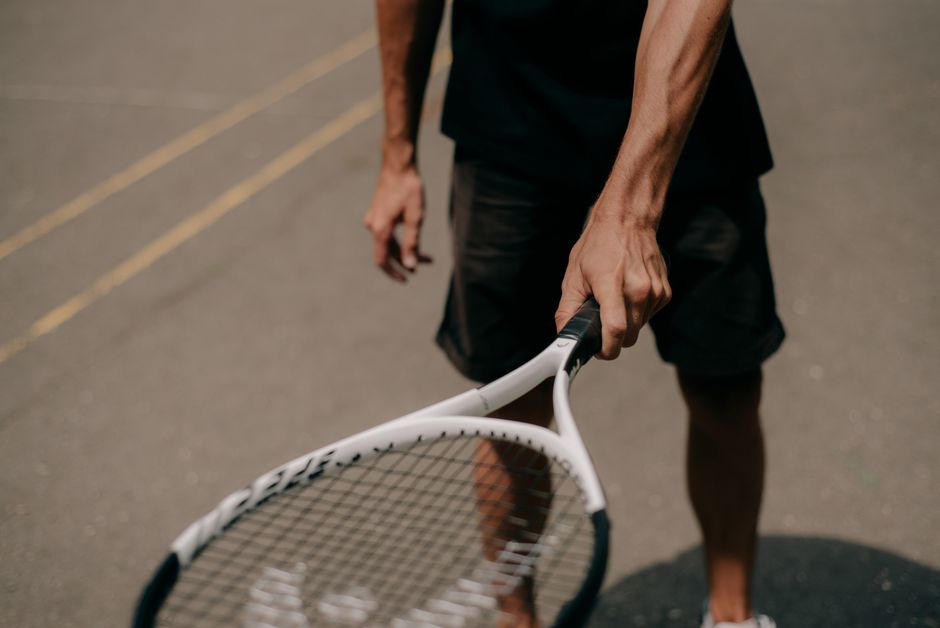
Choosing the right tennis racket size comes down to two separate measurements: grip size and head size. Grip size is about comfort and injury prevention, measured in inches around the handle. Head size is about power and control, measured in square inches of the string bed. Most adult players use a grip between 4 1/8 and 4 5/8 inches, and a head size between 98 and 110 square inches. Getting these two numbers right matters more than any other specification on the racket.
How Do I Measure My Tennis Grip Size?
The standard method for measuring grip size has been used for decades. Hold the racket in your dominant hand with a continental grip, which is the same grip you use to hit a serve. The continental grip means the base knuckle of your index finger sits on the bevel that points diagonally up. Once you hold it this way, slide the index finger of your other hand into the gap between your fingertips and your palm. If your finger fits snugly into that space without forcing it, your grip size is correct. If your finger cannot fit or only fits with pressure, the grip is too small. If there is a large gap with room to spare, the grip is too large.
A second method uses a ruler. Measure the distance from the middle crease of your palm to the tip of your ring finger. That measurement in inches closely matches your grip size. For example, if that distance is 4 5/8 inches, you likely need a 4 5/8 grip. This method is less precise than the finger test but works well as a starting point when you cannot test a racket in person.
What Happens If My Grip Size Is Wrong?
A grip that is too small causes you to squeeze the handle harder to keep the racket stable. That extra tension travels up your forearm and can lead to tennis elbow or general arm fatigue. Many players who complain of arm pain are actually using a grip that is one size too small.
A grip that is too large restricts wrist snap on serves and makes it harder to change grips quickly between shots. You may also feel like you cannot hold the racket securely, which leads to a death grip and the same arm strain you would get from a grip that is too small.
The fix is straightforward. If the grip is slightly too small, you can add an overgrip, which increases the circumference by about 1/16 of an inch. If you need a full size increase, a heat-shrink sleeve or a replacement grip built up with tape can add roughly 1/8 of an inch. If the grip is too large, you must replace the grip with a thinner one or switch rackets.
How Do I Choose Tennis Racket Head Size?
Head size is measured in square inches and typically ranges from 95 to 110 for adult rackets. Midsize rackets around 95 square inches offer the most control but require precise timing. Midplus rackets between 98 and 104 square inches are the most common choice for intermediate and advanced players. Oversize rackets between 105 and 110 square inches provide more power and a larger sweet spot, making them forgiving on off-center hits.
The trade-off is real. A larger head size creates more power because the string bed acts like a trampoline, but it also produces more torque when you hit off-center. That torque can twist the racket in your hand and make control harder. Smaller head sizes give you less power but more precision because the string bed is tighter and the frame twists less.
For beginners and recreational players, a head size of 105 to 110 square inches is usually the right choice. For club players and competitors, 98 to 104 square inches offers the best balance. If you are unsure, start with a 100-square-inch racket. It is the most common spec on the market for a reason.





How To Size A Tennis Racket Grip Length Head Size Together?
Grip size and head size are independent measurements, but they work together in one important way. A racket with a large head and a small grip feels whippy and unstable. A racket with a small head and a large grip feels heavy and sluggish through the air. The right combination depends on your playing style and physical strength.
Power players who hit flat, aggressive shots often prefer a smaller head with a slightly larger grip for stability. Players who rely on spin and quick racket head speed often prefer a midplus head with a smaller grip to allow easy wrist movement. There is no universal formula, but a simple guideline works: choose your grip size first based on the finger test, then choose your head size based on your skill level and swing style.
The racket length also matters here. Standard adult rackets are 27 inches long. Extended-length rackets reach 27.5 or 28 inches and provide more leverage on serves but are harder to maneuver. Grip size does not change with length, but head size and length together affect the racket’s overall balance and swing weight.
Should I Size Up or Down If Between Grip Sizes?
When your measurement falls between two standard sizes, choose the smaller grip. A slightly smaller grip allows you to add an overgrip to fine-tune the fit. A slightly larger grip cannot be reduced easily. You can always make a grip bigger, but you cannot easily make it smaller without replacing the base grip.
This advice applies to most players, but not all. Players with arthritis or hand weakness sometimes prefer a larger grip because it requires less gripping force to hold the racket steady. Players who hit heavy topspin often prefer a smaller grip because it makes wrist snap easier. Consider your specific needs, but default to the smaller size when in doubt.
What Grip Size Do Most Adults Use?
The most common grip sizes for adult men are 4 3/8 and 4 1/2 inches. The most common for adult women are 4 1/8 and 4 3/8 inches. These are general ranges, not rules. Hand size varies widely regardless of gender or height. A tall man can have small hands, and a short woman can have large hands. Always measure your own hand rather than assuming based on your body size.
Junior rackets come in smaller grip sizes, typically from 3 5/8 to 4 inches. Children need smaller grips because their hands are still growing. A junior player using an adult grip size will develop poor technique and may strain their arm. If you are buying for a child, measure their hand the same way you would for an adult and match it to a junior grip size chart.
Does Head Size Affect String Tension?
Head size directly affects the recommended string tension range. Larger head sizes need higher tension to control the extra power they generate. Smaller head sizes can use lower tension to add power. Most rackets display a recommended tension range on the frame, usually between 50 and 60 pounds.
A 110-square-inch racket strung at 50 pounds will feel like a rocket launcher. A 95-square-inch racket strung at 60 pounds will feel like a board. If you choose a larger head size for power, you may want to string it near the middle or upper end of its range to keep the ball in play. If you choose a smaller head for control, stringing lower can restore some power.
How Often Should I Check My Grip Size?
Your grip size does not change as an adult, but your grip feel does. Replacement grips compress over time and become thinner. A grip that once fit perfectly may feel too small after six months of regular play. Overgrips also wear down and lose their cushioning. Replace your overgrip when it feels slick or worn, usually every 10 to 15 hours of play. Replace the base grip once or twice a year depending on how often you play.
Heat also affects grip feel. In hot weather, grips become softer and slightly thicker. In cold weather, they harden and feel thinner. If a racket feels different between seasons, the grip material is the likely cause, not your hand size.
What If I Buy the Wrong Size?
Most tennis shops allow you to test rackets before buying. Many also have demo programs where you can borrow a racket for a few days. Take advantage of these programs whenever possible. Hitting with a racket for ten minutes in a store tells you almost nothing. Playing a full set with it tells you everything.
If you already bought a racket and the grip feels wrong, visit a pro shop. A technician can build up a grip with tape or replace it with a different thickness. Changing grip size professionally costs far less than buying a new racket. Head size cannot be changed, so if the head size is wrong, you must buy a different racket.
Frequently Asked Questions
How do I measure my tennis grip size at home?
Hold the racket with a continental grip and slide your other index finger between your fingertips and palm. The finger should fit snugly without forcing.
What is the most common tennis grip size for men?
The most common grip sizes for adult men are 4 3/8 and 4 1/2 inches. Always measure your hand because hand size varies regardless of height.
What head size is best for a beginner?
A head size between 105 and 110 square inches works best for beginners. This size provides more power and a larger sweet spot for off-center hits.
Can I change the grip size on an existing racket?
Yes, a professional can build up a grip with tape or replace it with a thicker one. Grip size can be increased but not easily decreased without replacing the base grip.
