
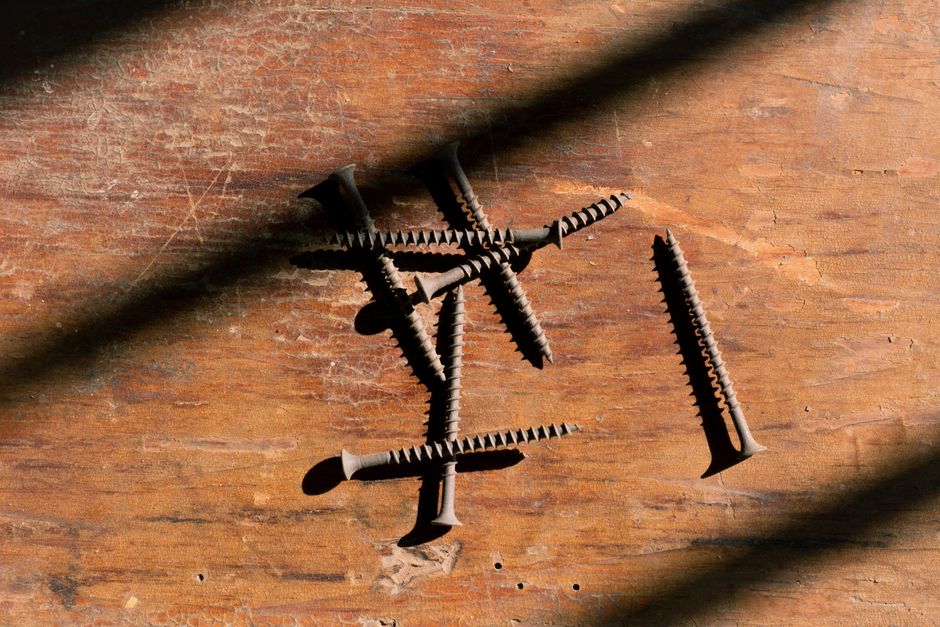
You can screw into concrete without a hammer drill, but the tool you use has to match the job. A hammer drill works by pulsing the bit forward while it spins, which chips through hard aggregate. Without that hammering action, you need either a bit made for the material or a fastener that creates its own hole. For a single shelf bracket or a picture frame, a carbide-tipped masonry bit in a regular drill will often get the job done. For a dozen holes in old, hard concrete, the same setup may burn out your bit and your patience.
Why Regular Drill Bits Fail In Concrete
Concrete is not wood or metal. It is a mix of cement paste and aggregate — sand, gravel, crushed stone — that cures into a hard, abrasive, brittle material. A standard twist bit for metal has a sharp point and cutting edges designed to slice through relatively soft steel. Press that bit into concrete and the hard aggregate grinds the cutting edges down almost immediately. The bit spins, heats up, and stops cutting.
Carbide-tipped masonry bits are different. The tip is a piece of tungsten carbide, which is harder than the aggregate in most concrete. It does not slice so much as grind and chip away material. That is why the bit generates dust rather than curls of waste. It is also why the bit gets hot — friction is doing the work, and friction produces heat.
This is the core problem when you remove the hammer drill from the equation. The hammering action lets the bit break concrete into small pieces with each impact. Without it, the bit has to grind through the entire depth of the hole, which is slower and generates more heat. Heat is what kills masonry bits.
What Tools Actually Work Without A Hammer Drill
A corded or cordless rotary drill with a carbide-tipped masonry bit is the most common substitute. It works best in softer concrete, in block or brick, and for shallow holes. The key is to use low speed and firm, steady pressure. High speed creates heat without cutting faster in concrete. Let the bit do the work and pull it out periodically to clear dust.
A rotary hammer is a different tool from a hammer drill and is often confused with it. A rotary hammer uses a piston mechanism to deliver much stronger blows and is the standard tool for drilling concrete in professional work. If you own one, you do not have this problem. If you are choosing a tool for a project that involves many holes, a rotary hammer is the correct purchase, not a workaround.
For small jobs, self-tapping concrete screws are the real answer. These are hardened screws with a special thread that cuts its own path into a pre-drilled hole. You still need a pilot hole, but the hole can be smaller and shallower than what an anchor requires. Some concrete screws are designed to be driven directly into a pilot hole without a separate anchor, which simplifies the whole process.
There is also the option of a chemical anchor or adhesive. You drill a hole, clean it, inject a two-part epoxy or acrylic resin, insert a threaded rod or rebar, and let it cure. This does not reduce the drilling problem — you still need a hole — but it changes what the hole needs to accomplish. The holding strength comes from the adhesive bond, not from mechanical expansion.
Step-By-Step: How To Screw Into Concrete Without A Hammer Drill
Start by marking the hole location precisely. Concrete does not forgive a misplaced hole the way drywall does. Use a pencil or a marker, and if you are mounting something with multiple holes, mark all of them and check alignment before drilling anything.
Choose the right bit. For a concrete screw, the manufacturer specifies a pilot hole diameter, and that number matters. Too small and the screw will bind or snap. Too large and it will not grip. For an expansion anchor, the bit size must match the anchor diameter exactly. A 1/4-inch anchor needs a 1/4-inch hole, not a 5/16-inch hole “to be safe.”
Fit a carbide-tipped masonry bit into your drill. Set the drill to low speed. If your drill has a clutch, set it high enough that it does not slip under load. If it has a hammer setting, you can use it, but on a standard drill that setting is usually a light vibration that helps only marginally.
Drill the pilot hole. Apply firm, steady pressure straight into the wall. Do not push so hard that the bit stalls. Pull the bit out every few seconds to clear dust. Concrete dust packs into the flutes and stops the bit from cutting. A shop vacuum held near the hole helps, and a piece of tape on the bit marks your depth so you do not drill too deep.
Clean the hole. This step is skipped constantly and it matters. Blow or vacuum out the dust. For adhesive anchors, a clean hole is essential — dust weakens the bond. For mechanical anchors, dust can prevent the anchor from seating fully.
Insert the anchor or drive the screw. For an expansion anchor, tap it in with a hammer until it is flush, then tighten the screw or bolt. For a concrete screw, drive it in with a drill or impact driver set to low torque. Stop when the head seats against the surface. Over-tightening can strip the hole, especially in softer concrete or block.





Which Fastener Should You Use?
The fastener choice depends on what you are holding and how much load it carries. A picture frame needs almost nothing. A shelf holding books or a wall-mounted TV needs a fastener rated for that load, and the rating should come from the manufacturer, not from guesswork.
Plastic anchors are for light loads in solid concrete or block. They expand slightly when the screw goes in and grip the hole walls. They are not appropriate for overhead loads or anything that could hurt someone if it falls.
Wedge anchors and sleeve anchors are for heavier loads. They expand against the concrete as you tighten them. They are strong in solid concrete but perform poorly in cracked concrete or in the hollow cores of block.
Concrete screws are convenient and removable. They are rated for specific load capacities, and those ratings assume correct hole size and proper installation. In cracked concrete, their holding capacity drops.
Adhesive anchors are often used for heavy loads and for situations where the concrete is cracked or the hole is close to an edge. The adhesive bonds to the concrete along the full depth of the hole. Cure time varies by product and temperature, and the anchor should not be loaded until the adhesive has fully cured.
Common Mistakes That Cause Failures
The most common failure is the wrong hole size. People drill a hole that is too large because the anchor “felt tight,” and the anchor spins without gripping. The second most common is not drilling deep enough. An anchor needs to sit at the correct depth, and if the hole is too shallow, the anchor cannot expand properly.
Drilling into the wrong material is another frequent problem. Concrete, brick, and block behave differently. Block has hollow cores, and a hole can open into empty space where no anchor will hold. A hammer drill does not solve this — you need to know what is behind the surface.
Over-tightening is a quiet failure. It can crack the concrete around the hole or strip the threads, and the damage may not show until the load is applied. Tighten to the manufacturer’s specification, not until it feels “tight enough.”
Finally, ignoring dust. Dust left in the hole reduces friction for mechanical anchors and weakens the bond for adhesive anchors. It takes ten seconds to clear a hole and it is the difference between a fastener that holds and one that pulls out.
When You Should Rent Or Buy A Hammer Drill
If you are drilling more than a few holes, or if the concrete is old and hard, a hammer drill or rotary hammer will save you time and bits. Masonry bits are consumable, and burning through several of them costs more than renting the right tool for a day. For a project like mounting a TV, installing a railing, or anchoring a shed, the right tool is not optional — it is the difference between a secure installation and a dangerous one.
For a single picture hook, a carbide bit and a steady hand are fine. Match the tool to the job, and when the load matters, do not compromise on the fastener or the hole.
Frequently Asked Questions
Can I use a regular drill bit for concrete?
No, a standard metal or wood bit will dull almost immediately in concrete. You need a carbide-tipped masonry bit, which is hard enough to grind through the aggregate.
Do concrete screws need a pilot hole?
Yes, concrete screws require a pilot hole sized to the manufacturer’s specification. The screw cuts threads into the concrete, and the hole must be the correct diameter for that to work.
How deep should I drill for a concrete anchor?
The hole should be at least as deep as the anchor’s embedment depth, which the manufacturer specifies. Drilling deeper than needed is fine, but too shallow means the anchor cannot seat or expand correctly.
Will a hammer drill work on brick and block?
A hammer drill can drill brick and block, but block has hollow cores that may not hold an anchor. You need to know what is behind the surface before choosing a fastener.
