
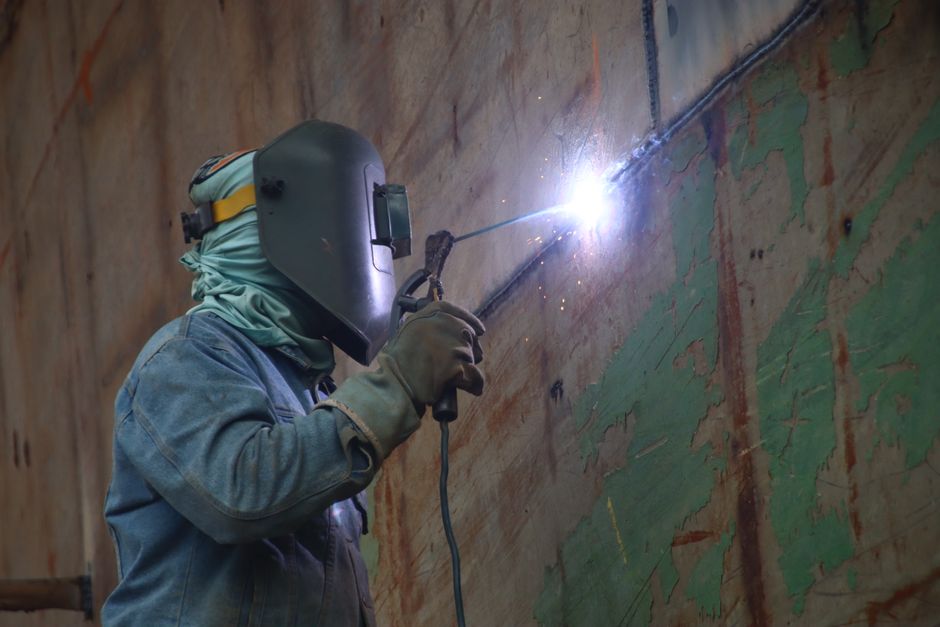
You have a cracked polyethylene kayak, a leaking water tank, or a split HDPE bucket, and you need to know whether to weld it or glue it. The honest answer: welding is the reliable repair for polyethylene, and adhesives are a distant second. Polyethylene has one of the lowest surface energies of any common plastic, which means most glues physically cannot form a strong bond to it. Heat welding melts the material itself, fusing new polyethylene into the old — no adhesive chemistry required.
Why Is Polyethylene So Hard To Glue?
Polyethylene’s surface is the problem. Its molecules are long chains of carbon and hydrogen with no reactive chemical groups sticking out. There is nothing for an adhesive to grab onto.
Adhesives work through two main mechanisms. Some form chemical bonds with reactive groups on a surface. Others rely on molecular attraction and mechanical interlocking. Polyethylene offers neither. It is chemically inert, and its surface energy is very low — commonly cited in materials science references as roughly 30 to 31 dynes per centimeter.
Compare that to a material like aluminum or glass, which have surface energies well above 40 dynes per centimeter. For a liquid adhesive to “wet out” and spread across a surface rather than bead up, its surface tension generally needs to be lower than the surface energy of the material it is bonding. Most structural adhesives sit above polyethylene’s threshold, so they bead up instead of grabbing.
There is also no meaningful porosity. Polyethylene is non-porous and non-polar. Adhesives that depend on soaking into a surface and locking in place have nothing to soak into.
This is why a glued polyethylene repair often fails at the bond line rather than the material itself. The plastic holds. The glue lets go.
How Does Polyethylene Welding Actually Work?
Welding sidesteps the adhesion problem entirely. Instead of bonding to the surface, you melt the polyethylene and let it fuse with new polyethylene of the same type.
When two polyethylene surfaces are heated to their melting range and pressed together, the polymer chains at the interface become mobile. They tangle across the boundary. As the material cools, those entangled chains lock into a single continuous piece. The result is not a glued joint sitting on top of the plastic. It is the plastic.
This matters because a properly executed weld can approach the strength of the surrounding material. A glued joint cannot. The bond line is always a separate material with its own properties, and on polyethylene it is usually the weakest point in the assembly.
One non-obvious point: welding only works well when the filler material matches the base material. Polyethylene comes in different densities and formulations — HDPE, LDPE, UHMWPE — and they do not all melt at the same temperature or blend cleanly. Using the wrong rod can produce a joint that looks fine and fails later.
How To Repair Polyethylene: Welding Vs Adhesives
The choice depends on what you are repairing, how much load it carries, and whether the part sees water, chemicals, or temperature swings.
| Factor | Welding | Adhesives |
|---|---|---|
| Bond mechanism | Melts and fuses the plastic itself | Relies on surface adhesion |
| Typical strength | Can approach base material strength | Usually much weaker on PE |
| Surface prep needed | Clean and dry; some methods require oxidation | Often requires flame or plasma treatment first |
| Water and chemical resistance | Same as the parent plastic | Limited by the adhesive, not the plastic |
| Skill required | Moderate to high | Low, but results are unreliable on PE |
| Best use | Structural, load-bearing, watertight repairs | Non-structural, low-stress, cosmetic fixes |
For anything that holds water, bears weight, or takes impact, welding is the appropriate repair. Adhesives are reasonable only for low-stress cosmetic work where a failed bond would not cause a leak or a structural problem.
What Are The Main Polyethylene Welding Methods?
There are three methods most people encounter. Each suits different situations.
- Hot air welding — a heat gun with a welding tip softens both the base material and a polyethylene filler rod. You feed the rod into the joint as you go. This is the most common method for tanks, kayaks, and large HDPE parts.
- Plastic welding with an extruder — a handheld extruder pushes molten polyethylene into the joint. It is faster and produces a more consistent weld, but the equipment costs more.
- Thermal fusion — used mainly for joining polyethylene pipe. The ends are heated and pressed together. This is a controlled industrial process, not a workshop repair method.
Hot air welding is the realistic option for most home repairs. It takes practice. The two most common mistakes are moving too fast, which leaves the joint cold and weak, and overheating, which degrades the polyethylene and makes it brittle.
Temperature matters. Polyethylene melts in a range rather than at a single point, and that range differs between HDPE and LDPE. Manufacturer guidance for your specific rod and base material is the reliable source here. Guessing at temperature is how welds fail.
Can You Glue Polyethylene If You Treat The Surface First?
Sometimes, but the results are inconsistent and the process is more involved than most people expect.
The idea behind surface treatment is to raise the surface energy of the polyethylene so an adhesive can wet out and bond. Two methods are used commercially:
- Flame treatment — a brief pass with an oxidizing flame chemically modifies the top layer of the plastic, adding polar groups that adhesives can bond to.
- Plasma treatment — exposes the surface to ionized gas, achieving a similar effect with more control.
Both are real industrial processes. Both are also time-sensitive. The treated surface can revert toward its original low-energy state over time, so the adhesive must be applied soon after treatment. In a home workshop, controlling flame treatment precisely enough to help rather than damage the plastic is difficult.
Even with treatment, adhesives formulated for polyethylene — typically cyanoacrylates or two-part acrylics designed for low-energy plastics — do not match a weld. They are a fallback, not an equal option.
What About Tape And Sealants?
They are not repairs. They are temporary measures.
Pressure-sensitive tapes and flexible sealants can slow a leak or cover a crack for a while. They do not restore structural strength, and on polyethylene they often peel away because of the same low surface energy problem that defeats adhesives. Silicone sealants in particular tend to release from polyethylene surfaces over time.
If a tape or sealant is holding for now, treat it as a stopgap. The underlying repair still needs to be a weld.
Which Repair Should You Choose?
Match the method to the load.
- Structural, load-bearing, or watertight: weld it. This is the only repair that can approach the strength of the original material.
- Low-stress and cosmetic: a specialty adhesive for low-energy plastics may be acceptable, with the understanding that it can fail.
- Temporary: tape or sealant to get you through, then weld it properly.
One more consideration: polyethylene that has been exposed to sunlight for years may have degraded. UV exposure breaks down the polymer chains near the surface. If the plastic around a crack is chalky, brittle, or crumbling, welding may not hold because the surrounding material itself is compromised. In that case, the part may be beyond repair.
The short version: polyethylene resists adhesives by its basic chemistry, and welding works because it does not fight that chemistry — it uses it. For any repair that matters, welding is the answer.
Frequently Asked Questions
Can you glue polyethylene?
Standard adhesives do not bond well to polyethylene because of its very low surface energy. Specialty adhesives for low-energy plastics exist, but even with surface treatment they do not match the strength of a weld.
Is welding stronger than gluing for polyethylene?
Yes. Welding melts and fuses the polyethylene itself, so a good weld can approach the strength of the surrounding material. A glued joint is a separate layer that usually fails before the plastic does.
What is the best way to repair a cracked HDPE kayak or tank?
Hot air welding with a matching polyethylene filler rod is the standard repair for cracked HDPE. It produces a watertight, load-bearing joint that adhesives cannot match on this material.
Why do glues peel off polyethylene?
Most adhesives cannot wet out on polyethylene’s low-energy surface, so they sit on top rather than bonding. Without a chemical or mechanical grip, the bond fails at the interface.
