
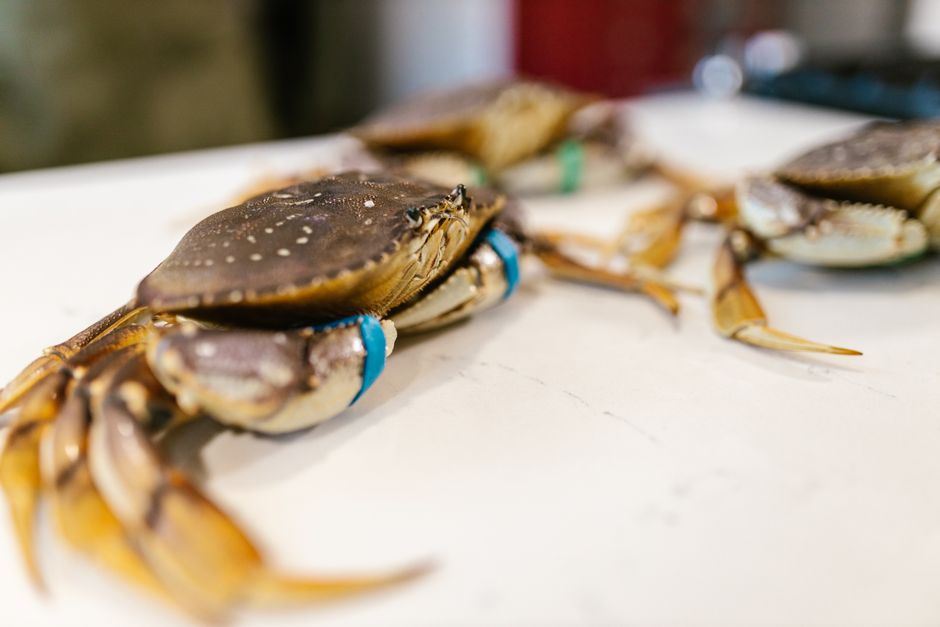
Removing a stone crab claw without killing the crab is possible because stone crabs can regrow lost limbs through a process called regeneration. The key is to take only one claw, twist it at the joint closest to the body, and return the crab to the water quickly. This practice is actually built into how stone crab fisheries operate — Florida law requires that harvesters take only the claws and release the crab alive.
How To Remove Stone Crab Claws Without Killing Them
The technique itself is straightforward once you understand the anatomy. A stone crab has two claws — one larger crusher claw and one smaller pincer claw. You take one, not both.
Grip the crab from behind, holding the shell on both sides of the carapace. This keeps the claws away from your fingers. Take the claw you intend to remove and hold it firmly near the body. Twist it quickly at the joint where the claw meets the body — the same joint where the claw naturally breaks when a crab sheds a limb.
The claw should separate cleanly at a predetermined breakage point. Crabs have a specialized structure at the base of each limb that allows for controlled detachment. This is not a random tear. The joint is designed to separate with minimal damage to the crab’s body.
After removal, return the crab to the water immediately. Do not leave it on a dock, in a bucket, or on hot pavement. The crab needs to be back in its environment to begin the healing and regeneration process.
There is a common misconception that you must “snap” the claw with force. You do not. A firm, quick twist at the correct joint is what works. Pulling or yanking can damage the body and reduce the crab’s chances of survival.
Why Does Removing a Stone Crab Claw Not Kill It?
Stone crabs have an unusual ability among crustaceans: they can survive the loss of a claw and regrow it. This is not a rare fluke. It is a normal part of their biology.
When a claw is removed at the correct joint, the crab’s body seals off the wound quickly. Hemolymph — the crab equivalent of blood — clots at the break point. The crab does not bleed out. Within hours, the wound site begins to heal.
Over the following months, a new claw starts to grow. It emerges as a small bud called a limb bud, then gradually develops into a functional claw. Research on stone crab regeneration indicates that a new claw can reach a usable size within about one year, depending on the crab’s age, diet, and water conditions. The regrown claw is often smaller than the original at first. With each subsequent molt, it grows larger.
This is why stone crab fisheries can operate the way they do. Harvesters remove one claw and release the crab. The crab regrows the claw, and in time it can be harvested again. It is one of the few examples in commercial fishing where the animal is not killed to harvest part of it.
Which Claw Should You Take?
Take only one claw. Taking both is lethal in most cases. A stone crab with no claws cannot feed, defend itself, or manipulate its environment. It will starve or be eaten.
If the crab has one large crusher claw and one smaller pincer claw, the choice matters. Some research suggests that removing the crusher claw may have a greater impact on the crab’s ability to feed, because the crusher is used to break open hard-shelled prey like oysters and clams. The pincer claw is more for grasping and tearing.
In practice, many harvesters take whichever claw meets the legal size limit. Florida regulations require that the claw be at least 2.75 inches long, measured from the tip of the claw to the first joint. If neither claw meets that size, both are left on the crab. The crab is returned to the water untouched.
If you are harvesting for personal use and both claws meet the size requirement, taking the smaller pincer claw may be the better choice for the crab’s survival. But the evidence on this is not definitive. Some studies show no significant difference in survival between crabs missing a crusher versus a pincer. Other studies suggest the crusher is more important for feeding. The honest position is that either claw can be taken legally, and the crab has a reasonable chance of surviving either way, but taking the pincer may be slightly less disruptive to its feeding ability.





What Happens If You Remove the Claw Incorrectly?
An incorrect removal can kill the crab or severely reduce its chances of survival. The most common mistakes are pulling instead of twisting, breaking the claw at the wrong joint, or removing both claws.
If the claw is pulled rather than twisted, the break may occur closer to the body, damaging the joint capsule or the body wall. This can lead to uncontrolled bleeding, infection, or inability to seal the wound. The crab may survive for a time but is unlikely to recover.
Breaking the claw at the wrong joint — for example, mid-claw rather than at the body joint — leaves a stump that may not seal properly. The crab may lose more hemolymph than it can replace. It may also be unable to regenerate a functional claw from that point.
Removing both claws is almost always fatal. A crab with no claws cannot feed. It cannot defend itself. It cannot compete for shelter. Even if it survives the initial injury, it will likely die within days to weeks.
Stress also matters. A crab that is handled roughly, kept out of water for a long time, or exposed to high temperatures may die after release even if the claw removal itself was done correctly. Return the crab to the water quickly and handle it as little as possible.
Is There a Legal Size for Stone Crab Claws?
Yes. In Florida, where the majority of stone crab harvesting occurs in the United States, the legal minimum claw size is 2.75 inches, measured from the tip of the claw to the first joint. Claws smaller than this must not be taken. The crab must be returned to the water with both claws intact.
Florida’s stone crab season runs from October 15 to May 1. During that period, harvesters may take claws from legal-sized crabs. Outside the season, taking claws is prohibited. These rules are enforced by the Florida Fish and Wildlife Conservation Commission.
Other states and countries have different rules. If you are harvesting stone crabs outside Florida, check your local regulations. Some areas prohibit claw removal entirely. Some require a permit. Some have different size limits or seasonal closures.
The legal framework exists because stone crab populations can be harmed by overharvesting. Taking claws from undersized crabs, taking both claws, or harvesting outside the season can reduce the population’s ability to sustain itself. The rules are not arbitrary. They are based on decades of fisheries data.
Does the Crab Feel Pain When You Remove Its Claw?
This is a question with no simple answer. Whether crustaceans experience pain in the way mammals do is an active area of research. The nervous system of a crab is decentralized and quite different from a human’s. They have no brain in the vertebrate sense.
Some studies suggest crustaceans may have nociceptors — sensory neurons that detect damaging stimuli. Other studies show that crabs will avoid locations where they previously received a shock, which some researchers interpret as evidence of a pain-like experience. But the question of whether they consciously suffer is not settled.
What is clear is that crabs respond to injury. They withdraw from damaging stimuli. They groom and protect wounded areas. They alter their behavior after losing a limb. Whether that constitutes pain in the human sense is a philosophical and scientific question that remains open.
From a practical standpoint, the removal is quick. A clean twist at the joint takes less than a second. The crab’s nervous system responds, but the duration of any potential suffering is brief. This is not a justification for rough handling. It is simply the reality of the procedure.
Can You Remove a Stone Crab Claw Without Special Tools?
Yes. You do not need any tools. Your hands are sufficient if you know where to grip and how to twist.
Some harvesters use a cloth or glove to get a better grip on the claw. This can help if the claw is wet or slippery. But it is not required. The key is a firm grip near the body and a quick twist at the joint.
Do not use pliers, clippers, or knives. These can crush the claw, damage the joint, or injure the crab. The natural breakage point is designed to work with a twisting motion, not a cutting one.
If you are harvesting many crabs, work quickly and efficiently. Have a bucket of seawater ready to hold the crabs briefly if needed, but do not leave them out of water for long. Return each crab to the water as soon as its claw is removed.
What Should You Do With the Crab After Removing the Claw?
Return it to the water immediately. Do not hold it for a photo. Do not put it in a cooler. Do not leave it on the deck while you finish harvesting others.
Place the crab back in the water gently. Do not throw it. A crab that has just lost a claw is stressed and may be less able to right itself if dropped from a height. Lower it into the water or let it crawl off your hand.
If you are on a boat, release the crab away from the propeller and away from areas where predators are concentrated. If you are wading or on a dock, release it into water deep enough to cover it.
The crab will likely retreat to shelter. It may hide for a day or two while it recovers. Within a few days, it will resume normal activity. Within weeks, the regeneration process will begin.
How Long Does It Take for a Stone Crab to Regrow Its Claw?
A stone crab can regrow a functional claw in about one year. The exact timeline depends on the crab’s size, age, diet, water temperature, and how much energy it has stored.
Younger crabs tend to regenerate faster than older crabs. Warmer water speeds up metabolism and molting, which accelerates regeneration. A crab that molts more frequently will regrow its claw more quickly than one that molts less often.
The new claw starts as a small bud. Over several molts, it grows larger. It may take more than one year for the claw to reach the same size as the original. But even a partially regrown claw allows the crab to feed and defend itself.
This is why stone crab populations can sustain claw harvesting if it is done correctly. The crab is not permanently disabled. It loses a limb, regrows it, and continues to live. The fishery depends on this biology.
Frequently Asked Questions
Can you take both claws from a stone crab and still release it alive?
No. Taking both claws is almost always fatal because the crab cannot feed or defend itself. Florida law requires that only one claw be taken and the crab released alive.
What is the legal size for a stone crab claw in Florida?
The claw must be at least 2.75 inches long, measured from the tip to the first joint. Claws smaller than this must not be taken, and the crab must be returned to the water with both claws intact.
Do you need a license to harvest stone crab claws?
In Florida, a recreational harvester needs a saltwater fishing license and must follow the same size and season rules as commercial harvesters. Other states have different requirements.
How long can a stone crab survive out of water after claw removal?
A stone crab can survive out of water for a short time, but the longer it is out, the lower its chances of survival after release. Return it to the water immediately after removing the claw.
