
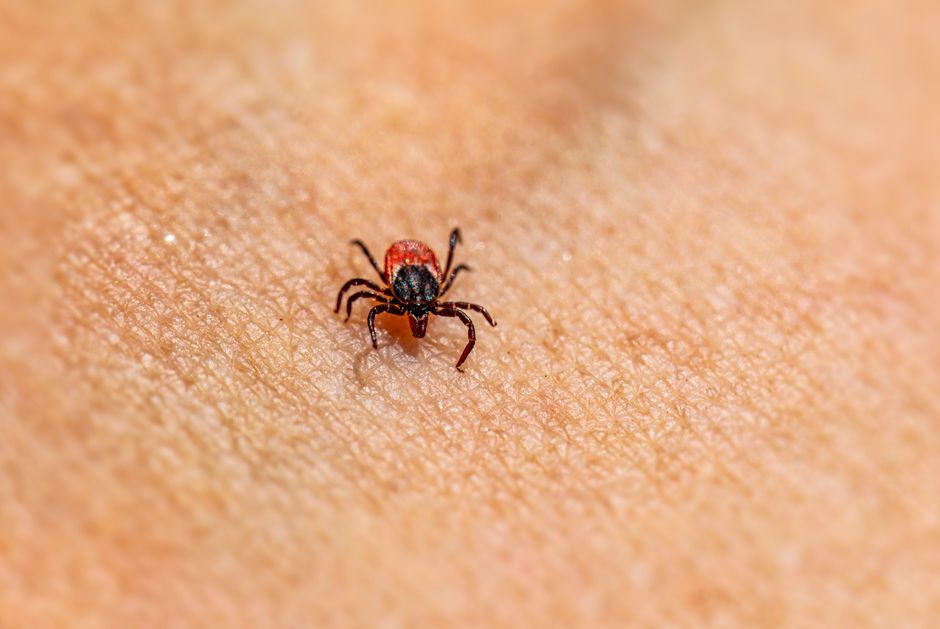
If a tick’s head is stuck in your skin, do not dig, squeeze, or burn it. Grab fine-tipped tweezers, grip the tick as close to your skin as you can get, and pull straight up with steady, even pressure. If the mouthparts break off and stay behind, leave them alone and let your skin heal — the pieces usually work their way out on their own over days to weeks.
That is the whole answer, and it is the same one public health agencies give. The harder part is not the pulling. It is knowing what “embedded” actually means, why the head is so hard to remove cleanly, and what to watch for afterward. This guide covers all of it, including the mistakes that make things worse.
What Does It Mean When a Tick Head Is Embedded?
A tick does not bite the way a mosquito does. It cuts a small opening in your skin and then pushes a set of mouthparts down into it. Those mouthparts include a central feeding tube and two rows of backward-facing barbs on either side. The barbs act like hooks. Once they are in, pulling the tick straight off is like pulling a fishhook out the way it went in.
To hold on tighter, the tick also releases a cement-like substance that hardens around the mouthparts and glues them into your skin. This is why a tick can stay attached for days and why it can be hard to remove without leaving something behind.
Here is the part most people get wrong. What looks like a “head” left in the skin is almost never the tick’s actual head. The tick’s body is a sac. Its true head is small and largely inside the skin already while it feeds. The dark speck you see after a botched removal is usually the feeding tube and the barbed mouthparts — the tick’s mouthparts, not its brain or head capsule.
That distinction matters for how much you should worry. Mouthparts left behind cannot grow, cannot lay eggs, and cannot reattach. They are a foreign object, not a living tick.
How To Remove An Embedded Tick Head Step by Step
Use fine-tipped tweezers. Not your fingers, not blunt household tweezers, not a credit card. Fine points let you get underneath the tick’s body right where it meets your skin, which is the only place that matters.
- Clean the area and your hands first. Rubbing alcohol or soap and water both work.
- Grip the tick as close to the surface of your skin as you possibly can. If you grab the tick’s bloated body instead, you will squeeze its contents back into you.
- Pull upward with slow, steady, even pressure. Do not twist, jerk, or yank.
- Do not stop halfway. Keep pulling until the tick lets go or comes free.
- Put the tick in a sealed bag, a small container, or a bit of tape. Do not crush it with your fingers.
- Clean the bite area and your hands with alcohol, iodine, or soap and water.
If the mouthparts stay in the skin, stop trying to get them out. More poking and digging causes more tissue damage than the leftover pieces ever would. Leave the site alone and let it heal.
One clarification worth knowing: the old advice to smother a tick with petroleum jelly, nail polish, or alcohol, or to hold a match to it, is not supported. Those methods can make a tick regurgitate its stomach contents into your bloodstream, which is the opposite of what you want. Physical removal with tweezers is the standard approach for a reason.
What Happens If the Tick Head Stays in Your Skin?
In most cases, not much. Your immune system treats the leftover mouthparts as a splinter. Over days to a few weeks, the skin around them breaks them down or pushes them toward the surface, and they come out on their own or flake away. A small red bump or a firm little nodule can form at the site and slowly fade.
Sometimes the skin closes over the fragment and forms a small granuloma — a tiny knot of inflamed tissue around the foreign material. These are usually harmless and often disappear over weeks to months. Some clinicians will remove a stubborn granuloma if it stays irritated, but many resolve without intervention.
What you should not do is treat the leftover piece as an emergency. It is not one. The real question is not whether the mouthparts are still there. It is whether the tick passed anything into you while it was attached.





What Diseases Can a Tick Transmit?
Ticks can carry several disease-causing organisms, and the risk depends heavily on the tick species, the region, and how long it was attached. In the United States, the blacklegged (deer) tick is the main carrier of the bacteria that cause Lyme disease, along with other infections. Other tick species transmit different organisms.
Timing matters. For Lyme disease specifically, transmission generally requires the tick to be attached for a prolonged period — often estimated at more than 24 hours, and risk rises the longer it feeds. A tick that was attached for a short time is much less likely to have passed the bacteria along. This is one reason prompt, complete removal matters so much.
Watch for these after a bite, especially in the weeks that follow:
- An expanding rash, including the classic bull’s-eye pattern, though not everyone gets one
- Fever, chills, headache, or muscle aches
- Fatigue that does not improve
- Joint pain or swelling
- Facial drooping or other neurological symptoms
Any of these warrant a call to a healthcare provider. Tell them you had a tick attached and roughly when. Early treatment of tick-borne illness is generally more effective than waiting.
When Should You See a Doctor After a Tick Bite?
See a provider if you develop any of the symptoms above, if the bite site becomes increasingly painful, hot, or swollen, or if you cannot remove the tick yourself. A provider can remove a stubbornly attached tick and assess the site.
If you live in or have traveled to an area where tick-borne disease is common, bring that up. Geography changes which infections are possible. So does the tick species — if you saved the tick, a provider or your local health department may be able to identify it, which can inform next steps.
For most routine bites with no symptoms and no leftover concerns, no testing or treatment is needed. That said, recommendations for preventive treatment after a high-risk bite exist in some circumstances, and whether they apply to you is a decision for a clinician, not a general article.
How Can You Prevent Ticks From Embedding in the First Place?
Prevention is more reliable than removal. Ticks tend to wait on grass and low brush, then climb onto you as you pass. They often crawl for a while before attaching, so a check soon after being outdoors can catch them before they settle in.
- Walk in the center of trails and avoid tall grass and brush where possible.
- Wear light-colored clothing so ticks are easier to spot.
- Use an EPA-registered tick repellent on skin and clothing, following label directions.
- Check your whole body after time outdoors — including scalp, ears, armpits, waist, and groin.
- Shower soon after coming inside, which can wash off unattached ticks.
- Check pets, since they can carry ticks indoors.
Removing an attached tick quickly is the single most effective step you can take once one has latched on. The sooner it is off, the less opportunity it has to feed and transmit anything.
Common Mistakes That Make It Worse
The instinct to get every last bit of the tick out is understandable, but it often backfires. Digging with a needle, squeezing the body, or applying heat all cause more harm than the leftover mouthparts.
Do not cover the tick in petroleum jelly or nail polish. Do not try to burn it. Do not twist it out with your fingers. Each of these can trigger the tick to release its gut contents into your skin, which is exactly the scenario you are trying to avoid.
If tweezers are not available and you must act, use a clean, fine-tipped tool to grip as close to the skin as possible and pull straight up. Fingers alone are a poor substitute because they cannot get under the tick’s body without squeezing it.
The takeaway is simple. Remove the tick correctly and completely if you can. If the mouthparts break off, leave them and let your body handle it. Then watch for symptoms over the following weeks, because the piece left in your skin is not the real concern — what the tick may have passed to you is.
Frequently Asked Questions
Does the tick head stay in your skin and grow?
No. The leftover piece is mouthparts and feeding tube, not a living head, and it cannot grow or reproduce. It is a foreign object that your skin typically breaks down or pushes out over days to weeks.
Can you leave an embedded tick head in your skin?
Yes, in most cases you can leave it alone and let it heal. Digging it out causes more tissue damage than the fragment itself, so the standard advice is to clean the area and let your body handle it.
What happens if you squeeze a tick while removing it?
Squeezing the tick’s body can force its stomach contents into your bloodstream, which may increase the chance of disease transmission. Always grip as close to your skin as possible and never crush the tick with your fingers.
How long does it take for leftover tick mouthparts to come out?
It varies. Many fragments work their way out or dissolve within days to a few weeks, though some can remain longer as a small, harmless bump under the skin.
