
The muscle that connects your neck to your shoulder blade is a common source of stubborn neck and upper back pain. Tightness in the levator scapulae often feels like a deep ache at the base of the neck that refuses to go away. Releasing this tension for good requires more than a quick stretch; it demands correcting the posture and movement habits that keep the muscle in a shortened, overworked state.
What Causes Levator Scapulae Tension in the First Place?
The levator scapulae muscle sits at the side and back of your neck. It attaches to the top of your shoulder blade and to the upper vertebrae of your neck. Its main job is to lift the shoulder blade and help tilt and rotate your neck.
Most tension in this muscle comes from sustained positions that keep it contracted. Looking down at a phone or computer for hours forces the muscle to work overtime just to hold your head up. The average adult head weighs about 10 to 12 pounds. For every inch your head moves forward, the weight your neck muscles must support roughly doubles.
Stress also plays a direct role. When you are anxious, you tend to shrug your shoulders and hold them up near your ears. This constant low-level contraction fatigues the levator scapulae. Over time, the muscle develops trigger points — localized knots that refer pain to the base of the neck and the area around the shoulder blade.
How To Release Levator Scapulae Tension For Good
Releasing this muscle permanently requires a two-part approach. First, you must actively lengthen the muscle when it is tight. Second, you must stop doing the things that shorten it throughout your day.
Passive stretching alone will not fix the problem if you spend eight hours a day hunched forward. The muscle will simply tighten again within hours. The most effective strategy combines daily stretching with immediate posture corrections and strength work for the muscles that oppose the levator scapulae.
The stretch itself is simple but must be done with precision. Sit up straight and look forward. Tilt your head to one side, bringing your ear toward your shoulder. Then gently turn your chin toward your armpit on the same side. You should feel a pull along the back and side of your neck. Hold for 30 seconds and repeat on the other side.
Doing this stretch every two hours during a workday is more effective than doing it once in the morning and once at night. The muscle needs frequent reminders to return to its resting length.
Self-Massage Techniques That Actually Work
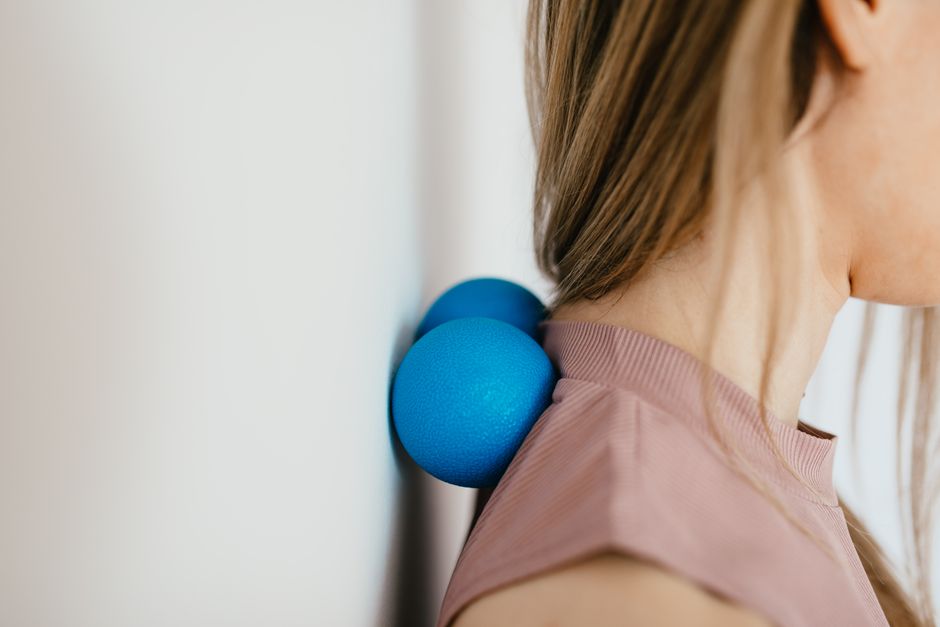
Self-massage can provide immediate relief and help break up trigger points. A tennis ball or lacrosse ball placed between the base of your neck and a wall can target the muscle directly. Position the ball just above the top of your shoulder blade, lean into the wall, and apply steady pressure for 30 to 60 seconds.
Do not roll aggressively over the area. The levator scapulae is a relatively small muscle, and too much pressure can increase muscle spasm. Instead, find the most tender spot and hold still. Breathe deeply and allow the muscle to relax around the pressure.
Fingertip massage can also work when you are at a desk. Reach your opposite hand over your shoulder and grasp the muscle between your thumb and fingers. Squeeze gently and apply small circular motions for one to two minutes. You are looking for a dull ache, not sharp pain. Sharp pain means you are pressing too hard or on the wrong structure.
Heat applied before massage increases blood flow and relaxes the tissue. A warm shower or a heating pad for 10 minutes prepares the muscle for deeper work. Ice after massage can reduce any residual soreness, but it is not necessary for everyone.





Why Your Desk Setup May Be Undoing All Your Effort
Your workstation setup determines whether your levator scapulae muscles get a break or stay active all day. If your monitor is too low, you tilt your head forward and down to see it. This position keeps the levator scapulae in a shortened, contracted state for hours.
The top of your monitor should be at or slightly below eye level. Your chair height should allow your elbows to rest at a 90-degree angle with your shoulders relaxed. Your feet should be flat on the floor. When your shoulders are rounded forward, the levator scapulae is lengthened at one end but forced to contract at the other — a combination that leads to strain.
One quick test: sit at your desk and close your eyes. Relax your shoulders completely. Open your eyes and look at your posture. If your shoulders have crept up toward your ears, your desk is likely too high or your chair too low. Adjust until your shoulders sit naturally without effort.
Strengthening the Muscles That Oppose the Levator Scapulae
Stretching a tight muscle without strengthening its opposite is a losing battle. The levator scapulae works to elevate the shoulder blade. The muscles that pull the shoulder blade down and back — the lower trapezius and the serratus anterior — need to be strong enough to counteract that pull.
Simple rows are one of the most effective exercises. Attach a resistance band to a door handle at chest height. Hold the band with both hands, keep your elbows close to your body, and pull backward while squeezing your shoulder blades together. Perform three sets of 12 repetitions daily.
Wall slides also help. Stand with your back against a wall, arms raised in a goalpost position. Slowly slide your arms up the wall until they are straight overhead, keeping your lower back flat against the wall. This movement strengthens the lower trapezius and teaches your shoulder blades to move correctly.
Chin tucks deserve special attention. Sit or stand tall and pull your head straight back, creating a double chin. Hold for five seconds and release. This exercise strengthens the deep neck flexors, which are often weak in people with tight levator scapulae muscles. Weak deep neck flexors force the levator scapulae to work harder than it should for basic head support.
Sleep Position and Pillow Choices That Prevent Recurrence
Your sleep position can tighten the levator scapulae overnight and undo all your daytime work. Sleeping on your stomach forces your neck into a rotated position for hours. This places the levator scapulae on one side under constant stretch and the other side in constant contraction.
Back sleeping with a supportive pillow is generally best. Your pillow should fill the space between your head and the mattress without propping your head up at an angle. The goal is for your cervical spine to remain in a neutral line with the rest of your spine.
Side sleepers need a pillow that keeps their head level with their shoulders. A pillow that is too thick or too flat causes the neck to bend sideways, which shortens the levator scapulae on one side. If you wake up with neck stiffness every morning, your pillow is likely the culprit.
Some people find relief by placing a small rolled towel under the base of their neck when sleeping on their back. This provides gentle support to the cervical curve and reduces the load on the levator scapulae. There is no strong clinical evidence that any single pillow type is superior, but the principle of neutral spine alignment is well established.
When Self-Care Is Not Enough
Most levator scapulae tension responds well to stretching, massage, and posture changes within two to four weeks. If you have been consistent with these measures and still experience significant pain, it is time to seek professional evaluation.
A physical therapist can assess whether your pain truly comes from the levator scapulae or from a different structure. Neck pain can originate from the cervical facet joints, the discs, or other muscles that refer pain to the same area. The levator scapulae is often the victim of these other problems rather than the cause.
Sharp pain, numbness, tingling in the arm or hand, or pain that wakes you from sleep warrants a medical evaluation. These symptoms may indicate nerve involvement that will not improve with stretching alone.
Dry needling and manual therapy performed by a licensed professional can help when self-massage fails to release stubborn trigger points. These treatments are generally safe when performed by trained clinicians, and some research supports their short-term effectiveness for neck pain. However, they address the symptom, not the underlying postural cause.
Frequently Asked Questions
How long does it take to release levator scapulae tension?
Most people notice significant improvement within two to four weeks of consistent stretching and posture correction. Chronic tension that has built up over years may take longer to fully resolve.
Can stress alone cause levator scapulae tightness?
Yes, stress causes you to unconsciously elevate and tense your shoulders, which keeps the muscle contracted for extended periods. Stress management techniques such as deep breathing can reduce this habitual tension.
Is it safe to massage the levator scapulae myself?
Self-massage with gentle pressure is generally safe for most people. Avoid pressing directly on the spine or the front of the neck, and stop if you feel sharp pain, numbness, or dizziness.
What is the best sleeping position for levator scapulae pain?
Sleeping on your back with a supportive pillow that maintains a neutral neck position is usually best. Side sleepers should use a pillow that keeps their head level with their shoulders, and stomach sleeping should be avoided.
