
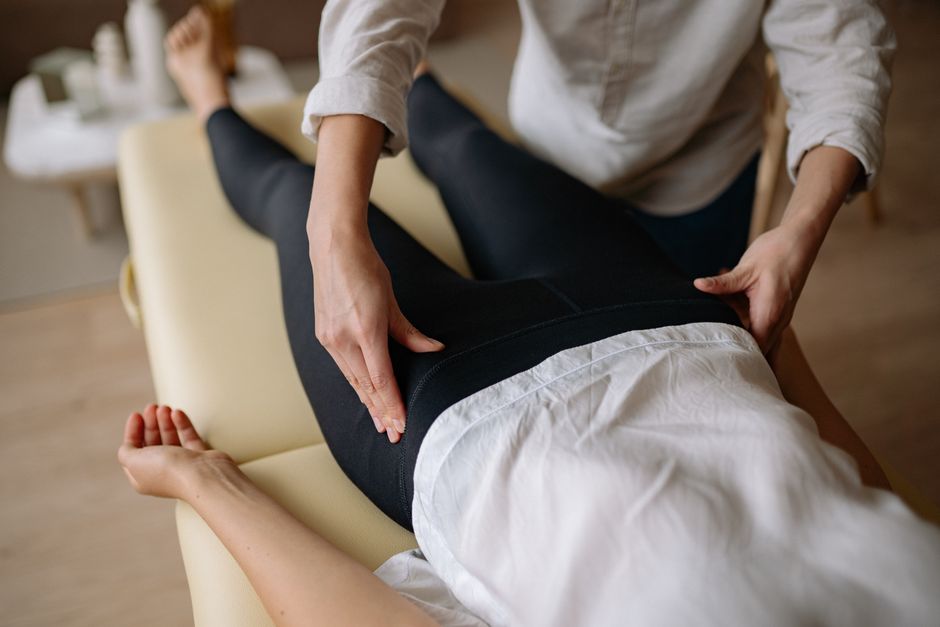
Tightness in the iliacus and psoas muscles rarely comes from the muscles themselves. These two muscles — together called the iliopsoas — connect your lower spine and pelvis to your thigh bone. They shorten when you sit a lot, guard when you’re stressed, and weaken when they’re never asked to work through a full range. Releasing them for good means doing three things consistently: lengthening them, strengthening them at length, and changing the daily habits that keep them short. Stretching alone almost never fixes the problem because a stretched muscle that stays weak will tighten again.
What Do The Iliacus And Psoas Actually Do?
The psoas major starts on the sides of the lower spine — roughly from the twelfth thoracic vertebra down to the fifth lumbar vertebra — and runs down through the pelvis to attach to the femur. The iliacus starts on the inner surface of the pelvis and joins the psoas tendon just before it reaches the thigh. Together they form the primary hip flexor group.
That anatomy matters because it explains the symptoms. When these muscles shorten, they pull on the lumbar spine and tilt the pelvis forward. That can create a feeling of tightness in the front of the hip, a deep ache in the lower back, or a sense that you cannot fully straighten up after sitting.
They are also postural muscles. They help stabilize the spine and the hip joint during walking, running, and standing. This is why aggressive stretching can backfire — an overstretched but unstable hip often causes the muscle to tighten again as a protective response.
Why Does Stretching Alone Not Fix Iliopsoas Tightness?
Stretching temporarily increases tolerance to stretch. It does not change the underlying reason the muscle is short. If you sit for eight hours a day and stretch for two minutes, the math does not work in your favor.
There is also a common misunderstanding worth correcting. A muscle that feels tight is not always a muscle that is short. Sometimes it feels tight because it is working hard to compensate for weak glutes, a stiff hip joint, or poor breathing mechanics. Stretching that muscle gives short-term relief and long-term nothing.
Research on stretching consistently shows that flexibility gains come from nervous system tolerance, not permanent tissue lengthening. That is not a reason to skip stretching. It is a reason to stop expecting stretching by itself to solve a problem that has multiple causes.
How To Release Iliacus And Psoas Tightness For Good
A lasting solution combines four elements: lengthening the muscle, strengthening it through a full range of motion, restoring normal hip joint mechanics, and reducing the daily positions that keep it short. Missing any one of these tends to bring the tightness back.
Lengthen Without Forcing
The most effective position for the iliopsoas is a half-kneeling hip flexor stretch with a posterior pelvic tilt. In plain terms: kneel on one knee, tuck your tailbone under slightly, and gently shift your weight forward until you feel a stretch in the front of the hip of the kneeling leg.
Hold for 20 to 30 seconds. Breathe normally. Do not arch your lower back to get more range — that defeats the purpose because it puts the muscle back into a shortened position relative to the spine.
Two to three sets per side, most days of the week, is a reasonable starting point. This is general clinical practice rather than a specific guideline, and individual needs vary.
Strengthen At Length
This is the step most people skip. A muscle that has been stretched needs to be trained to control that new range. Otherwise the nervous system pulls it back to where it feels safe.
- Split squats and lunges with a controlled tempo
- Hip flexor raises while lying on your back with knees bent
- Step-ups onto a low platform, focusing on full hip extension at the top
- Dead bugs and other core exercises that teach the pelvis to stay neutral
Start with bodyweight and small ranges. The goal is control, not load. Two to three sessions per week is a common recommendation, though no universal protocol exists.
Restore Hip Joint Mechanics
If your hip joint itself is stiff — a condition some clinicians call hip joint capsular tightness — no amount of muscle stretching will fully resolve the feeling of tightness. Hip rotations, gentle hip circles, and movements that take the joint through its available range can help.
If you have sharp pain, clicking, or catching in the hip, that is a reason to see a clinician rather than push through it. Several different conditions can produce similar hip symptoms, and self-diagnosis is unreliable.
Change The Daily Habits
This is where lasting change actually happens. The iliopsoas adapts to whatever position you hold most often. Sitting with the hips flexed for long stretches teaches the muscle to stay short.
Stand up and move every 30 to 45 minutes if you can. That number comes from general workplace movement guidance rather than a specific clinical trial. Even brief movement breaks help.
If you sit for work, consider a chair that lets your hips stay at or slightly above knee level. Sleeping position matters too — sleeping on your side with a pillow between the knees keeps the hips closer to neutral than sleeping flat on your stomach, which keeps one or both hips extended.




How Long Does It Take To See Results?
Most people notice some change within two to four weeks of consistent work. That is a general clinical observation, not a figure from a controlled trial, and it varies widely depending on how long the tightness has been present and what is causing it.
Lasting change — where the tightness stops coming back — usually takes longer. Weeks to months is realistic. The muscles themselves adapt relatively quickly, but the movement habits and postural patterns that created the problem take longer to shift.
If you have been consistent for six to eight weeks with no change at all, that is a signal to get assessed. Something else may be driving the symptoms.
What Else Can Feel Like Psoas Tightness?
A lot of things. This is worth knowing because treating the wrong thing wastes time.
- Hip osteoarthritis, which can cause stiffness and pain in the groin area
- Labral tears in the hip joint
- Lumbar spine conditions, including disc issues and facet joint problems
- Inguinal hernia or other soft tissue problems in the groin
- Referred pain from the lower back or sacroiliac joint
Distinguishing these from simple muscle tightness is not something you can reliably do on your own. A physical therapist or physician can assess hip range of motion, strength, and joint mechanics in ways that self-testing cannot.
Red flags that warrant prompt medical evaluation include pain that wakes you at night, numbness or tingling down the leg, weakness in the leg, unexplained weight loss, or pain that gets steadily worse rather than better.
Which Exercises Should You Avoid?
Aggressive static stretching held for a long time, deep backbends that compress the lumbar spine, and any movement that causes sharp pain are not helpful for this problem. Pain is a signal, not a challenge.
Also be cautious with intense foam rolling directly over the front of the hip. The psoas sits deep in the abdomen, behind other structures, so a foam roller cannot reach it directly. What people often feel when rolling the front of the hip is pressure on the quadriceps, the hip joint capsule, or nearby nerves — not the psoas itself.
Gentle movement, controlled strengthening, and consistent habit change do more for this problem than any single technique.
Does Stress Play A Role?
Yes, though the mechanism is indirect. The psoas has connections to the diaphragm through fascia, and breathing patterns change when you are stressed. Shallow chest breathing reduces the natural movement of the diaphragm and the lower ribs, which can change how the psoas and iliacus are loaded.
Diaphragmatic breathing — slow, deep breaths that expand the lower ribs rather than the upper chest — is a reasonable addition to a hip mobility routine. The evidence for breathing work specifically resolving iliopsoas tightness is limited, but the relationship between breathing mechanics and trunk stability is well established.
Frequently Asked Questions
Can you stretch the psoas directly?
You cannot isolate the psoas completely because it lies deep in the abdomen behind other structures, but a half-kneeling hip flexor stretch with a posterior pelvic tilt targets it effectively along with the iliacus. No stretch isolates one muscle perfectly.
How often should I stretch my hip flexors?
Most clinical guidance suggests stretching most days of the week, with two to three sets of 20 to 30 seconds per side. There is no single evidence-based frequency that has been confirmed in trials.
Is psoas tightness causing my lower back pain?
It can contribute, but lower back pain has many causes and the psoas is only one possible factor. A clinician can help determine whether hip flexor tightness is actually part of your problem.
Can a massage therapist release the psoas?
Some trained practitioners use techniques intended to address the psoas through the abdomen, but evidence that this produces lasting change is limited. Massage may provide short-term relief, but it does not address the strength and habit factors that keep the muscle tight.
