
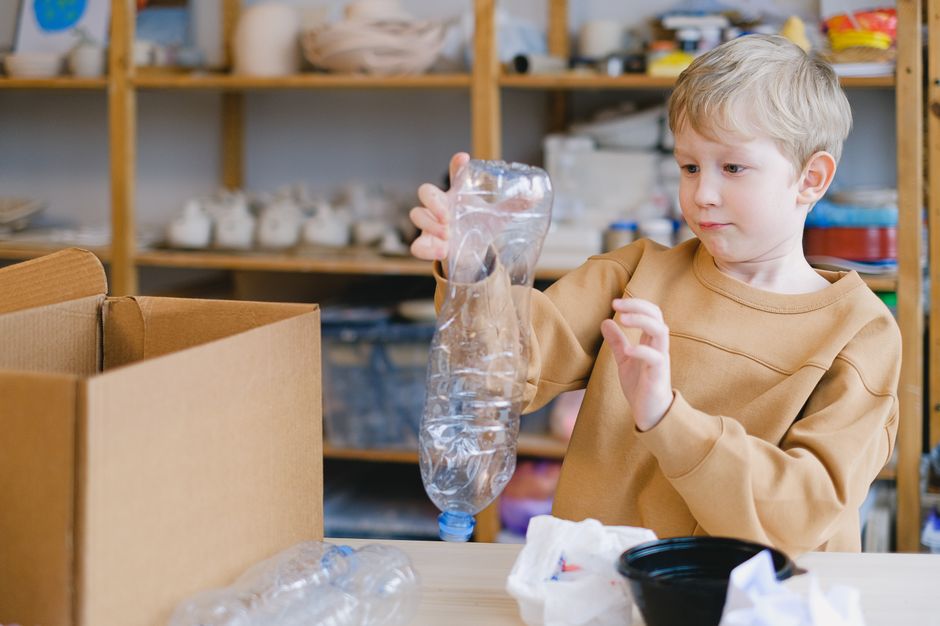
Teaching kids to recycle works best when the rules are simple, visual, and repeated the same way every time. Children learn sorting faster when they can see the bin, touch the item, and hear the same short instruction again and again. The goal is not a perfect recycler at age six. It is a habit that survives into adulthood.
How To Recycle For Kids Simple Rules That Stick
Young children can sort most household items into three or four categories by around age four or five. The trick is to keep the categories few and the labels obvious.
A workable set of rules for a household with kids looks like this:
- Paper and cardboard go in one bin. Flatten boxes so they fit.
- Plastic bottles and containers go in another. Empty and rinse them first.
- Glass and metal go together in many programs. Check your local rules.
- Everything else goes in the trash unless your area collects it separately.
That last rule matters more than parents expect. Young children generalize quickly. If one plastic item goes in the recycling bin, a child may assume all plastic does. Naming the exceptions out loud — “this wrapper is trash, this bottle is recycling” — prevents the confusion that leads to contaminated bins.
Contamination is the real-world problem here. When non-recyclable items get mixed into recycling, they can damage sorting equipment or cause whole loads to be sent to landfill. Teaching kids to pause before tossing is a practical skill, not just a nice habit.
What Age Can Kids Start Recycling?
Most children can participate in simple sorting tasks by age three or four. At that stage, the job is matching — this item looks like that picture on the bin.
Between ages five and seven, kids can start making small decisions on their own. They can check whether a container is empty, whether a box is flattened, and whether something belongs in the trash instead. This is also when they start asking why, which is a good opening to explain what happens to recycled material.
By age eight or older, many children can take on a real role in the household routine. That might mean carrying the recycling out, rinsing containers, or reminding other family members. Responsibility grows with the task, not with the age number alone.
One point worth being honest about: there is no single research-backed age at which recycling education “works.” Child development guidelines describe when children can follow multi-step instructions and sort by category, but the specific age a child adopts a recycling habit depends heavily on what happens at home.
Why Do Kids Forget The Rules?
Kids forget recycling rules for the same reason adults do. The rule is not obvious, the bin is not visible, or the instruction changes depending on who is giving it.
Three common breakdowns:
- The bin is out of sight. If the recycling bin is in the garage and the trash can is in the kitchen, the trash wins by default.
- The rule is too complicated. A child who has to remember seven categories will default to guessing.
- Adults do it differently. If one parent recycles a pizza box and the other throws it away, the child learns that the rule is flexible. It is not.
The fix is usually environmental, not motivational. Move the bin, cut the categories, and make sure every adult in the house follows the same rule. Stickers on the bins showing pictures of what goes inside help children who cannot yet read.
How Do You Make Recycling Stick Long Term?
Habits stick when they are tied to something that already happens every day. Recycling works best when it is attached to an existing routine — after dinner, before bed, or when a container is empty.
Repetition matters more than rewards. A sticker chart can help at the start, but the goal is for the action to become automatic. Once a child sorts without being asked, the habit is doing the work.
Letting kids see the result helps too. If your area has a recycling center that offers tours, that is a concrete way to connect the bin at home to something real. If not, a simple explanation — that bottles get turned into new bottles and boxes into new boxes — is enough for most young children.
Older kids respond to honesty. Recycling does not solve everything, and it does not work if the material is contaminated or if there is no market for it. Telling a ten-year-old that some plastics are hard to recycle is more likely to build trust than pretending every item gets a second life.
What Actually Goes In The Recycling Bin?
Rules vary by city and by program, so the local guide from your waste hauler is the only fully reliable source. That said, a few categories are consistent across most US curbside programs.
| Item | Usually Accepted | Usually Not Accepted |
|---|---|---|
| Paper | Newspaper, office paper, mail, flattened cardboard | Greasy pizza boxes, paper towels, napkins |
| Plastic | Bottles and jugs with necks | Bags, wraps, straws, most clamshells |
| Glass | Bottles and jars | Drinking glasses, mirrors, window glass |
| Metal | Aluminum cans, steel food cans | Aerosol cans in some areas, scrap metal |
Two clarifications worth passing on to kids. First, “recyclable” and “recycled” are not the same thing. A plastic item may carry a recycling symbol and still be rejected by your local program. Second, the number inside the triangle on plastic does not mean the item is accepted everywhere. It identifies the type of plastic, not whether your city takes it.
Greasy cardboard is a common mistake. Food residue can ruin a batch of paper recycling, so a pizza box with oil soaked into it usually belongs in the trash or compost. A clean lid can often be recycled on its own.
How Do You Teach Recycling Without Nagging?
Nagging teaches kids to avoid the task. Modeling teaches them to copy it. The most reliable way to get a child recycling is for them to see an adult do it without complaint, every day.
Make the child the helper, not the student. Hand them an item and ask where it goes. Let them be right or wrong without a lecture. Correct the mistake once, calmly, and move on.
Keep instructions short. “Empty, rinse, recycle” is easier to remember than a paragraph about why. For younger kids, a three-word rule is often enough: “Bottle in here.”
If a child loses interest, that is normal. Habits take time, and children cycle through interests. The bin stays in the same place, the rule stays the same, and the routine continues. Most kids come back to it.
Does Recycling At Home Actually Matter?
Household recycling does reduce the amount of material sent to landfill, but its impact depends heavily on local infrastructure. In some communities, a large share of what residents put in the bin is ultimately processed. In others, limited facilities mean much of it is not.
This is not a reason to stop. It is a reason to be accurate. Teaching kids that recycling is one useful habit among several — along with reducing what you buy and reusing what you can — gives them a more honest picture than the idea that recycling alone solves the problem.
Many schools now teach the three-part version: reduce, reuse, recycle, in that order. That framing is worth repeating at home. Recycling is the last step, not the first.
Frequently Asked Questions
At what age can a child start recycling?
Most children can help sort items into simple categories by age three or four. By age eight or older, many can take on a real role in the household recycling routine.
What are the simplest recycling rules for young kids?
Use three or four categories, label the bins with pictures, and repeat the same rule every time. “Paper here, bottles here, trash here” is easier to remember than a long list.
Should kids rinse containers before recycling?
Yes, empty and rinse containers before putting them in the bin. Food residue can contaminate paper and other recyclables and may cause a whole load to be rejected.
Does the recycling symbol mean an item can be recycled?
No. The number inside the triangle identifies the type of plastic, not whether your local program accepts it. Always check your city or waste hauler’s guide for what is accepted.
