
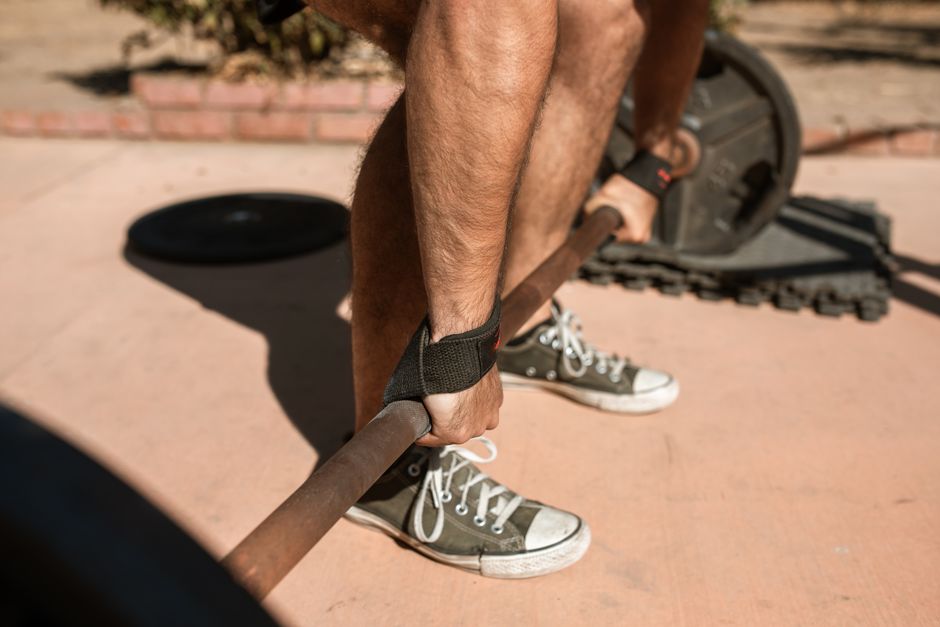
Putting on wrist straps for deadlifts correctly means threading the loose tail of each strap through its own loop to form a snug cuff around your wrist, then wrapping the remaining tail around the bar in the direction opposite your grip so the bar tightens the strap as it tries to roll. The loop sits just above the wrist bone, the cuff is snug but not tight enough to restrict blood flow, and the strap tail wraps around the bar two to three times before you grip it against your palm. Done this way, the strap supports your hold without changing how the lift itself is performed.
How To Put On Wrist Straps For Deadlifts Correctly
The setup has two stages: securing the strap to your wrist, then securing the strap to the bar. Most people get the first stage right and the second stage backwards, which is why the strap slips or feels useless.
Stage one: the wrist loop. Slide your hand through the loop at the end of the strap so the loop sits around your wrist, just above the wrist bone on the thumb side. Pull the loose tail through the loop’s opening to tighten it. The cuff should feel snug against your skin. It should not dig in or make your fingers tingle. If it does, loosen it. A strap that is too tight can compress the tissues of the wrist, and there is no benefit to that during a lift.
Stage two: the bar wrap. With the strap hanging down from your wrist, reach for the bar. Wrap the tail of the strap around the bar in the direction that opposes the way the bar would roll out of your hand. For a standard overhand grip, that means wrapping the tail away from you, over the top of the bar, and back toward your body. Wrap it two to three times. Then close your hand around the bar, trapping the wrapped strap between your palm and the bar.
The test is simple. Stand up with the bar and let it hang. If the strap tightens as the bar pulls down, you wrapped it the right way. If it loosens or unwinds, you wrapped it backwards. Reverse the direction and try again.
Which Direction Should You Wrap The Strap Around The Bar?
The strap must wrap in the direction that tightens under load. This is the single most common mistake with wrist straps, and it is entirely mechanical.
When you hold a deadlift bar, the bar wants to roll out of your fingers and toward your fingertips. A strap wrapped the correct way turns that rolling force into tightening force. As the bar tries to roll, it pulls the strap tighter around itself and against your hand. A strap wrapped the wrong way does the opposite. The bar rolls, the strap unwinds, and you get no help at all.
Here is the rule in plain terms. Look at your gripping hand from above. If you are using an overhand grip, the bar rolls toward your fingertips, away from your body. Wrap the strap so its tail crosses over the top of the bar and heads back toward your body. If you are using a mixed grip with one hand turned palm-forward, that hand wraps in the opposite direction from the other. Check each hand separately.
This is why some lifters find straps “don’t work” for them. The strap is fine. The wrap direction is reversed. It takes about ten seconds to fix once you know what to look for.
How Tight Should Wrist Straps Be?
Snug on the wrist, firm on the bar, and never tight enough to compress the wrist. That is the standard.
The wrist loop should stay in place when you let your arm hang but should not leave deep marks or cause numbness. The wrist contains blood vessels and nerves running through a narrow space, and sustained compression there is not something to chase during training. If your hand goes cold or tingly mid-set, the cuff is too tight.
On the bar side, the wrap should be firm enough that the strap does not slide. You should not need to crank it. The strap holds because of how it tightens under load, not because you pulled it hard at the start.
Do Wrist Straps Actually Help Deadlifts?
Wrist straps reduce the demand on your grip so that your back and hips can work against a heavier load. That part is straightforward and well established in how straps function mechanically.
What straps do not do is build grip strength. If you use straps on every deadlift, your forearms and hands get less of the training stimulus that builds grip. Over time, grip can become the limiting factor on any lift you do without straps. This is a real trade-off, not a myth.
Most strength coaches handle this by programming both. Straps go on for heavy top sets or high-repetition work where grip would fail before the target muscles are challenged. Straps come off for lighter sets, warm-ups, and dedicated grip work. That approach lets you load the posterior chain heavily while still training your hands.
Some lifters also use straps when grip is fatigued from other training, or during higher-volume pulling where the hands would otherwise give out first. The straps are a tool for directing training stress, not a replacement for grip development.
Common Mistakes When Using Wrist Straps
Most strap problems come down to a handful of fixable errors.
- Wrapping in the wrong direction. The strap loosens under load instead of tightening. Reverse it.
- Too many wraps. Two to three turns around the bar is enough. More wraps add bulk and can make the strap harder to release.
- Loop too loose. If the wrist loop slides down over your hand mid-lift, it was never snug to begin with.
- Loop too tight. Numbness or tingling means the cuff is compressing the wrist. Loosen it.
- Gripping the strap instead of the bar. Your hand should close around the bar with the strap trapped between palm and bar, not around a wad of fabric.
- Using straps on every set. This limits grip development over time.
- Not practicing the release. You should be able to let go of the bar quickly and safely. Practice this with a light load before you need it under a heavy one.
Straps vs. Mixed Grip vs. Hook Grip
Wrist straps are one of three common ways to solve the same problem: keeping the bar in your hands when the load exceeds what a double-overhand grip can hold. Each has trade-offs.
| Method | How it works | Trade-offs |
|---|---|---|
| Wrist straps | A fabric loop and tail tie the bar to your wrist, so grip is no longer the limiting factor | Reduces grip training stimulus; requires setup time; banned in some competition formats |
| Mixed grip | One hand overhand, one hand palm-forward, which resists bar roll | Asymmetric loading; some lifters report biceps strain on the underhand side; no equipment needed |
| Hook grip | Thumb trapped under the fingers, locking the bar in place | Strong and symmetric but uncomfortable on the thumbs, especially at first; takes time to adapt |
None of these is universally “best.” Straps are the most reliable way to remove grip as a limiter, which is why they are common in training. Mixed grip and hook grip are more common in competition settings where straps are not allowed. Many lifters train with straps and compete with hook or mixed grip.
When Should You Start Using Wrist Straps?
Start using straps when your grip fails before the muscles you are trying to train. That is the practical trigger.
If your hands open on a set of deadlifts while your back and legs still have work left in them, straps let you keep training the intended muscles. If your grip is not the limiter, straps are not adding much except reduced grip work.
Beginners generally benefit from building grip and technique without straps for a period. There is no universal timeline for this, and no clinical or coaching guideline sets a specific number of weeks. The reasonable approach is to train without straps until grip becomes the clear limiting factor, then introduce them selectively.
Safety And Practical Notes
Wrist straps are low-risk equipment when used correctly, but a few points matter.
Practice releasing the bar. With straps, your hand is tied to the bar until you unwrap or open your hand. In a failed lift, you need to be able to let go. Practice this with light weight so it becomes automatic.
Do not ignore wrist pain. Straps themselves do not cause wrist injury in any established way, but a cuff that is too tight can compress the wrist, and persistent wrist pain during or after lifting deserves attention from a clinician rather than a tighter strap.
Check your gym or competition rules. Some powerlifting federations prohibit straps in competition. Knowing this in advance avoids surprises.
Frequently Asked Questions
Which way do you wrap wrist straps for deadlifts?
Wrap the tail around the bar in the direction opposite the way the bar would roll out of your hand, so the strap tightens under load. For an overhand grip, that means wrapping over the top of the bar and back toward your body.
Should wrist straps be tight or loose?
The wrist loop should be snug enough to stay in place but not tight enough to cause numbness or tingling. The wrap around the bar should be firm, not cranked.
Do wrist straps make deadlifts easier?
Straps remove grip as the limiting factor, so you can pull heavier loads with your back and hips. They do not reduce the effort of the lift itself, and using them on every set can limit grip development over time.
Can you use wrist straps with a mixed grip?
Yes, but each hand wraps in a different direction because the palms face opposite ways. Check each hand separately so both straps tighten under load.
