
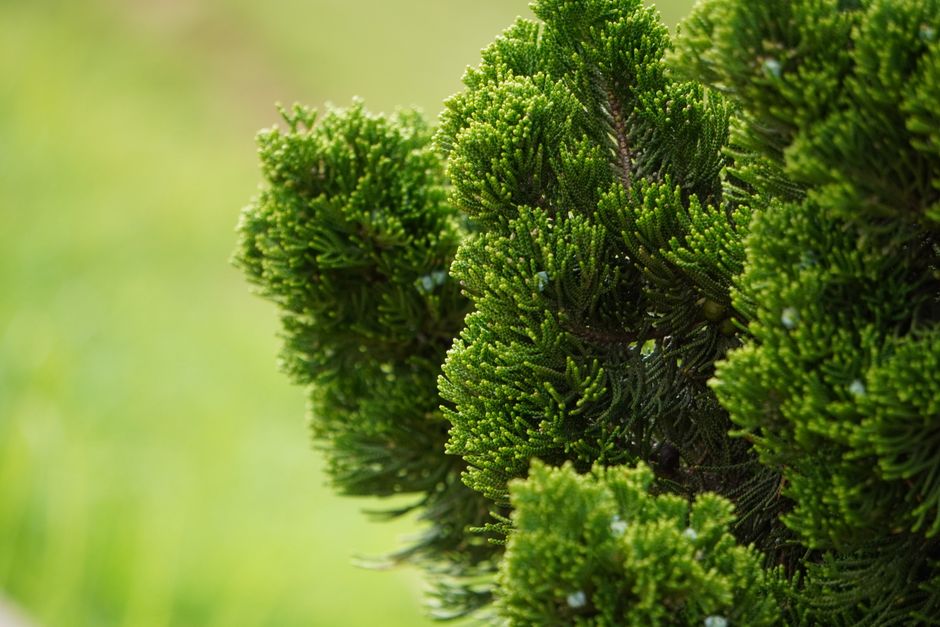
Pruning a Hinoki cypress is different from pruning most evergreens. You should not cut the plant back to bare wood or shear it into a tight hedge. Instead, thin and lightly tip the branches in late winter or early spring, removing no more than about a quarter of the live growth at one time. This keeps the tree’s natural layered shape, improves airflow, and avoids the bare patches that heavy cutting causes.
Hinoki cypress (Chamaecyparis obtusa) is a slow-growing evergreen with soft, fan-like foliage. It does not regrow from old, leafless wood the way yew or boxwood does. That single fact drives almost every pruning decision you will make.
Why Hinoki Cypress Responds Differently To Pruning
Most conifers have dormant buds hidden along their older branches. Cut them back hard and new growth often pushes from those buds. Hinoki cypress does not work that way.
Its dormant buds sit mainly near the branch tips, in the green foliage. Once a branch is bare — no green needles along its length — the tree generally cannot sprout new growth from that bare section. Cut into old wood and you are usually left with a permanent gap.
This is why the plant is sometimes described as unforgiving. It is not fragile, but it has little ability to fill in after a mistake. The practical takeaway: always leave some green foliage on any branch you shorten.
Hinoki also grows in a distinctive fan pattern. Each branchlet spreads flat like a hand. If you shear across those fans with hedge trimmers, you cut the tips off hundreds of small sprays at once. The result is a brown, tufted surface that looks nothing like the tree’s natural form and can take years to grow out.
When Is The Best Time To Prune A Hinoki Cypress?
Late winter to early spring is the safest window. The tree is still dormant, the structure is easy to see, and it has a full growing season ahead to heal and push new growth.
You can also do light tip pruning in early summer, after the first flush of growth has hardened. Avoid heavy pruning in late summer or fall. New growth triggered then may not harden off before cold weather and can be damaged by frost.
One more timing note: if your Hinoki is in a cold climate, pruning in the depths of winter can expose fresh cuts to freeze damage. Waiting until the worst of the cold has passed is generally safer.
For a plant you are shaping gradually, an annual light session beats an occasional heavy one. Hinoki grows slowly, so small corrections each year keep the tree in form without shocking it.
How To Prune A Hinoki Cypress For Shape And Health
Work slowly and cut less than you think you need to. The goal is to guide the tree’s natural shape, not to force a new one.
Start by stepping back and looking at the whole plant. Identify the main trunk or trunks and the natural tiers of foliage. Decide which branches are crowding the interior, crossing each other, or growing back toward the center.
- Use sharp bypass pruners or hand shears. Bypass tools make clean cuts; anvil pruners crush stems.
- Reach into the interior and remove the crowded, crossing, or dead branches first. This opens airflow and lets light reach the inner foliage.
- Shorten overly long branches by cutting back to a side branch that still has green growth. Never cut past the last green needles.
- Trim individual branch tips by hand rather than shearing across the surface. Follow the natural fan shape of each spray.
- Remove no more than roughly a quarter of the live foliage in a single session.
- Step back every few cuts and check the overall silhouette from more than one angle.
Dead, damaged, or diseased wood can be removed at any time of year. That is a health task, not a shaping task, and it does not need to wait for the ideal window.
Disinfect your tools between plants, especially if you are cutting anything that looks diseased. A dilute bleach solution or rubbing alcohol works. This is standard practice and helps avoid spreading problems from one plant to the next.




What Happens If You Cut Into Old Wood?
You usually get a permanent bare spot. Because Hinoki cypress rarely regrows from leafless branches, a cut that removes all the green from a branch often leaves a gap that never fills in on its own.
If you have already made that cut, you have two realistic options. You can leave it and let surrounding branches gradually grow over the space, which can take several years on a slow grower. Or you can remove the entire branch back to the trunk or a main limb so the tree looks intentional rather than patchy.
This is the main reason to avoid the “cut it back hard and let it fill in” approach that works on many shrubs. With Hinoki, that approach usually produces a worse result than doing nothing.
Can You Shear A Hinoki Cypress Into A Hedge?
You can, and people do. But it comes with trade-offs worth understanding before you start.
Shearing produces a dense outer shell of foliage. Over time that shell shades the interior, and the inner branches lose their needles. You end up with a plant that is green only on the surface, with a dead, hollow center. Once that happens, you cannot cut back into the plant to reduce its size without exposing bare wood.
If a formal hedge is genuinely what you want, shearing can maintain it for years. Just know that you are committing to a surface-only plant and that reducing its size later is difficult or impossible.
For most home gardeners who want a healthy, natural-looking specimen, selective hand pruning is the better path. It is slower, but the tree stays full and can be kept to a reasonable size over time.
Common Mistakes That Damage Hinoki Cypress
Most problems come from a handful of avoidable errors.
- Cutting into bare wood. This is the most common and least reversible mistake.
- Shearing the whole plant. It flattens the natural form and eventually hollows out the interior.
- Removing too much at once. Heavy pruning stresses the tree and can leave large gaps.
- Pruning in late summer or fall. New growth may not harden before frost.
- Using dull or anvil-type tools. Crushed stems heal poorly and invite problems.
- Pruning a plant that is already stressed. Drought, disease, or recent transplanting are reasons to wait.
A healthy Hinoki needs very little pruning to look good. If you find yourself cutting a lot every year, the plant may simply be in a spot that is too small for it, and the real fix is a different location or a different plant.
Does Pruning Actually Improve The Tree’s Health?
Light, selective pruning can help. Removing crowded and crossing branches improves airflow through the interior, which reduces the conditions that favor some fungal problems. It also lets light reach inner foliage that would otherwise thin out and die.
That said, pruning is not a treatment for disease, and it will not fix a tree that is failing because of poor drainage, root problems, or the wrong climate. If your Hinoki is declining, the cause is usually in the soil or the site, not the branch structure.
Be cautious about assuming that any pruning automatically makes a plant healthier. Over-pruning does the opposite. The benefit comes from targeted removal of specific problems, not from cutting for its own sake.
Frequently Asked Questions
Can you cut a Hinoki cypress back hard?
Generally no. Hinoki cypress rarely regrows from old, leafless wood, so a hard cutback often leaves permanent bare patches. Remove no more than about a quarter of the live growth at a time and always leave green foliage on any branch you shorten.
What is the best time of year to prune a Hinoki cypress?
Late winter to early spring is the safest window, while the tree is dormant and has a full season to recover. Light tip pruning in early summer is also fine, but avoid heavy cutting in late summer or fall.
Will a Hinoki cypress grow back after pruning?
It regrows from green foliage near the branch tips, but not from bare older wood. This is why you should never cut a branch back past its last green needles.
Can you use hedge trimmers on a Hinoki cypress?
You can, but shearing flattens the natural fan-shaped form and eventually shades out the interior, leaving a hollow plant. Selective hand pruning keeps the tree full and healthy.
