
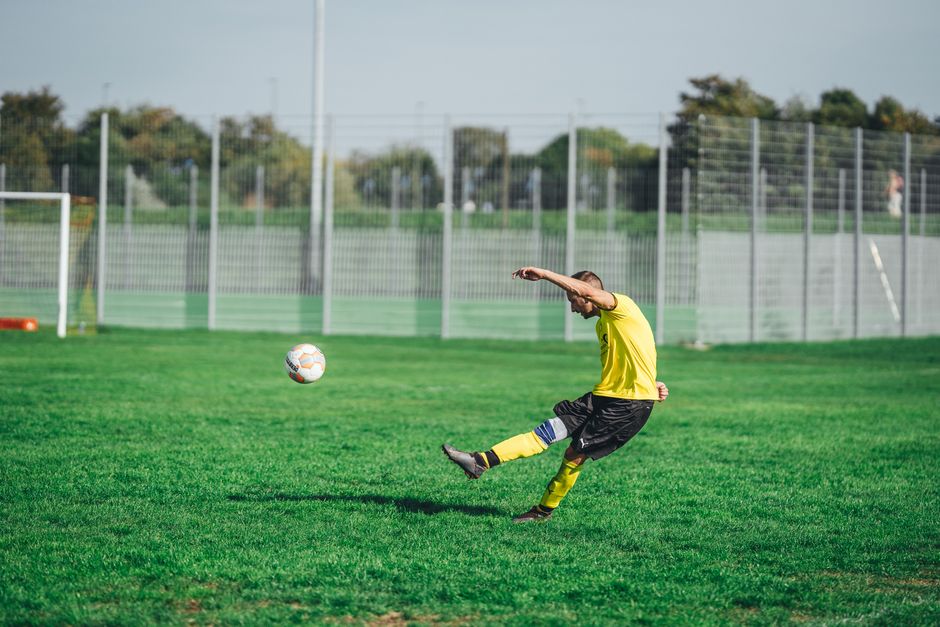
Kicking a soccer ball properly comes down to three things: striking the ball with the right part of your foot, planting your standing foot in the correct position, and following through with your leg. A clean strike uses the hard bone on the inside of the foot or the laces on top, not the toes. Most power and accuracy problems come from planting the foot too far from the ball or leaning backward at contact.
This guide breaks the motion into steps you can practice. It also explains the different kicks, the mistakes that cost power, and what science says about how hard a ball actually travels.
How Do You Kick a Soccer Ball Step by Step?
The basic technique is the same for most kicks. You approach the ball, plant your standing foot, swing your kicking leg, strike a specific part of the ball, and follow through.
Here is the sequence for a standard instep drive, the kick used for power and distance:
- Approach at an angle. Walk or jog toward the ball from a slight diagonal, not straight on. This lets your hips rotate through the kick.
- Plant your standing foot. Place it beside the ball, roughly a hand-width away, with the toes pointing toward your target.
- Lock your ankle. Point your toes down and tighten the ankle so the foot stays firm at contact. A loose ankle absorbs energy.
- Strike with the laces. Contact the ball with the hard top of your foot, through the middle or slightly below the center.
- Follow through. Let your leg swing across your body toward the target after contact.
The plant foot is where most kicks fail. If it lands too far behind the ball, you reach and lose power. If it lands too far ahead, you stub the kick. Beside the ball is the reliable starting point.
Which Part of the Foot Should You Use?
Different kicks use different surfaces of the foot. The surface you choose controls both power and accuracy.
The laces (instep) give the most power. The inside of the foot gives the most accuracy. The outside gives curve and disguise. Toes give neither power nor control and should be avoided.
| Kick | Foot surface | Best for |
|---|---|---|
| Instep drive | Laces (top of foot) | Power, long passes, shots |
| Inside push pass | Inside of foot | Short accurate passes |
| Outside of foot | Outside edge | Curve, quick passes |
| Toe poke | Toes | Quick reaction only |
The inside-of-foot pass is the most used kick in the game. It is the most accurate because the striking surface is flat and large. Coaches teach it first for that reason.
How Do You Kick a Soccer Ball With More Power?
Power comes from your whole body, not just your leg. The force builds from the ground up through your hips and core, then releases through your thigh and lower leg.
Think of it as a whip, not a hammer. The leg accelerates as it swings. A stiff, straight leg produces less speed than a leg that snaps through the ball.
These factors raise ball speed:
- Follow-through. Letting the leg swing fully after contact transfers more energy.
- Locked ankle. A firm foot pushes the ball instead of cushioning it.
- Hip rotation. Turning your hips into the kick adds force.
- Contact point. Striking through the center of the ball sends it straight and fast.
Here is a point many players miss. Leaning your upper body slightly forward at contact keeps the shot low. Leaning backward lifts the ball. That is why players who lean back often shoot over the goal.
Where Should You Make Contact on the Ball?
The spot you strike on the ball decides where it goes. The ball responds to where your foot meets it.
Striking the center sends the ball straight. Striking below the center lifts it. Striking above the center keeps it low. Striking the side adds curve.
For a standard shot on goal, aim for the middle of the ball or just below it. For a low driven shot, strike slightly above the center and lean forward.
Curve works through a principle called the Magnus effect. When the ball spins, air pressure builds differently on each side, and the ball bends in flight. Striking the ball off-center with the inside or outside of the foot creates that spin.
What Are the Most Common Kicking Mistakes?
Most kicking errors trace back to a few habits. Fixing them often improves a kick quickly.
The most common mistake is using the toes. Toe kicks feel powerful because the foot is small and hard, but you cannot control direction and the ball flies unpredictably.
Other frequent problems:
- Planting the standing foot too far from the ball. This forces you to reach and reduces control.
- Looking up before contact. Keep your eyes on the ball through the strike.
- Locking the knee too early. Let the leg swing naturally through the motion.
- Leaning back. This sends the ball high and reduces accuracy.
- Hesitating at contact. Commit to the swing and follow through.
Practice slowly first. Speed and power come after the motion feels natural. Rushing the technique usually locks in bad habits.
How Fast Can a Kicked Soccer Ball Travel?
Elite players can strike a ball at very high speeds. Some of the hardest recorded shots in professional soccer have been clocked well above 100 miles per hour.
You do not need that speed to play well. Most effective passes and shots in a game are placed, not blasted. Accuracy beats raw power for most situations.
Ball speed depends on leg strength, technique, and the mass of the ball. A regulation adult soccer ball weighs about 410 to 450 grams (roughly 14 to 16 ounces). That weight is set by the sport’s rules, so it does not change between players.
How Do You Practice Kicking a Soccer Ball?
Practice works best when you break the kick into parts. Start with the plant foot, then add the swing, then add power.
Repetition builds muscle memory. A player who repeats a clean motion hundreds of times will kick more consistently than one who only practices at full speed.
Useful practice methods:
- Shadow the motion. Practice the plant and swing without a ball to build the pattern.
- Pass against a wall. The wall returns the ball and gives instant feedback on accuracy.
- Aim at targets. Place cones or markers and try to hit them.
- Practice both feet. A weak foot limits your options in a game.
One clarification worth knowing. Kicking a ball does not damage your knees or ankles on its own when technique is sound. Poor technique and overuse are the usual causes of kicking-related soreness, not the act of kicking itself. Warming up before hard kicking is sensible, as it is for any activity that loads the leg muscles.
Does the Type of Ball Matter?
Ball size and weight affect how a kick feels, especially for younger players. Soccer balls come in different sizes for different age groups.
A larger, heavier ball takes more force to move. A smaller ball is easier for a child to control. Using the right size for your age and level makes learning easier.
Ball pressure also matters. An over-inflated ball feels hard and bounces oddly. An under-inflated ball feels soft and slow. Following the manufacturer’s recommended pressure gives the most predictable response.
Frequently Asked Questions
What part of the foot should you kick a soccer ball with?
Use the laces for power and the inside of the foot for accuracy. Avoid the toes, which give poor control and unpredictable direction.
Why does my soccer ball go too high when I kick?
Leaning your upper body backward at contact lifts the ball. Leaning slightly forward and striking the middle of the ball keeps the shot lower.
How do you kick a soccer ball harder?
Power comes from hip rotation, a locked ankle, and a full follow-through rather than leg strength alone. Striking through the center of the ball also sends it faster and straighter.
How far should your plant foot be from the ball?
Place the standing foot beside the ball, roughly a hand-width away. Planting too far back or too far ahead reduces power and control.
