
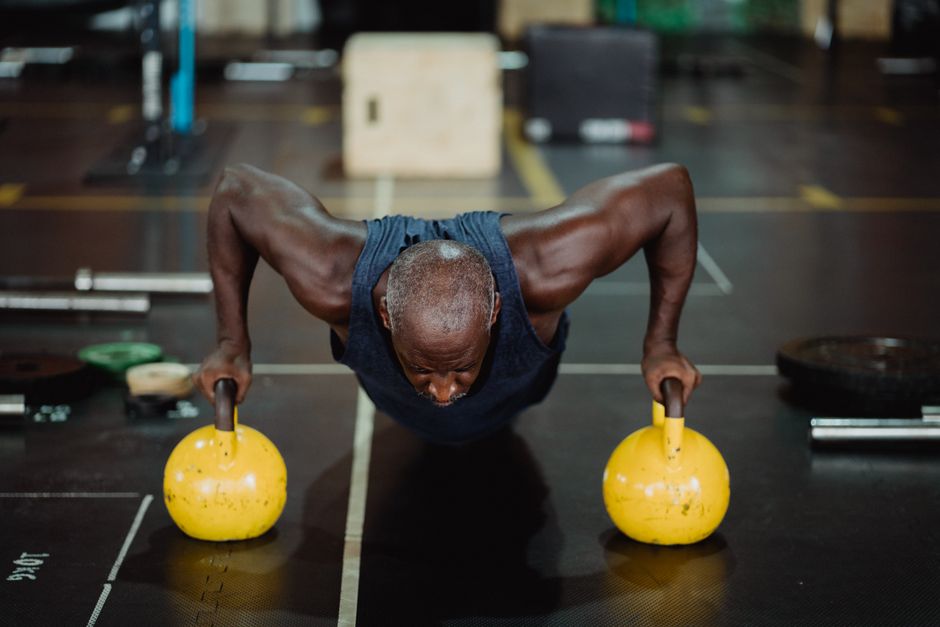
Progressive overload means asking your muscles to do slightly more work over time, and with push ups you can do it by adding reps, adding sets, changing your body angle, slowing the tempo, reducing rest, or adding external weight. Push ups are a bodyweight exercise, so the load is your own body mass, but you can still increase the demand in measurable ways. The six methods below are the standard ways to do it, and they work because muscle and strength adapt to gradually increasing challenge.
What Is Progressive Overload and Why Does It Matter for Push Ups?
Progressive overload is the principle that muscles get stronger and larger only when they are asked to handle more than they are used to. If you do the same number of push ups at the same angle forever, your body adapts to that demand and then stops changing.
The mechanism is well established. When muscle fibers are challenged beyond their current capacity, they experience mechanical tension and a degree of damage that triggers repair and growth during recovery. That process is called hypertrophy. Without a rising challenge, there is no ongoing signal to adapt.
Push ups complicate this because the load is fixed at your body weight. You cannot add plates the way you would on a barbell. That is why bodyweight training relies on other levers — reps, sets, leverage, tempo, rest, and added resistance — to keep the challenge climbing.
One clarification worth knowing: soreness is not a reliable measure of overload. You can progressively overload for weeks with little soreness and still gain strength. Judge progress by what you can do, not by how you feel the next day.
Method 1: Add More Reps
Adding reps is the simplest form of progressive overload and the first one most people should use. If you can do 10 push ups, work toward 11, then 12, over the following sessions.
The principle is straightforward: more total reps means more total work, and more work at a given load is a genuine increase in demand. This works best when you are still relatively new to push ups, because the strength gains in early training come quickly.
Two practical notes. First, keep your form consistent — a rep with sagging hips or a half range of motion is not the same rep. Second, do not chase reps endlessly at the expense of everything else. Once you can perform high rep counts with clean form, adding more reps becomes a test of endurance rather than a strong growth stimulus. At that point the other methods below become more useful.
Method 2: Add More Sets
Adding sets increases the total volume of work you do in a session. If three sets of 10 push ups feels manageable, four sets of 10 is a real step up in demand.
Volume — the total amount of work — is one of the main drivers of muscle growth. Research on resistance training consistently shows that doing more productive sets, up to a point, tends to produce more growth than doing fewer.
The “up to a point” matters. More is not always better, and recovery has limits. A common approach is to add a set every week or two until you reach a volume you can recover from, then hold there and progress through other methods. If your push up performance starts dropping session to session, or you feel persistently run down, you have likely added volume faster than you can recover from it.
Method 3: Change Your Body Angle
Changing your body angle changes how much of your body weight your arms actually have to move. This is the most effective way to make push ups harder or easier without adding equipment.
Elevating your feet shifts more of your weight onto your hands and chest, increasing the load. Elevating your hands — for example, with hands on a bench or step — reduces the load and makes the movement easier. This is why incline push ups are a common starting point and decline push ups are a common progression.
The physics is simple. The closer your body is to horizontal with your feet raised, the more of your mass you are pressing. As your feet rise toward shoulder height and beyond, the demand on the chest, shoulders, and triceps climbs.
This method is especially useful because it lets you progress in small, controlled steps. You do not have to jump from a standard push up to a one-arm push up. You can raise your feet an inch at a time.
Method 4: Slow Down the Tempo
Slowing the tempo increases the time your muscles spend under tension during each rep. A push up that takes one second down and one second up becomes a different exercise when it takes three seconds down and one second up.
More time under tension at a given load means more total work per rep. It also tends to demand more control, which can improve form and body awareness. A common approach is a controlled lowering phase of two to four seconds, a brief pause, then a normal press back up.
Evidence on tempo is more mixed than evidence on volume or load. Some studies suggest that deliberately slow eccentric (lowering) phases can support muscle growth, but the research is not unanimous, and very slow tempos can reduce the total number of reps you complete. Treat tempo as a useful tool for adding challenge and control, not as a magic variable that outperforms everything else.
Method 5: Reduce Rest Between Sets
Cutting rest time between sets increases the density of your workout — the same work done in less time. This raises the cardiovascular and muscular demand of the session.
Reducing rest is a legitimate way to make a workout harder, but it comes with a tradeoff. Shorter rest means you will likely complete fewer reps per set, and your muscles may not recover enough between sets to produce quality work. For pure strength and growth, adequate rest between sets generally supports better performance.
Where reduced rest helps most is in building work capacity and muscular endurance. If your goal is to do more push ups in a single effort, training with shorter rest can help. If your goal is maximum strength or size, prioritize the other methods and keep rest long enough to perform well.
Method 6: Add External Weight
Adding weight is the most direct way to increase load on a push up. A weighted vest, a weight plate balanced on your upper back, or resistance bands can all add resistance beyond your body weight.
This method is best saved for when the other methods have been exhausted — when you can perform high rep sets with clean form and elevated feet, and you still want more challenge. Adding load too early tends to compromise form and increase injury risk, particularly in the shoulders and lower back.
Safety matters here. A plate on your back can shift or fall, so it needs to be stable and you need a safe way to get into and out of position. A weighted vest is generally more secure. Resistance bands anchored above or around you add resistance that increases through the range of motion, which is a different stimulus than a fixed weight.
No clinical guidelines specify how much external weight to add for push ups, or when exactly to introduce it. The general principle from resistance training is to add load gradually and only when current work is consistently manageable with good form.
How Do You Put These Six Methods Together?
You do not use all six at once. The sensible approach is to progress through them in roughly the order above, adding one variable at a time and holding it for several weeks before adding the next.
A reasonable sequence looks like this:
- Start by adding reps until you can perform clean sets in a higher range.
- Add sets to build total volume.
- Raise your feet to increase load through angle.
- Introduce slower tempo to add control and time under tension.
- Reduce rest if endurance is your goal.
- Add external weight last, once bodyweight variations are no longer challenging.
The common thread is gradual change. Progress happens when the challenge rises slightly above what you are used to, then you recover, then you rise again. Jumping several steps at once tends to produce soreness, poor form, and stalled progress rather than faster gains.
Track what you do. A simple note of sets, reps, and angle from session to session is enough. Without a record, it is easy to believe you are progressing when you are actually repeating the same workload.
Frequently Asked Questions
How often should I increase push ups?
Most people can add a small amount of challenge every one to two weeks. Progress slower if form breaks down or you feel persistently fatigued.
Are push ups enough to build muscle?
Push ups can build muscle in the chest, shoulders, and triceps when you progressively overload them. They do not train the back or legs, so they work best as part of a fuller program.
Should I add weight to push ups or just do more reps?
Add reps and other bodyweight progressions first. External weight is generally best saved for when high rep sets with elevated feet are no longer challenging.
Does slowing down push ups really build more muscle?
The evidence is mixed. Slower tempo increases time under tension and control, but it does not clearly outperform other overload methods for growth.
