
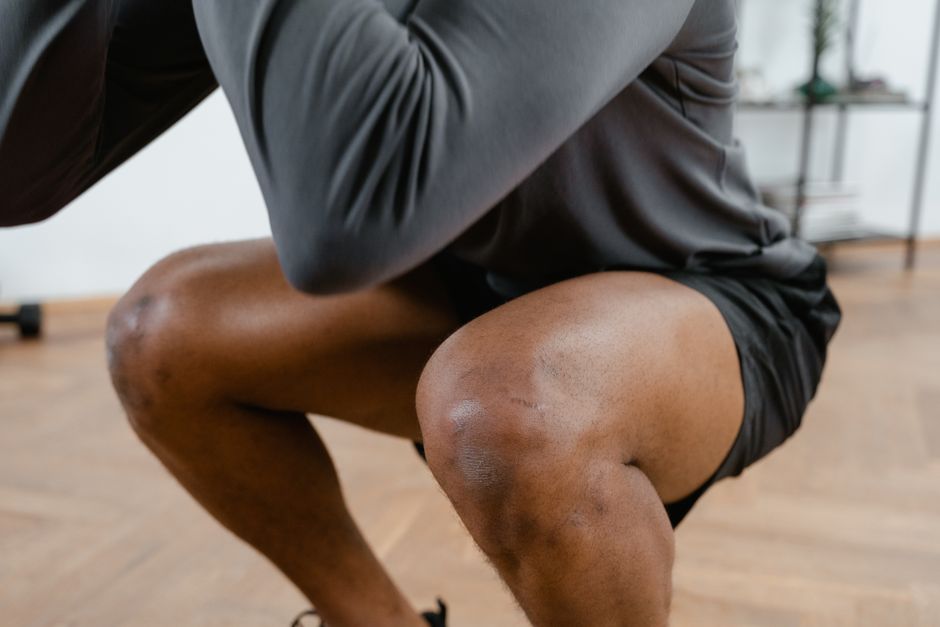
Patellar tendonitis happens when the tendon connecting your kneecap to your shinbone gets overloaded and starts to break down. The most effective way to prevent it is to build leg strength gradually, increase training loads slowly, and give the tendon time to recover between hard sessions. Exercise does not cause this condition on its own — doing too much, too soon, without enough recovery does.
What Actually Causes Patellar Tendonitis?
The patellar tendon is a thick band of connective tissue that transfers force from your quadriceps muscles through your kneecap to your shinbone. Every jump, sprint, squat, and landing sends load through it. That is normal. Tendons adapt to load by becoming stronger — but only when the load is applied gradually and followed by adequate recovery.
Tendon damage occurs when the rate of loading outpaces the tendon’s ability to repair itself. This is why the condition is common in sports that involve repeated jumping and cutting: basketball, volleyball, soccer, and track. It is also common in recreational athletes who ramp up training volume quickly after a period of inactivity.
Research on tendon physiology has shown that tendinopathy is not primarily an inflammatory condition, as was once believed. It involves failed healing and structural breakdown at the cellular level. That distinction matters because it changes how prevention and treatment should be approached — rest alone does not fix a tendon, and loading it correctly is part of the solution.
Several factors raise risk:
- Rapid increases in training volume or intensity
- Weak quadriceps and gluteal muscles
- Poor landing mechanics
- Insufficient recovery between sessions
- Sudden changes in training surface or footwear
- Age — tendon resilience decreases over time
How To Prevent Patellar Tendonitis With Exercise
Prevention comes down to three things: making the tendon stronger, managing how fast you increase training demands, and allowing recovery. Each one matters, and skipping any of them raises your risk.
Build Strength With Controlled Loading
Heavy, slow resistance training is one of the most studied approaches for tendon health. Exercises like squats, leg presses, and Bulgarian split squats load the patellar tendon in a controlled way that promotes adaptation. The key is progressive overload — adding weight or reps gradually over weeks, not days.
Eccentric exercises, where the muscle lengthens under load, have been studied extensively for tendon rehabilitation. For prevention, they can be part of a well-rounded strength program. A simple example is a slow, controlled squat descent taking three to four seconds to lower. This is not a guaranteed protective measure, but it is consistent with how tendons respond to load.
Strengthen the Muscles Around the Knee
The quadriceps absorb most of the force that reaches the patellar tendon. Strong quads mean less stress transferred to the tendon itself. Glute and hip strengthening also matters because weak hips change how the knee tracks during landing and cutting movements.
Effective exercises include:
- Step-ups and split squats for quad and glute strength
- Romanian deadlifts for hamstring and hip development
- Hip thrusts and lateral band walks for glute activation
- Single-leg balance work for stability
Train Landing Mechanics
How you land matters as much as how you jump. Landing with stiff, straight legs sends a sharp spike of force through the tendon. Landing with soft knees and hips absorbs that force through the muscles instead.
Practicing soft landings during warm-ups — jumping and landing quietly with bent knees — is a simple way to build this habit. It is widely used in sports training programs and reflects sound biomechanics, though research specifically linking landing drills to reduced patellar tendonitis rates is limited.
How Much Training Is Too Much?
There is no universal number. The threshold where a tendon breaks down depends on your age, strength, training history, and how quickly you have built up. What is well established is that spikes in training load — sudden increases in volume or intensity — are a consistent factor in tendon injuries.
A commonly used guideline in sports medicine is the 10 percent rule: avoid increasing weekly training volume by more than about 10 percent. This is not a formal clinical standard backed by large trials, but it reflects the principle of gradual progression that tendon research supports.
Pay attention to these warning signs:
- Dull ache below the kneecap after activity
- Pain that appears during warm-up then fades
- Stiffness the morning after hard training
- Discomfort when climbing stairs or sitting for long periods
Pain that worsens during activity — rather than easing as you warm up — is a sign to reduce load and let the tendon recover. Pushing through it tends to make things worse, not better.



Does Stretching Help Prevent Patellar Tendonitis?
Stretching alone is not an effective prevention strategy for patellar tendonitis. Static stretching before activity does not reduce injury risk in most studies, and it does not address the underlying issue, which is the tendon’s capacity to handle load.
That said, tight quadriceps and hip flexors can alter movement patterns in ways that increase stress on the knee. If you have significant tightness, addressing it as part of a broader program may help. But stretching by itself, without strength work, will not protect the tendon.
A dynamic warm-up is more useful than static stretching before training. Leg swings, walking lunges, high knees, and bodyweight squats raise muscle temperature and prepare the tendon for load. This is well-established sports science practice.
What Role Does Recovery Play?
Tendons adapt during rest, not during training. The loading session creates the stimulus; recovery is when the tissue actually gets stronger. Skip recovery and you accumulate damage faster than the tendon can repair.
Key recovery factors:
- Sleep — most tissue repair happens during sleep
- Rest days — at least one full day off from jumping or high-impact activity per week
- Nutrition — adequate protein supports connective tissue repair
- Load cycling — alternating hard and easy days rather than going hard every session
There is no single recovery formula that works for everyone. The principle is straightforward: if your knee feels worse the day after training than it did before, you did too much.
Can You Prevent Patellar Tendonitis If You Already Have Symptoms?
If you are already feeling early symptoms, the approach shifts. Complete rest is rarely the answer — tendons need some load to heal, but the right amount. Reducing training volume and intensity while continuing controlled strengthening is the general clinical direction.
Some clinicians recommend isometric exercises — holding a contracted position, like a wall sit — for pain relief in early tendinopathy. The evidence for this is mixed. Some studies show short-term pain reduction; others show no clear benefit. It is a reasonable option to discuss with a healthcare provider, but it is not a proven universal solution.
If pain persists for more than a few weeks despite load management, see a sports medicine doctor or physical therapist. Persistent tendon pain that limits daily activity is not something to manage on your own indefinitely.
What About Equipment and Footwear?
Footwear and playing surface can influence how much force reaches the knee. Hard surfaces like concrete increase impact compared to grass or rubber tracks. Worn-out shoes lose their shock-absorbing capacity.
There is no specific shoe proven to prevent patellar tendonitis. What matters more is replacing worn footwear and being aware that switching surfaces suddenly — from soft to hard, or from flat to cambered — changes the load on your knees. Introduce those changes gradually.
Frequently Asked Questions
How often should I train to prevent patellar tendonitis?
Two to three strength sessions per week with at least one rest day between them is a reasonable approach for most recreational athletes. The key is gradual progression, not frequency alone.
Can I keep playing sports with mild knee pain?
Mild pain that eases as you warm up and does not worsen over time may allow continued play with reduced volume. Pain that increases during activity or lingers afterward is a sign to back off and get it checked.
Is running bad for the patellar tendon?
Running itself is not harmful when volume increases gradually and strength is adequate. Sudden increases in mileage or intensity are the bigger concern.
Do knee braces or straps help prevent patellar tendonitis?
There is no strong evidence that braces or straps prevent the condition. Some people report less pain while wearing them, but they do not address the underlying load tolerance of the tendon.
