
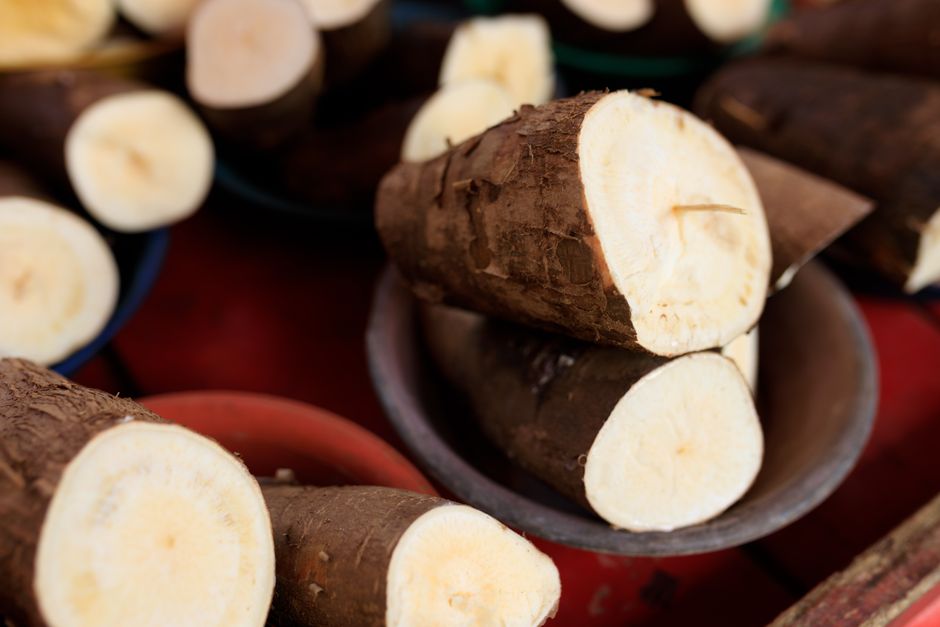
Cassava is a root crop eaten by hundreds of millions of people, and it contains cyanide. That sounds alarming, but the poison is not a contaminant that got in by accident. It is made by the plant itself, and it can be removed with basic preparation. The short answer: peel cassava, cut it into pieces, and either soak it, ferment it, or cook it thoroughly — never eat it raw, and never assume a quick boil is enough. Bitter varieties need more care than sweet ones.
Why Does Cassava Contain Cyanide?
Cyanide in cassava is a defense mechanism. The plant stores two separate compounds in its tissues: cyanogenic glucosides, mainly linamarin and lotaustralin, and an enzyme called linamarase. As long as those two stay apart, nothing happens.
When the plant’s cells are broken — by cutting, grating, chewing, or bruising — the enzyme meets the glucoside and releases hydrogen cyanide. This is why the danger appears during preparation and eating, not while the root sits whole in a basket.
Cassava varieties fall into two broad groups. Bitter cassava carries much higher cyanide levels than sweet cassava. The terms are about chemistry, not taste preference. A bitter root can hold many times the cyanide of a sweet one, and the difference matters enormously for how you handle it.
Hydrogen cyanide interferes with how cells use oxygen. It blocks an enzyme in the mitochondria called cytochrome c oxidase, which is the last step in the chain that produces energy. Cells effectively suffocate even when blood is carrying plenty of oxygen. This is why acute poisoning can progress quickly and why it is a genuine medical emergency rather than a stomach upset.
How Do You Remove Cyanide From Cassava?
Peeling is the first and most important step, because most of the cyanide sits in the skin and the outer layers of the root. Cut away the peel generously rather than shaving it thin, and remove the woody core of bitter varieties if you can.
After peeling, the reliable methods all share one principle: give the enzyme time to release cyanide, then give the cyanide a way to escape as a gas. Hydrogen cyanide is volatile and dissolves in water, so soaking, drying, and cooking all move it out of the food.
- Soaking: Cut the peeled root into pieces and soak in plenty of water. Discard the water rather than cooking in it.
- Fermentation: Traditional fermentation, used in products like gari and fufu, lowers cyanide substantially over time.
- Drying: Sun-drying or oven-drying thin pieces lets cyanide escape into the air. This is the basis of cassava flour production.
- Thorough cooking: Boiling, roasting, or frying drives off remaining cyanide, but only if the pieces are small enough and cooked long enough for heat to reach the center.
Combining methods works better than any single one. Peeling plus soaking plus thorough cooking removes far more cyanide than peeling alone. Traditional processing methods in cassava-growing regions were developed around this reality, and they generally work.
One point that gets lost: the water you soak cassava in contains cyanide. Do not drink it, do not use it for soup, and do not pour it where children or animals might drink it.
Is Boiling Cassava Enough to Make It Safe?
Boiling helps, but it is not automatically sufficient. The problem is that cyanide release depends on the enzyme working, and heat destroys that enzyme. If you drop large pieces straight into boiling water, the outside cooks fast, the enzyme inside is destroyed before it can do its job, and trapped cyanide can stay locked in the center of the piece.
Smaller pieces, longer cooking, and enough water volume all improve removal. Soaking before boiling is safer than boiling alone. And a single quick boil of a large chunk of bitter cassava is exactly the scenario where poisoning has occurred.
There is a common misconception worth naming directly. Some people believe that if cassava tastes fine, it is safe. Taste is not a reliable test. Bitter varieties are more dangerous on average, but the relationship between bitterness and cyanide content is not tight enough to depend on your tongue.
What Are the Symptoms of Cassava Poisoning?
Acute cyanide poisoning from a single large exposure can begin within a short time of eating. Early symptoms include headache, dizziness, confusion, nausea, and a sense of breathlessness. As it progresses, breathing becomes rapid and then labored, the heart rate can rise, and consciousness can be lost.
Severe cases can involve seizures, coma, and death. This is not a condition to watch at home. If someone develops these symptoms after eating cassava, it is a medical emergency and emergency services should be called immediately.
There is a second, slower pattern that looks nothing like acute poisoning. Long-term daily consumption of poorly processed cassava has been linked to a condition called konzo, which causes sudden and permanent weakness or paralysis of the legs, particularly in children and in people whose diets are low in protein. Konzo has been documented in several African countries and is associated with reliance on insufficiently processed bitter cassava during food shortages. The mechanism involves chronic cyanide exposure and is not fully understood.
A third concern involves iodine. Cassava contains compounds that can interfere with thyroid function, and populations eating large amounts of cassava with low iodine intake have shown higher rates of goiter. This is a nutritional issue tied to diet patterns, not a reason to fear occasional cassava.
How To Prevent Cassava Poisoning From Cyanide
Prevention comes down to choosing the right root, processing it properly, and not cutting corners when you are in a hurry.
- Buy from a known source and ask whether the cassava is sweet or bitter. If the seller does not know, treat it as bitter.
- Peel thickly and remove the woody center of bitter roots.
- Cut into small pieces before soaking or boiling.
- Soak for an extended period, discarding the water, before cooking.
- Cook thoroughly, in enough water, until pieces are fully soft all the way through.
- Never eat raw cassava, and never taste it to check if it is safe.
- Do not drink soaking water or use it in other cooking.
- If you are unsure whether processing was adequate, do not eat it.
For cassava flour, buy from reputable commercial producers where possible. Commercial processing generally includes grating, pressing, and drying steps that reduce cyanide more consistently than home methods done in a rush.
If you are preparing cassava for young children, be more careful, not less. Children are more vulnerable to konzo and to acute poisoning because of their smaller body size. The same processing that is adequate for an adult may not be adequate for a small child eating a large portion.
Does Cassava Ever Become Safe to Eat Raw?
No. There is no variety of cassava that is safe to eat raw. Sweet varieties have lower cyanide, but lower is not zero, and raw consumption is not a recognized safe practice. This applies to the root, the leaves, and any part of the plant.
Cassava leaves are eaten in several cuisines, but they must be pounded and cooked thoroughly. Raw or lightly cooked cassava leaves carry their own cyanide load and have caused poisoning.
What About Cassava in Packaged Foods?
Cassava products sold commercially — tapioca starch, cassava flour, and similar items — are generally processed in ways that reduce cyanide to low levels. Tapioca starch in particular is a highly refined product and is not a meaningful cyanide source.
That said, “generally” is doing real work in that sentence. Regulatory limits for cyanide in cassava products exist in some countries and not others, and enforcement varies. If you are buying from an unfamiliar producer, especially an imported product with no processing information, you have less certainty than you would with an established brand.
For most people eating cassava occasionally as part of a varied diet, the risk is low. The serious harm happens in populations where cassava is a dietary staple, processing is rushed or incomplete, and protein and iodine intake are low. That combination, not cassava by itself, is what produces the documented disease patterns.
Frequently Asked Questions
Can you get cyanide poisoning from eating cassava?
Yes, if the cassava is raw or poorly processed, especially bitter varieties. Proper peeling, soaking, and thorough cooking remove most of the cyanide and make it safe.
How long should you soak cassava to remove cyanide?
Traditional processing typically soaks peeled, cut cassava for an extended period, often overnight or longer, and discards the water. Exact times vary by variety and method, so longer soaking combined with thorough cooking is the safer approach.
Is sweet cassava safe to eat without cooking?
No. Sweet cassava has less cyanide than bitter cassava, but it is not cyanide-free and should still be peeled and cooked thoroughly.
What should you do if someone shows symptoms after eating cassava?
Call emergency services immediately. Symptoms such as confusion, difficulty breathing, or loss of consciousness after eating cassava require urgent medical care.
