
Pressing pills is not melting or molding powder into shape. It is a controlled squeezing process. A measured amount of powder or granules is trapped in a steel die and compressed between two punches until the particles lock together into a solid tablet. The pressure involved is enormous — typically thousands of pounds per square inch in commercial manufacturing — and that force is what turns loose powder into a tablet that holds its shape.
You can do a simplified version of this at home with a pill press or a tablet mold, but the result is rarely the same as a pharmacy tablet. Prescription and over-the-counter tablets are engineered formulations, not just compressed chemicals. Understanding what actually happens inside a die explains why tablet making is harder than it looks.
What Actually Happens When Powder Becomes a Tablet?
A tablet forms because particles bond together under pressure. There is no glue holding a typical tablet together, though some formulations do include a binder. The main force is mechanical.
When powder is squeezed, several things happen at once. Particles get pushed closer together, squeezing out the air gaps between them. As the pressure rises, particles deform — some flatten, some fracture into smaller pieces. Fresh surfaces touch, and weak chemical attractions between molecules (called van der Waals forces) begin to hold neighboring particles together. Some materials also form solid bridges where particles have partially fused at contact points from the heat and friction of compression.
The result is a compact that behaves like a solid. If you look at a tablet under magnification, it is not a uniform block. It is a dense network of interlocked and bonded particles with tiny remaining pores.
Two properties matter most in this process. Compressibility is how much a powder volume shrinks under pressure. Compactability is how well the squeezed powder actually holds together into a strong tablet. A powder can be highly compressible but still form a weak, crumbly tablet. These are different things, and confusing them is a common mistake.
How Does a Tablet Press Work?
A tablet press is built around three parts: a die, a lower punch, and an upper punch. The die is a precise hole, usually round or oval, that defines the tablet’s shape and diameter. The punches are metal rods that fit the die closely.
The basic cycle runs like this:
- The die is filled with a measured volume of powder or granules.
- The lower punch sits at a set depth, controlling how much powder the die holds.
- The upper punch descends and compresses the powder against the lower punch.
- The upper punch lifts away, and the lower punch rises to push the finished tablet out of the die.
On a single-punch press, this happens one tablet at a time. On a rotary press, dozens of die-and-punch stations are arranged in a circle on a rotating turret, so tablets are produced continuously — often hundreds of thousands per hour in industrial settings.
The depth of the lower punch sets the fill volume, which controls tablet weight. The distance the upper punch travels sets the compression force, which controls hardness. These two settings are adjusted separately, which is why tablet weight and tablet hardness are independent variables in manufacturing.
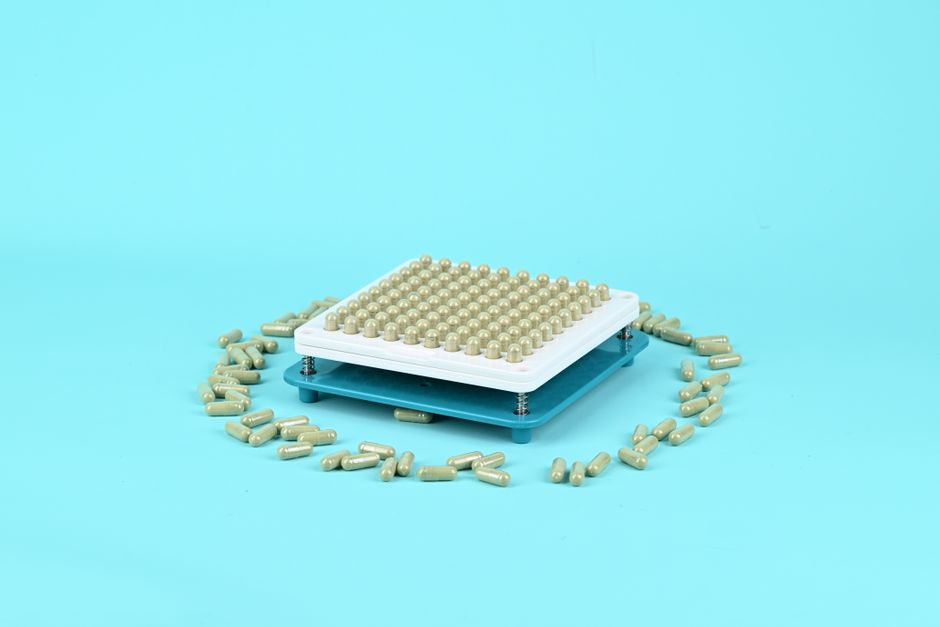
How To Press Pills Tablet Compression Explained for Home Use
Home pill presses and tablet molds exist, and they work on the same basic principle — fill a cavity, apply force, eject the tablet. But there are real limits to what they can do.
Most consumer presses are manual or use a lever or screw mechanism. They generate far less force than a commercial press. That lower force means weaker particle bonding, so homemade tablets tend to be softer and more fragile.
There is a bigger issue than hardness. A commercial tablet contains more than the active ingredient. It also contains excipients — fillers, binders, disintegrants, lubricants, and sometimes coatings. These ingredients control how the powder flows, how it compresses, how the tablet breaks apart in your stomach, and how the drug is released. If you simply compress a raw powder at home, you are skipping all of that.
This matters for safety. A tablet that does not break apart properly may pass through your body without releasing its contents. A tablet that breaks apart too fast can dump a full dose at once. Neither outcome is something you can predict without testing. Home pressing of any medication or supplement is not something clinical guidelines support, and dosing accuracy is very hard to control.
Why Do Tablets Sometimes Crack or Stick?
Tablet defects are common in manufacturing and they have specific causes. Knowing them explains why formulation is so demanding.
Capping is when the top of the tablet separates as a cap. It usually happens when air trapped inside the powder cannot escape fast enough during compression, or when the formulation compresses unevenly. Lamination is a similar failure where the tablet splits into horizontal layers.
Sticking and picking happen when powder adheres to the punch faces instead of releasing cleanly. This is often a lubrication problem or a sign the punch surfaces are worn or dirty.
Mottling is uneven color on the tablet surface, usually from poor mixing or from one ingredient migrating during processing.
Preventing these problems is why real formulations include a lubricant (often a small amount of magnesium stearate), a binder to hold particles together, and a disintegrant to help the tablet break up later. Getting the blend right is a large part of tablet development.
What Role Do Excipients Play in a Tablet?
Excipients are the inactive ingredients, and they are not filler for the sake of bulk. Each one has a job.
- Fillers (diluents) add volume so a tiny dose of active ingredient can be made into a tablet you can actually handle.
- Binders help particles stick together and improve tablet strength.
- Disintegrants help the tablet break apart in the digestive tract so the active ingredient can be released.
- Lubricants reduce friction between the tablet and the die and punches, preventing sticking.
- Glidants improve powder flow so the die fills evenly.
In many tablets, the active ingredient is a small fraction of the total weight. The excipients make up the rest. This is one reason two tablets with the same active ingredient can behave very differently — different excipients, different compression, different release.
Does Compression Force Change How a Drug Works?
Yes, and this is an area where the details are easy to underestimate. Compression force affects tablet hardness and porosity. Those properties affect how quickly the tablet breaks apart and dissolves, which can affect how fast the drug is absorbed.
For some drugs, this matters a lot. If a tablet is compressed too hard, it may dissolve too slowly and reduce absorption. If it is too soft, it may crumble during packaging or dissolve too quickly. Manufacturers set compression targets and test dissolution to confirm each batch behaves as intended.
This is also why you should not crush, split, or chew a tablet unless a pharmacist or prescriber says it is safe. Some tablets are designed to release a drug slowly over many hours. Breaking that design can release the full dose at once. That is a genuine safety concern, not a minor one.
Are Homemade Pills Safe?
No clinical guidelines support making your own medication tablets at home, and the reasons are practical rather than theoretical. You cannot easily control dose accuracy, tablet hardness, or how the tablet will break down once swallowed. Small differences in how hard you press can change the outcome.
For supplements, the risk is lower than for prescription drugs, but it is not zero. Contamination, uneven mixing, and inconsistent dosing are all real possibilities when you are working without lab equipment or testing.
If your interest is in how tablets are made, learning the process is worthwhile. If your interest is in taking a specific medication or supplement, the formulations made under regulated manufacturing conditions exist for good reasons. The evidence for home tablet pressing as a safe substitute is essentially absent.
Frequently Asked Questions
What is tablet compression in simple terms?
Tablet compression is the process of squeezing a measured amount of powder between two punches inside a die until the particles bond into a solid tablet. The force, not any glue, is what holds it together.
Can I make my own pills at home safely?
No clinical guidelines support making medication tablets at home, mainly because dose accuracy and how the tablet breaks down are very hard to control. For supplements the risk is lower but still present.
Why do some tablets need to stay whole?
Some tablets are designed to release their contents slowly, and crushing or splitting them can release the full dose at once. Always check with a pharmacist before breaking any tablet.
What makes a tablet hard or soft?
Compression force and the formulation both control tablet hardness. More force generally means a harder tablet, but the excipients and how the powder compresses also play a major role.
